

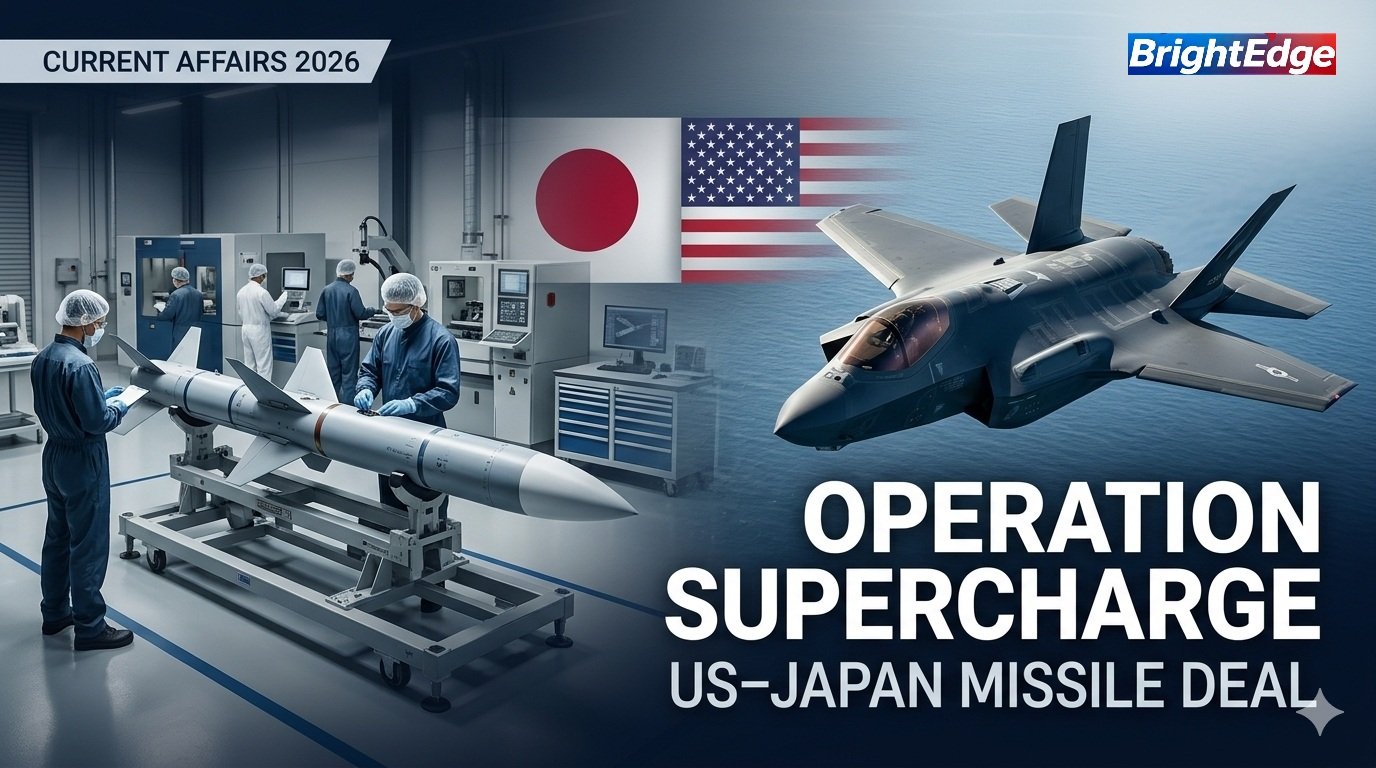
The United States and Japan have finalised an agreement to establish a missile production facility in Japan for the AIM-120 Advanced Medium-Range Air-to-Air Missile (AMRAAM), marking a significant development in bilateral defence-industrial cooperation.
Announced on October 28, 2026, the agreement will establish a facility for the final assembly and inspection of AMRAAM missiles.
Japanese Defence Minister Shinjiro Koizumi announced the agreement after meeting US Defence Secretary Pete Hegseth in Cebu, Philippines, during the ASEAN Defence Ministers’ Meeting-Plus.
The initiative, called Operation Supercharge, is intended to strengthen the defence industrial base of both countries, diversify missile production capacity and support the availability of critical munitions for the United States and its allies.
What Is Operation Supercharge?
- Operation Supercharge is the name associated with the US–Japan initiative to establish a facility in Japan for the final assembly and inspection of AMRAAM missiles.
- The agreement was announced following discussions between Japanese Defence Minister Shinjiro Koizumi and US Defence Secretary Pete Hegseth on the sidelines of the ASEAN Defence Ministers’ Meeting-Plus in the Philippines.
- The initiative builds on discussions that began in July 2024 under the two countries’ defence-industrial cooperation framework.
Key Features of Operation Supercharge
- Participating countries: United States and Japan.
- Primary objective: Establish an AMRAAM final assembly and inspection facility in Japan.
- Missile: AIM-120 Advanced Medium-Range Air-to-Air Missile.
- Associated fighter aircraft: F-35 Lightning II, among other compatible platforms.
- Announcement date: October 28, 2026.
- Announcement location: Cebu, Philippines.
- Broader objective: Strengthen defence production capacity and supply-chain resilience.
The precise location of the Japanese facility and its production schedule had not been publicly announced in the initial reporting on the agreement.
What Is the AIM-120 AMRAAM Missile?
- AMRAAM stands for Advanced Medium-Range Air-to-Air Missile.
- Developed by the United States and manufactured by RTX’s Raytheon business, it is an air-to-air missile designed to engage airborne targets at beyond-visual-range distances.
- Unlike missiles that depend entirely on continuous guidance from the launching aircraft, AMRAAM uses an onboard active radar seeker during the terminal phase of engagement. This allows it to guide itself towards a target during the final stage of an engagement, subject to the missile variant and engagement conditions.
Important Features of AMRAAM
1. Beyond-visual-range capability
- AMRAAM is designed to engage airborne targets beyond the pilot’s direct visual range, using targeting information and guidance appropriate to the missile variant.
2. Active radar guidance
- The missile uses an active radar seeker in its terminal guidance phase to locate and engage the intended airborne target.
3. Compatibility with multiple aircraft
- AMRAAM is integrated with several compatible fighter aircraft and other platforms. These include the F-35 Lightning II and F-22 Raptor, as well as selected legacy fighter aircraft.
4. All-weather capability
- The missile is designed for operational use in a range of weather conditions, subject to the performance limitations of the weapon and its guidance system.
5. Multiple variants
- The AIM-120 family includes different variants developed to improve capabilities such as range, guidance and resistance to electronic countermeasures.
- The AIM-120D family represents a later generation of the missile compared with its original versions.
Why Is Japan Establishing an AMRAAM Production Facility?
- The agreement addresses the need to expand and diversify the industrial capacity available for manufacturing critical air-to-air missiles.
- Modern fighter aircraft depend not only on the availability of airframes but also on reliable supplies of compatible weapons, spare parts and maintenance support.
- A production facility in Japan could help strengthen regional supply chains and improve the ability of the United States and its partners to sustain their defence requirements.
1. Strengthening the Defence Industrial Base
- Joint production can distribute certain manufacturing responsibilities across participating countries.
- For Japan, the agreement provides an opportunity to expand its participation in advanced defence manufacturing. For the United States, it can help diversify the industrial base supporting an important missile programme.
2. Improving Supply-Chain Resilience
- Missile production depends on specialised components, manufacturing equipment, skilled workers and quality-control processes.
- A broader production network can reduce dependence on a single manufacturing location and provide additional capacity when demand increases.
- However, the actual effect will depend on the facility’s production rate, component availability and implementation schedule.
3. Supporting F-35 Operations
- The AMRAAM is one of the air-to-air weapons compatible with the F-35 family of fighter aircraft.
- Japan operates F-35 aircraft, and the United States also uses the platform extensively.
- A regional facility could support the availability of compatible munitions for participating users, subject to procurement arrangements, export controls and production capacity.
4. Strengthening Defence Cooperation
- The agreement builds on the wider US–Japan defence relationship, which includes military exercises, technology cooperation, equipment procurement and industrial collaboration.
- It also reflects the growing importance that both countries attach to the ability to produce and sustain critical military equipment.
What Is the Connection Between AMRAAM and the F-35 Fighter Jet?
- The F-35 Lightning II is a family of fifth-generation multirole stealth fighter aircraft developed by Lockheed Martin.
- The aircraft is designed for missions including air defence, strike operations, intelligence gathering and surveillance.
- AMRAAM provides an air-to-air weapon option for compatible F-35 configurations.
F-35 and AMRAAM: Key Facts
| Feature | Details |
|---|---|
| Aircraft | F-35 Lightning II |
| Aircraft manufacturer | Lockheed Martin |
| Missile | AIM-120 AMRAAM |
| Missile manufacturer | Raytheon, an RTX business |
| Missile category | Air-to-air missile |
| Engagement capability | Beyond visual range |
| Guidance | Active radar seeker in the terminal phase |
| Participating countries in the new production agreement | United States and Japan |
The new agreement concerns the missile’s production infrastructure. It is not an agreement to jointly manufacture the F-35 aircraft itself.
US–Japan Defence Cooperation: Background
- The United States and Japan maintain a longstanding security alliance that includes defence cooperation, joint exercises, equipment interoperability and industrial collaboration.
- Both countries have been working to strengthen their ability to produce and maintain critical military equipment.
- The Japan–US Defense Industrial Cooperation, Acquisition, and Sustainment framework, commonly known as DICAS, provides a mechanism for discussions on defence manufacturing, maintenance and supply-chain resilience.
- In April 2026, Japan’s Ministry of Defense reported progress on the potential co-production of AMRAAM components and further discussions regarding final assembly and inspection in Japan.
- Mitsubishi Electric also announced in April 2026 that it was discussing participation in AMRAAM co-production with industry partners, including Raytheon.
- The October agreement therefore follows earlier feasibility work and bilateral defence-industrial discussions.
Click Here to Read: India Makes Big Move for 6th-Gen Fighter Jet With France
Click Here to Read: India Joins Elite Group as DRDO Successfully Tests Ballistic Missile Defence System and NASM-M