

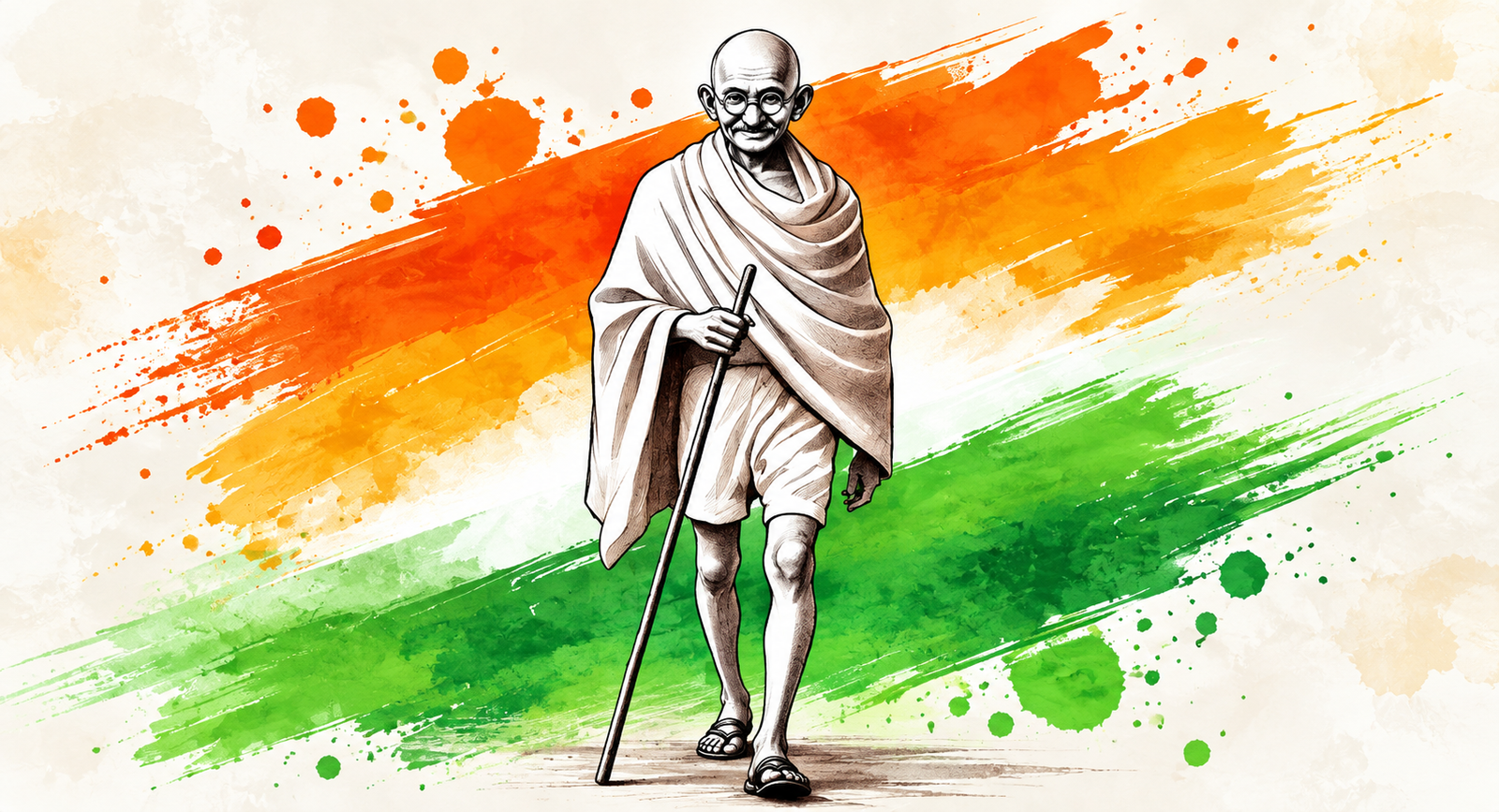
- Mahatma Gandhi, popularly known as the Father of the Nation in India, was one of the most influential leaders of India’s freedom struggle.
- His philosophy of truth, non-violence, and peaceful resistance inspired millions of people in India and across the world.
- Gandhi played a significant role in mobilising Indians against British colonial rule.
Early Life and Education
- Mohandas Karamchand Gandhi was born on 2 October 1869 in Porbandar, Gujarat.
- His father, Karamchand Gandhi, served as a government official, while his mother, Putlibai, deeply influenced his values and spiritual outlook.
- Gandhi studied law in London and later travelled to South Africa, where he experienced racial discrimination.
- These experiences shaped his commitment to justice, equality, and non-violent resistance.
Role in India’s Freedom Struggle
After returning to India in 1915, Gandhi emerged as a prominent leader in the independence movement. Some of his most significant campaigns included:
- Champaran Satyagraha (1917): Supported indigo farmers facing exploitation.
- Kheda Satyagraha (1918): Supported farmers seeking tax relief after crop failure.
- Non-Cooperation Movement (1920–1922): Encouraged Indians to boycott British institutions and goods.
- Dandi March (1930): Challenged British salt laws through a peaceful march.
- Quit India Movement (1942): Called for an end to British rule in India.
Gandhi promoted swadeshi, encouraged the use of khadi, and advocated Hindu-Muslim unity and social reform.
Philosophy of Truth and Non-Violence
Gandhi believed that lasting social and political change could be achieved through truth (Satya) and non-violence (Ahimsa). His method of Satyagraha emphasised peaceful resistance, moral courage, and civil disobedience.
His ideas later influenced international civil rights and freedom movements.
Death of Mahatma Gandhi
- Mahatma Gandhi was assassinated on 30 January 1948 in New Delhi by Nathuram Godse.
- His death shocked India and the world. The date is observed in India as Martyrs’ Day.
Legacy of Mahatma Gandhi
- Gandhi’s legacy continues through his teachings on peace, justice, equality, and non-violent action.
- The United Nations observes 2 October as the International Day of Non-Violence, recognising the continuing relevance of his principles.
Conclusion
Mahatma Gandhi remains a significant figure in modern Indian history. His leadership helped mobilise millions during the struggle for independence, while his commitment to truth and non-violence continues to influence discussions about peaceful social change.
His life reminds us that courage, discipline, and peaceful action can play an important role in shaping society.