

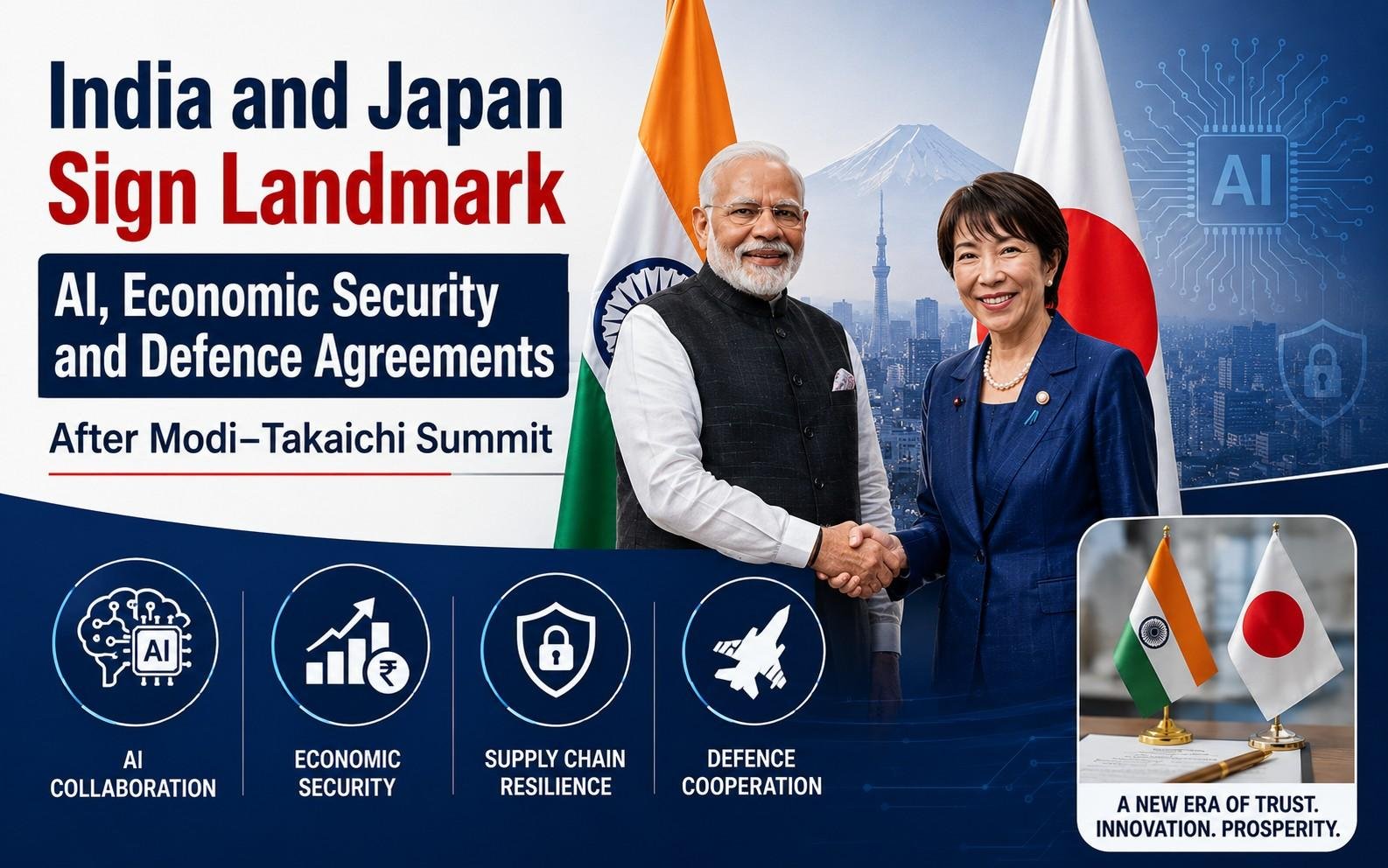
- India and Japan have significantly expanded their strategic partnership by signing a series of landmark agreements covering artificial intelligence (AI), economic security, defence technology, clean energy, healthcare and maritime cooperation.
- The agreements were finalised during summit talks between Prime Minister Narendra Modi and Japanese Prime Minister Sanae Takaichi, who is on a three-day official visit to India from July 1 to July 3, 2026.
- The summit marks another major milestone in the growing India–Japan relationship, with both nations unveiling a shared roadmap to strengthen supply chains, promote advanced technologies and enhance regional security amid rising geopolitical uncertainties.
Three Landmark Agreements Signed
Following the bilateral talks held in New Delhi, both countries adopted three major strategic documents that will guide future cooperation:
- Joint Declaration on Economic Security
- Joint Statement on Cooperation in the Field of Artificial Intelligence
- Joint Statement on Energy Resilience
These agreements reflect the shared commitment of India and Japan to build resilient economies, secure critical supply chains and accelerate technological innovation.
Economic Security Becomes a Strategic Priority
A major highlight of the summit was the adoption of a comprehensive roadmap on economic security.
Prime Minister Narendra Modi said that both countries recognise the growing importance of economic and energy security in an increasingly uncertain global environment.
The roadmap focuses on strengthening resilient supply chains in critical sectors, including:
- Semiconductors
- Quantum technologies
- Advanced materials
- Critical minerals
- High-end manufacturing
The initiative aims to reduce vulnerabilities caused by global disruptions while promoting trusted and diversified supply chains.
India–Japan Partnership in Artificial Intelligence
- Artificial Intelligence emerged as one of the biggest areas of cooperation during the summit.
- Both leaders announced a dedicated Joint Statement on AI cooperation, highlighting their commitment to responsible innovation, advanced research and emerging technologies.
- The combination of Japan’s world-class precision engineering and India’s software expertise would create a powerful platform for global AI development.
- The collaboration is expected to promote research, innovation, talent development and responsible deployment of AI technologies across multiple sectors.
Defence Cooperation Reaches a New Level
India and Japan also signed their first-ever defence co-development agreement, marking a historic step in bilateral defence relations.
The project involves the joint development of the “Unicorn” naval radio antenna, a sophisticated communication system designed for naval platforms.
The agreement is expected to:
- Strengthen maritime security.
- Promote indigenous defence manufacturing.
- Enhance defence technology collaboration.
- Support a free, open and rules-based Indo-Pacific.
Both countries reaffirmed their commitment to maintaining peace, stability and security in the region.
Clean Energy and Energy Security
Recognising growing concerns over global energy markets, India and Japan launched a new initiative on Energy Resilience.
The partnership will strengthen cooperation in:
- Green hydrogen
- Advanced battery technologies
- Nuclear energy
- Clean energy transition
- Energy supply resilience
The initiative aims to reduce vulnerability to global oil price shocks while supporting sustainable economic growth.
India–Japan Biogas Initiative
Another important announcement was the launch of the India–Japan Biogas Initiative.
The programme aims to establish 1,000 biogas and organic fertiliser plants across India.
The initiative will complement the Government of India’s GOBARdhan programme by:
- Promoting waste-to-wealth initiatives.
- Supporting rural livelihoods.
- Increasing renewable energy production.
- Improving organic fertiliser availability.
- Advancing sustainable agriculture.
Healthcare and Biotechnology Cooperation
India and Japan also expanded cooperation in healthcare by signing agreements covering:
- Pharmaceuticals
- Medical devices
- Biotechnology
The partnership combines India’s large-scale manufacturing capabilities with Japan’s technological excellence to develop affordable, high-quality healthcare solutions for global markets.
Next-Generation Mobility Partnership
- To promote future transportation technologies, both countries established the India–Japan Next-Generation Mobility Partnership Framework.
- The initiative is expected to encourage collaboration in electric mobility, intelligent transportation systems, advanced manufacturing and emerging mobility technologies.
Strengthening a Special Strategic Partnership
- The latest agreements reinforce the India–Japan Special Strategic and Global Partnership, which has steadily expanded across trade, investment, infrastructure, defence, technology and regional security.
- With growing geopolitical uncertainties and evolving global supply chains, both nations are positioning themselves as trusted partners committed to innovation, resilience and sustainable development.
Conclusion
- The Modi–Takaichi summit represents a major advancement in India–Japan relations.
- From AI and defence technology to clean energy, healthcare and economic security, the agreements lay the foundation for deeper cooperation in several strategic sectors.
- As both countries continue to strengthen their partnership, these initiatives are expected to boost innovation, improve supply-chain resilience, enhance regional security and contribute to long-term economic growth across the Indo-Pacific.