

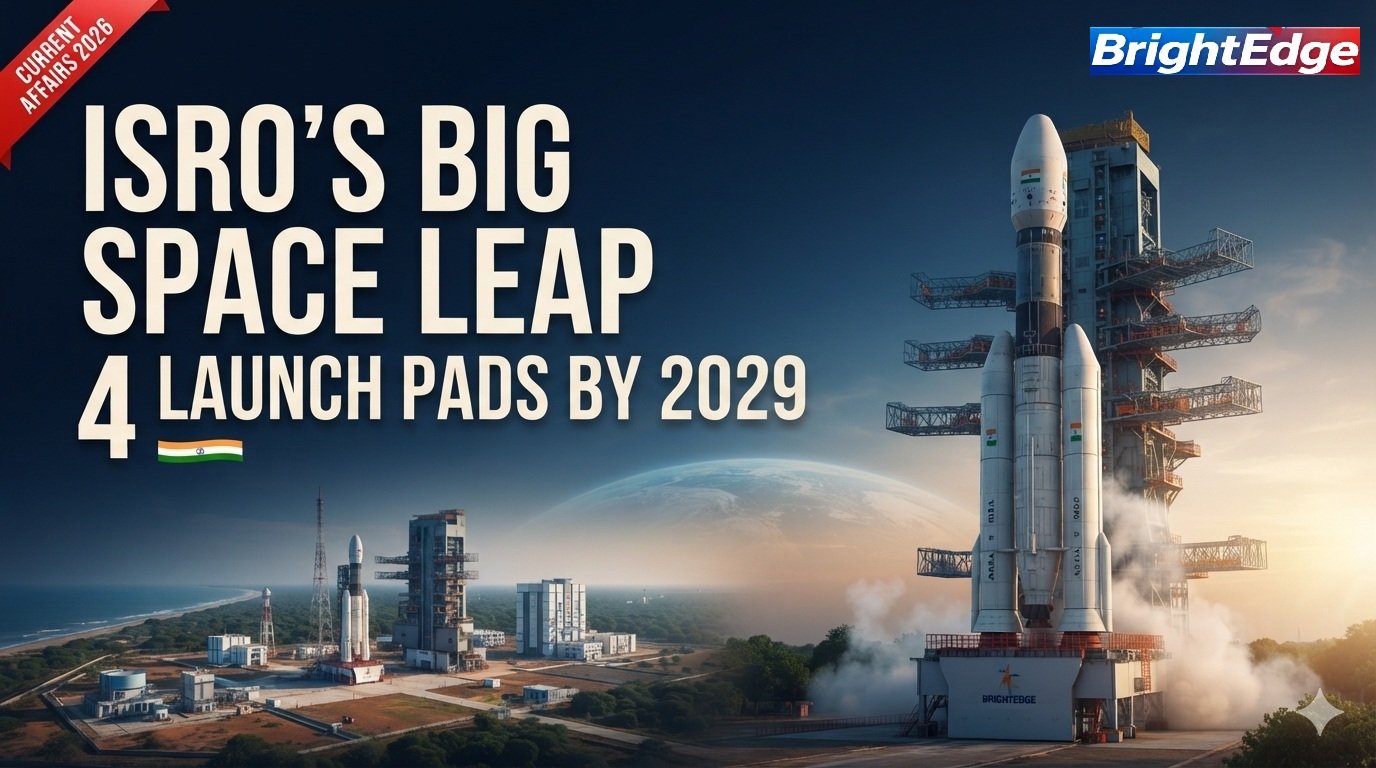
India is planning a major expansion of its space-launch infrastructure, with the Indian Space Research Organisation (ISRO) targeting four functional launch pads by 2029. ISRO Chairman V. Narayanan announced the plan, which includes a dedicated Small Satellite Launch Vehicle (SSLV) launch complex at Kulasekarapattinam in Tamil Nadu and a third launch pad at Sriharikota. The expansion aims to meet rising global demand for satellite launches, strengthen India’s commercial space capabilities and support the country’s ambitious future space missions.
ISRO Announces Four Functional Launch Pads by 2029
- India is preparing to expand its rocket-launch infrastructure as the country’s space programme enters a new phase of growth.
- ISRO Chairman V. Narayanan outlined the plan to have four functional launch pads by 2029. The initiative is intended to increase launch capacity and help India respond to growing domestic and international demand for satellite deployment.
- The announcement highlights India’s ambition to strengthen its position in the global space industry while supporting scientific research, commercial satellite launches and future human spaceflight missions.
- The expansion will include a dedicated SSLV complex at Kulasekarapattinam in Tamil Nadu and a third launch pad at the Satish Dhawan Space Centre in Sriharikota. The existing two launch pads at Sriharikota form the foundation of India’s current launch infrastructure.
- The exact completion and commissioning schedules will determine when the additional facilities become fully operational.
Where Will India’s New Launch Facilities Be Located?
The proposed expansion involves two important infrastructure developments.
1. Kulasekarapattinam SSLV Launch Complex, Tamil Nadu
- ISRO is developing a dedicated launch complex for the Small Satellite Launch Vehicle at Kulasekarapattinam in the Thoothukudi district of Tamil Nadu.
- The planned facility covers approximately 2,000 acres and is intended to support launches of small satellites.
- The complex is expected to include essential infrastructure such as launch facilities, vehicle integration buildings, rail-track systems, and telemetry, tracking and command systems.
- These systems help engineers prepare launch vehicles, monitor their performance and communicate with rockets during flight.
- A dedicated SSLV facility could make India’s small-satellite launch operations more efficient by providing infrastructure designed specifically for this category of launch vehicle.
- The new spaceport is also expected to improve access to space for satellite operators and commercial customers.
2. Third Launch Pad at Sriharikota, Andhra Pradesh
- The second major development is the planned third launch pad at the Satish Dhawan Space Centre in Sriharikota, Andhra Pradesh.
- India currently operates two launch pads at the centre.
- The third launch pad is intended to support ISRO’s future launch-vehicle requirements, including next-generation rockets.
- The facility is targeted for completion around the 2029–30 timeframe in the government’s earlier planning documents. The precise operational date will depend on construction, testing and commissioning.
- The new pad is expected to strengthen India’s launch infrastructure and provide additional flexibility as the country’s space programme expands.
- Together, the Kulasekarapattinam facility and the proposed third pad at Sriharikota form key elements of India’s planned expansion.
Why Does ISRO Need Four Launch Pads?
- The global demand for satellite launches is increasing as countries, businesses and research institutions deploy more spacecraft for communications, navigation, Earth observation and scientific research.
- India has developed a reputation for cost-effective space missions. However, expanding launch infrastructure is important if the country wants to accommodate more customers and missions.
- The planned expansion could deliver several benefits.
1. Higher Satellite Launch Capacity
Additional launch infrastructure could allow ISRO and India’s wider space industry to accommodate more missions, subject to rocket availability and operational readiness.
2. Stronger Commercial Space Industry
Dedicated launch facilities could help India attract international satellite customers and expand its commercial launch services.
3. Support for Future Space Missions
Additional capacity could provide greater scheduling flexibility for scientific, lunar and human-spaceflight programmes.
4. Reduced Dependence on Limited Infrastructure
Operating with more launch facilities could improve scheduling resilience and reduce the impact of maintenance or delays at individual launch pads.
5. More Opportunities for Private Companies
ISRO plans to work with Indian startups and private enterprises to strengthen the space ecosystem through technology transfer, industrial participation and commercial operations.
The expansion is therefore not simply about constructing additional launch pads. It is also about preparing India’s space industry for a larger role in the global space economy.
ISRO’s Current and Upcoming Launch Pads in India
| No. | Launch Pad / Facility | Location | Current Status | Main Purpose |
|---|---|---|---|---|
| 1 | First Launch Pad (FLP) | Satish Dhawan Space Centre, Sriharikota, Andhra Pradesh | Operational | Launches of PSLV and SSLV |
| 2 | Second Launch Pad (SLP) | Satish Dhawan Space Centre, Sriharikota, Andhra Pradesh | Operational | Launches of PSLV, GSLV and LVM3 |
| 3 | Third Launch Pad (TLP) | Sriharikota, Andhra Pradesh | Approved; development planned | Next Generation Launch Vehicles and backup for the Second Launch Pad |
| 4 | SSLV Launch Complex (SLC) | Kulasekarapattinam, Thoothukudi district, Tamil Nadu | Under development | Dedicated small-satellite launches using SSLV |
Upcoming ISRO Space Missions: 2026–2035
| No. | Mission | Expected Timeline | Main Objective | Key Facts |
|---|---|---|---|---|
| 1 | Gaganyaan G1 | Q4 2026 target | First uncrewed experimental mission in India’s human-spaceflight programme | Planned to carry the Vyommitra half-humanoid robot |
| 2 | Gaganyaan G2 and G3 | Following G1; targets subject to revision | Further uncrewed tests before the crewed mission | Validate spacecraft and human-spaceflight systems |
| 3 | India’s first crewed Gaganyaan mission | Targeted by 2027 in the government roadmap | Send Indian astronauts into low Earth orbit | India’s first indigenous human spaceflight mission |
| 4 | Chandrayaan-4 | Targeted for 2027 in earlier plans; verify the latest schedule | Demonstrate lunar sample collection and return technologies | Planned lunar sample-return mission |
| 5 | Chandrayaan-5 / LUPEX | Under development; launch date to be confirmed | Investigate the lunar surface, including areas near the south pole | India–Japan collaboration involving ISRO and JAXA |
| 6 | Venus Orbiter Mission | Earlier target around 2028; schedule subject to revision | Study Venus’s atmosphere and surface environment | India’s planned dedicated mission to Venus |
| 7 | Next Generation Launch Vehicle (NGLV) | Development ongoing; first developmental flight targeted for FY 2031–32 | Develop a more capable next-generation launch system | Intended to support future heavy-lift requirements |
| 8 | Bharatiya Antariksh Station (BAS) | Planned operationalisation by 2035 | Establish India’s own space station | Government roadmap includes a five-module configuration |
| 9 | Future lunar exploration and human-spaceflight programmes | 2030s and beyond | Expand India’s capabilities in space exploration | Includes longer-term lunar ambitions |
Click Here to Read: Gaganyaan Achieves Human-Rating Milestones
Click Here to Read: ISRO GSLV-F17 Launches EOS-05