

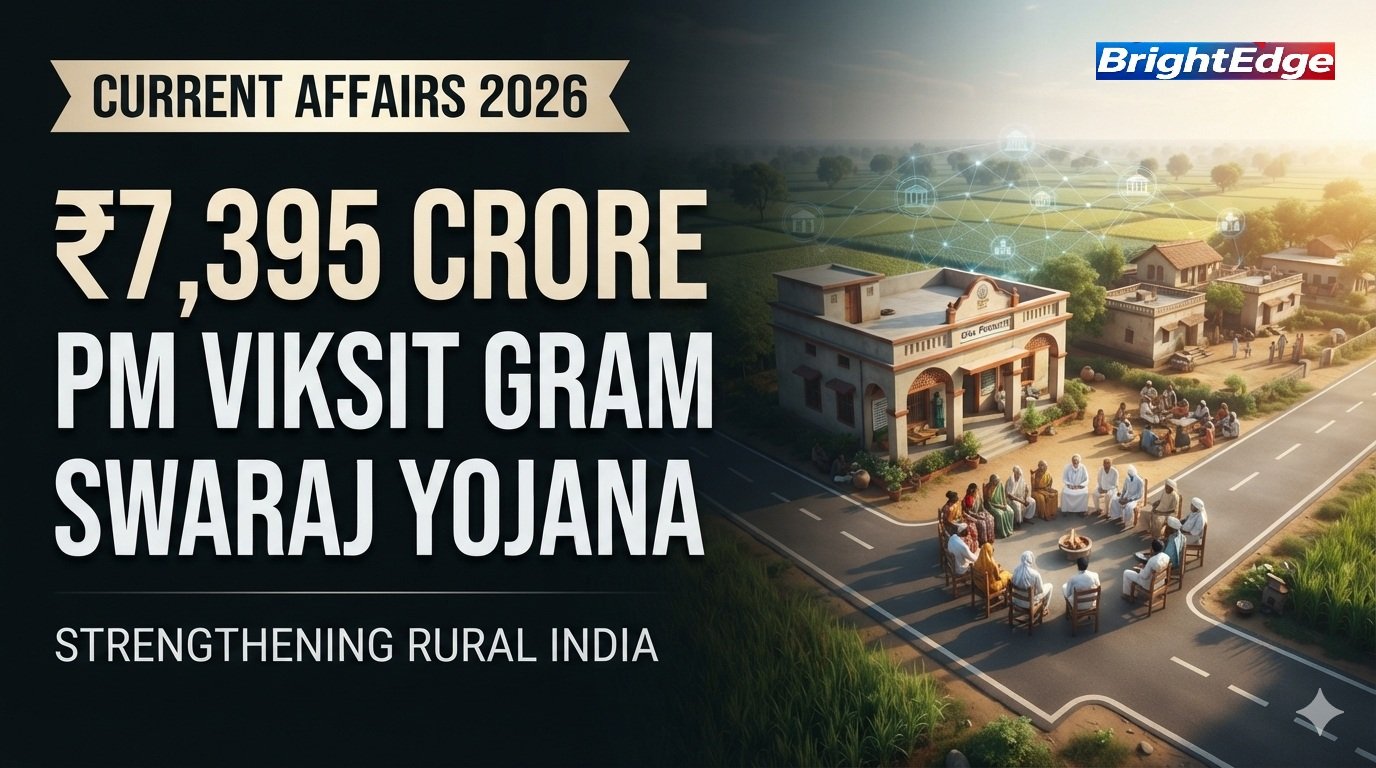
The Union Cabinet has approved the Pradhan Mantri Viksit Gram Swaraj Yojana (PM VGSY), a ₹7,395.55 crore initiative aimed at strengthening rural governance, improving village-level development planning, and making Gram Panchayats more transparent and financially self-reliant. The scheme will be implemented across India from 2026–27 to 2030–31. Nodal ministry will be the Ministry of Panchayati Raj.
PM Viksit Gram Swaraj Yojana: Key Highlights
| Particulars | Details |
|---|---|
| Scheme name | Pradhan Mantri Viksit Gram Swaraj Yojana |
| Abbreviation | PM VGSY |
| Approval date | October 28, 2026 |
| Approved by | Union Cabinet |
| Chairperson of Cabinet meeting | Prime Minister Narendra Modi |
| Total financial outlay | ₹7,395.55 crore |
| Central government share | ₹4,869.48 crore |
| State government share | ₹2,526.07 crore |
| Implementation period | 2026–27 to 2030–31 |
| Nature of scheme | Centrally Sponsored Scheme |
| Coverage | All States and Union Territories |
| Panchayats covered | More than 2.55 lakh Panchayats and traditional local bodies |
| Direct beneficiaries | Around 32 lakh elected representatives and other stakeholders |
| Annual development planning target | 2.55 lakh Gram Panchayat Development Plans |
| Digital platforms | eGramSwaraj, AuditOnline and existing e-Panchayat systems |
| Nodal ministry | Ministry of Panchayati Raj |
What Is the PM Viksit Gram Swaraj Yojana?
- The Pradhan Mantri Viksit Gram Swaraj Yojana is a national initiative designed to strengthen the capacity of Panchayati Raj Institutions and other eligible rural local government bodies.
- The scheme focuses on improving local governance rather than creating a separate delivery mechanism for every rural development programme.
- It will help Gram Panchayats identify local development priorities, coordinate relevant government initiatives, use available financial resources effectively, and involve citizens in decisions concerning their villages.
- By improving digital governance, financial management, accountability, and administrative capabilities, the initiative seeks to make rural local bodies more effective and self-reliant.
Financial Allocation: How Will the ₹7,395 Crore Be Shared?
The scheme has a total approved outlay of ₹7,395.55 crore for five financial years, from 2026–27 to 2030–31.
The financial contribution will be shared between the Central and State governments.
| Funding component | Amount |
|---|---|
| Central government share | ₹4,869.48 crore |
| State government share | ₹2,526.07 crore |
| Total outlay | ₹7,395.55 crore |
The Central government will contribute approximately 65.8% of the total allocation, while the States will contribute approximately 34.2%.
The funding arrangement is intended to support the institutional capacity, digital systems, planning processes, and accountability mechanisms required for stronger rural governance.
The scheme’s implementation will be coordinated through State governments and Union Territory administrations.
Five Major Objectives of PM Viksit Gram Swaraj Yojana
1. Strengthening Gram Panchayat Development Planning
One of the scheme’s major objectives is to support the preparation of approximately 2.55 lakh comprehensive Gram Panchayat Development Plans annually.
These plans will bring together village-level priorities, relevant government schemes, departmental interventions, and available financial resources.
The objective is to help Panchayats identify development gaps and prepare evidence-based plans that reflect local needs.
The eGramSwaraj Portal will play an important role in supporting this planning process.
2. Improving Digital Governance
The scheme will build on existing e-Panchayat systems and digital platforms to improve the availability and use of information at the village level.
Information concerning government schemes, beneficiaries, benefits, community assets, and available resources will be brought together to support better planning and monitoring.
Digital tools can help Panchayats understand their financial position, identify service gaps, coordinate with departments, and monitor development activities more effectively.
Existing arrangements for delivering individual government schemes will continue.
3. Capacity Building for 32 Lakh Representatives
The initiative will strengthen the governance capabilities of approximately 32 lakh elected representatives, Panchayat functionaries, and other stakeholders.
Training and digital handholding will focus on areas such as:
- Preparation of comprehensive village development plans.
- Understanding government schemes and available resources.
- Financial management and resource utilisation.
- Communication with citizens.
- Digital governance and monitoring.
- Progress towards locally relevant Sustainable Development Goals.
These measures are intended to improve the ability of local representatives to turn village priorities into practical development plans.
4. Promoting Transparency and Financial Accountability
PM VGSY will focus on strengthening accounting, auditing, public disclosure, and the effective use of funds available to Panchayats.
The scheme will support the preparation of at least 2.55 lakh online audit plans annually and timely completion of the corresponding audits through AuditOnline.
It will also encourage Panchayats to improve the mobilisation of Own Source Revenue (OSR).
Own Source Revenue refers to income generated by a local body through its own permitted revenue sources, rather than relying exclusively on government transfers.
Improved financial management and revenue mobilisation can help local bodies become more financially capable and accountable.
5. Increasing Citizen Participation in Village Development
The scheme will use Gram Sabhas, Panchayat forums, digital platforms, and coordinated awareness campaigns to connect national development priorities with local needs.
Each coordinated awareness-generation exercise is expected to reach at least one crore citizens.
The initiative will also use PANCHAM, an AI-enabled, multilingual, two-way communication platform available in 17 Indian languages, to help explain government schemes and national initiatives in accessible language.
Greater public awareness and participation can help villagers understand available programmes and contribute to discussions about local development priorities.
How Will PM Viksit Gram Swaraj Yojana Be Implemented?
The scheme will be implemented through State governments and Union Territory administrations.
The implementation process will include the following steps:
Step 1: Preparation of annual action plans
States and Union Territories will prepare annual action plans specifying proposed activities, priorities, and requirements.
Step 2: Appraisal and approval
A designated Central Empowered Committee will appraise and approve the plans according to the applicable procedures and norms.
Step 3: Capacity building and technical support
Existing institutional arrangements, training systems, and digital platforms will be used to strengthen the capabilities of Panchayats and their functionaries.
Step 4: Integrated village-level planning
Panchayats will be supported in preparing comprehensive development plans that combine local priorities, government interventions, and available resources.
Step 5: Monitoring and accountability
Digital accounting, online audit planning, public disclosure, and monitoring mechanisms will support transparent and accountable resource utilisation.
The scheme will cover all States and Union Territories, including eligible traditional rural local government institutions in areas where Panchayats under Part IX of the Constitution do not exist.
What Is the Role of eGramSwaraj and AuditOnline?
Two important digital platforms associated with the scheme are eGramSwaraj and AuditOnline.
eGramSwaraj
The eGramSwaraj Portal supports digital governance and planning processes for Panchayats.
Under PM VGSY, it will help facilitate comprehensive Gram Panchayat Development Plans by bringing together village priorities, government interventions, and available resources.
AuditOnline
AuditOnline supports online audit-related processes for Panchayats.
The scheme will strengthen the preparation of online audit plans and encourage the timely completion of audits, helping improve financial transparency and accountability.
Together, these digital systems are expected to support better planning, financial management, and monitoring at the grassroots level.
Will PM Viksit Gram Swaraj Yojana Create Jobs?
- The scheme may create demand for need-based contractual human resources at State, district, and block levels to provide technical assistance and support implementation.
- However, the government has clarified that the scheme will not create permanent posts.
- Therefore, the initiative should not be interpreted as a direct recruitment programme offering permanent government jobs.
- Its primary objective is to strengthen rural governance institutions, improve administrative capacity, and make village-level development planning more effective.
Why Is PM Viksit Gram Swaraj Yojana Important for Rural India?
India’s rural development programmes depend significantly on the ability of local institutions to identify needs, coordinate interventions, and use public funds effectively.
The Sixteenth Finance Commission has recommended approximately ₹4.35 lakh crore in grants for Rural Local Bodies for the period 2026–27 to 2030–31.
PM VGSY aims to strengthen the institutional capacity required to use available resources effectively.
The scheme’s potential significance includes:
- Better local planning: Village development plans can reflect local priorities and resource availability.
- Improved coordination: Panchayats can coordinate relevant interventions across government departments.
- Stronger accountability: Online accounting, audit planning, and public disclosure can improve transparency.
- Greater financial capacity: Better resource management and own-source revenue mobilisation can support financial self-reliance.
- More informed citizens: Awareness campaigns and Gram Sabha discussions can encourage public participation.
- Improved digital governance: Integrated information can support monitoring and evidence-based decisions.
The actual impact will depend on implementation quality, the effectiveness of training, coordination between departments, and the ability of Panchayats to translate plans into measurable outcomes.
Also,
Click here to read: PM Jan Dhan Yojana Completes 12 Years
Click here to read: PM Mudra Yojana Completes 11 Years
Click here to read: PM Shram Yogi Maandhan Yojana
Click here to read: Government Modifies Pradhan Mantri Fasal Bima Yojana