

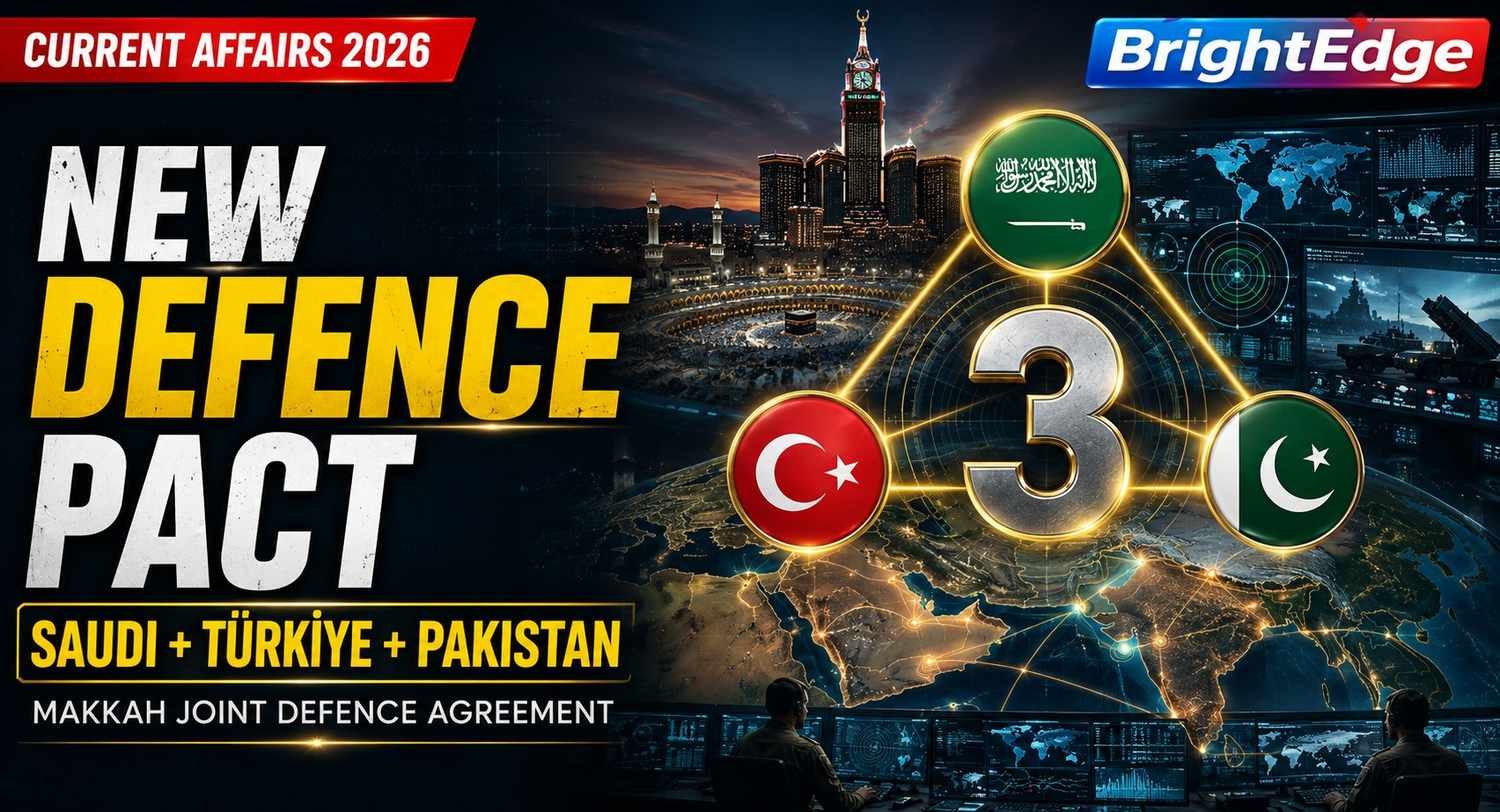
Saudi Arabia, Türkiye and Pakistan have signed the Makkah Joint Defence Agreement, creating a new framework for collective defence and strategic security cooperation among the three countries. The agreement was signed in Makkah on August 7, 2026, by Saudi Crown Prince Mohammed bin Salman, Turkish President Recep Tayyip Erdoğan and Pakistani Prime Minister Shehbaz Sharif.
The most significant provision of the Makkah Joint Defence Agreement states that an armed attack against any one of the three countries will be regarded as an attack against all three. Pakistan has described the agreement as defensive in nature and said it is consistent with the right of individual and collective self-defence under Article 51 of the UN Charter.
What is the Makkah Joint Defence Agreement?
- The Makkah Joint Defence Agreement (MJDA) is a trilateral security arrangement involving Saudi Arabia, Türkiye and Pakistan.
- The agreement aims to deepen defence and security cooperation between the three countries. Its collective-defence provision is particularly significant because it establishes a common response principle in the event of an armed attack against one of the participating states.
- However, the agreement should not automatically be described as a “Muslim NATO” or a NATO equivalent. Pakistani defence analysts have cautioned against making such a comparison, while officials have characterised the pact as defensive rather than directed against a particular country.
What does “attack on one is an attack on all” mean?
- The central security principle is collective defence.
- Under the agreement, an armed attack on Saudi Arabia, Türkiye or Pakistan is to be regarded as an attack against all three countries.
- This provision may increase the strategic cost to an adversary considering military action against any member.
- Pakistan’s Foreign Minister Ishaq Dar said the principle is consistent with Article 51 of the UN Charter, which recognises the inherent right of individual and collective self-defence.
Key Features of the Makkah Joint Defence Agreement (MJDA)
The Makkah Joint Defence Agreement, signed by Saudi Arabia, Türkiye and Pakistan on 7 August 2026 in Makkah, establishes a trilateral collective-defence framework. Its most important features are:
- Collective Defence Principle
The core provision says that an armed attack against any one of the three countries will be regarded as an attack against all three. - Three Signatories
The agreement brings together Saudi Arabia, Türkiye and Pakistan, linking strategic interests spanning the Gulf, Middle East and South Asia. - Defensive Nature
The pact has been presented as a defensive arrangement, rather than an agreement directed against a particular country. - Enhanced Defence Cooperation
It provides a framework for deeper cooperation in defence and security, building on the countries’ existing bilateral military relationships. - Strategic Deterrence
The collective-defence commitment is intended to strengthen deterrence by signalling that aggression against one member could trigger a collective response. - Potential for Wider Participation
Reporting indicates that the framework could potentially be opened to additional countries, although any expansion would depend on future decisions by the participating states. - Regional Security Significance
The agreement comes amid heightened tensions in the Middle East and represents a potentially important development in the evolving West Asian security architecture.
Why is the pact important?
- The agreement brings together three countries with very different but complementary strategic capabilities.
- Pakistan has extensive military experience and is the world’s only Muslim-majority nuclear-armed state.
- Türkiye, a NATO member, possesses a large military and a rapidly expanding domestic defence industry.
- Saudi Arabia brings substantial financial resources, energy importance and considerable regional influence.
- Their closer coordination could therefore strengthen military planning, defence cooperation and strategic coordination across a large area spanning South Asia, the Middle East and the eastern Mediterranean.
Will other countries be able to join?
- Pakistan has indicated that the arrangement could remain open to other countries that are willing to uphold its principles and resolve disputes peacefully.
- This could potentially give the agreement a broader regional dimension in the future, although the actual expansion of membership would depend on political decisions by the three founding countries and potential participants.
How does it relate to the Pakistan-Saudi defence agreement?
- The new trilateral pact builds on longstanding defence relations between Pakistan and Saudi Arabia.
- The two countries had already signed a separate Strategic Mutual Defence Agreement in September 2025, under which an attack on either country would be treated as aggression against both. The new Makkah agreement expands the framework to include Türkiye.
- Pakistan and Türkiye have also expanded their defence-industrial and military cooperation in recent years, making their participation in the new trilateral arrangement a continuation of an already developing strategic relationship.
What does the Makkah pact mean for regional security?
- The Makkah Joint Defence Agreement could become an important element of the evolving security architecture of the broader Middle East and South Asia.
- Its significance comes not simply from the three countries signing a defence agreement, but from the combination of their geographical positions, military capabilities, economic resources and diplomatic influence.
- At the same time, the precise operational mechanisms of the agreement will be important in determining how significant it becomes in practice. Analysts have cautioned that the pact should not be equated automatically with NATO’s collective-defence system.
Potential Implications of the Makkah Joint Defence Agreement on India
- Stronger strategic backing for Pakistan: Pakistan’s participation could provide Islamabad with additional diplomatic and defence support.
- More complex security calculations: India may need to consider the wider strategic relationships of Pakistan with Saudi Arabia and Türkiye during future crises.
- Türkiye factor: Türkiye’s defence cooperation with Pakistan could add another dimension to India’s security and diplomatic calculations.
- West Asia diplomacy becomes more important: India may seek to further strengthen its strategic partnership with Saudi Arabia and other Gulf countries.
- Need for greater defence preparedness: India may continue strengthening air defence, intelligence, surveillance, maritime security and strategic capabilities.
- Impact on India-Pakistan crises: The collective-defence clause could potentially increase the diplomatic and strategic costs of a future conflict involving Pakistan.
- Strategic balancing: India is likely to maintain its policy of strategic autonomy, engaging simultaneously with Saudi Arabia, Türkiye, Iran, Israel and other regional partners.
- Watch for military integration: The long-term impact will depend on whether the pact develops into joint exercises, intelligence sharing, defence-industrial cooperation or integrated military mechanisms.
Saudi Arabia |
Türkiye |
Pakistan |
 |
 |
 |
| Capital: Riyadh | Capital: Ankara | Capital: Islamabad |
| Official Name: Kingdom of Saudi Arabia | Official Name: Republic of Türkiye | Official Name: Islamic Republic of Pakistan |
| Currency: Saudi Riyal (SAR) | Currency: Turkish Lira (TRY) | Currency: Pakistani Rupee (PKR) |
| Continent/Region: Asia – West Asia | Continent/Region: Europe & Asia | Continent/Region: Asia – South Asia |
| King: Salman
Crown Prince &PM: Mohammed bin Salman |
President: Recep Tayyip Erdoğan
Vice President: Cevdet Yılmaz |
President: Asif Ali Zardari
Prime Minister: Shehbaz Sharif |
Click Here to Read: India, Australia Agree on Defence Trade Framework to Strengthen Military Cooperation
India and Japan Sign Landmark AI, Economic Security and Defence Agreements