

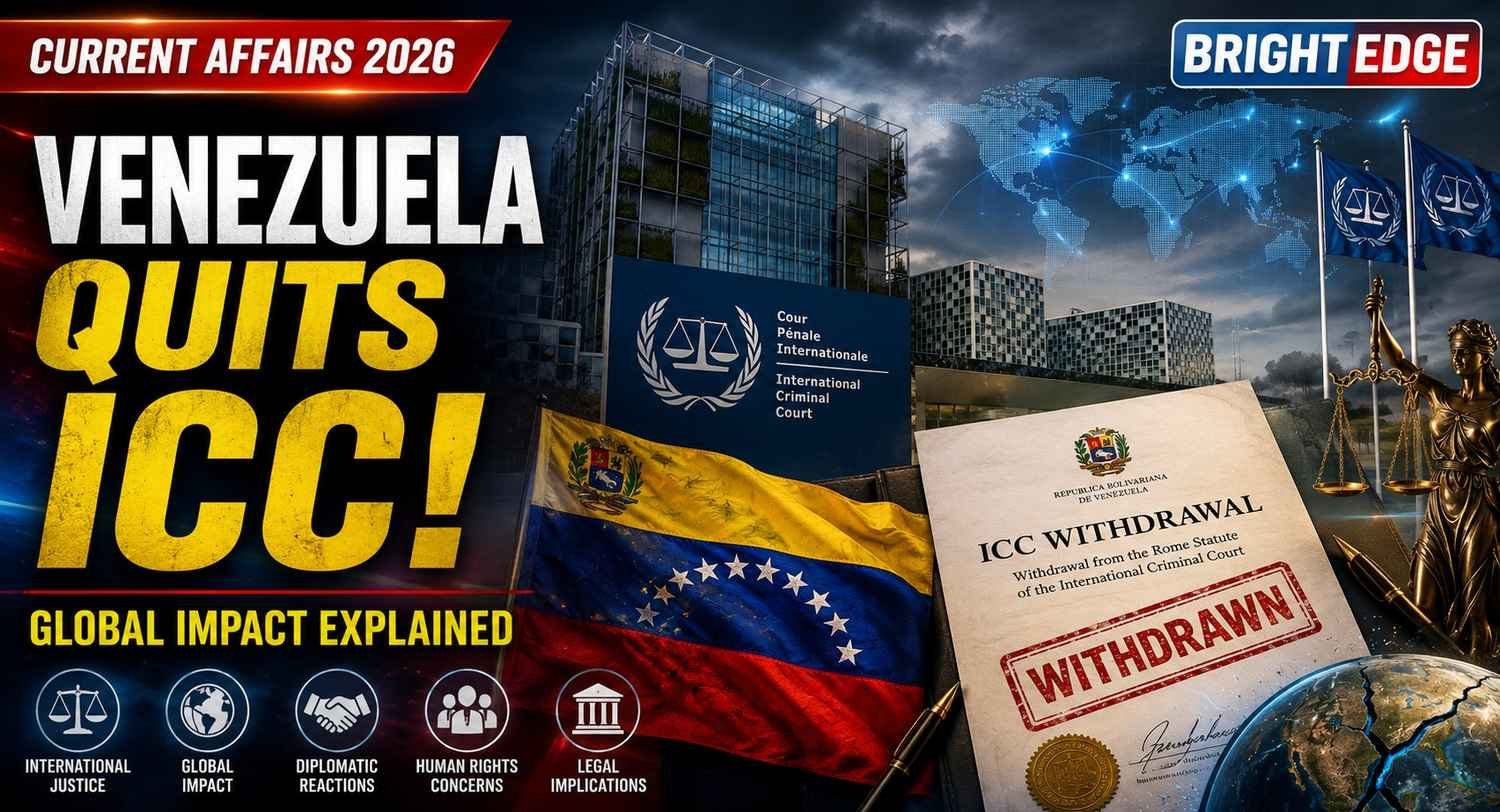
In a major geopolitical development, Venezuela has formally withdrawn from the International Criminal Court (ICC), a move that has sparked widespread international debate over accountability, sovereignty, and human rights. The decision comes amid years of legal scrutiny by the ICC over alleged crimes against humanity and raises important questions about the future of international justice.
The withdrawal is expected to influence Venezuela’s diplomatic relations, international legal obligations, and the global human rights framework.
What is the International Criminal Court (ICC)?
The International Criminal Court (ICC) is the world’s first permanent international court established under the Rome Statute (1998) and operational since 2002.
Headquarters
- The Hague, Netherlands
- Judges: 15 judges chosen for nine-year terms by the UN.
- Rules: Rulings are final and binding for the countries involved.
Purpose
The ICC prosecutes individuals accused of:
- Genocide
- Crimes against Humanity
- War Crimes
- Crime of Aggression
Unlike the International Court of Justice (ICJ), which settles disputes between states, the ICC prosecutes individuals responsible for the gravest international crimes.
Why Did Venezuela Withdraw?
According to the Venezuelan government, the withdrawal was based on several reasons:
1. National Sovereignty
The government argued that the ICC interferes in Venezuela’s internal affairs.
2. Allegations of Political Bias
Officials claimed the Court has been selectively targeting certain countries while ignoring similar violations elsewhere.
3. Ongoing Investigations
The ICC has been investigating alleged crimes against humanity linked to the treatment of protesters and political opponents.
4. Diplomatic Strategy
The move is also seen as an attempt to reduce international legal pressure while strengthening alliances with countries critical of Western-led institutions.
Background of the ICC Investigation
The ICC opened investigations into Venezuela after receiving complaints regarding:
- Arbitrary detention
- Torture
- Political persecution
- Excessive use of force during protests
- Human rights violations by security agencies
The Venezuelan government has consistently denied these allegations.
What Happens After Withdrawal?
Withdrawal does not automatically end ongoing investigations.
Important points:
- Existing investigations can continue for alleged crimes committed while Venezuela was still a member.
- Withdrawal generally takes effect after the notice period prescribed under the Rome Statute.
- The ICC may continue legal proceedings related to earlier events.
Global Reactions
Human Rights Organizations
Several international human rights groups expressed concern that the withdrawal could weaken accountability for serious crimes.
Western Nations
Many governments reiterated support for the ICC and emphasized the importance of international justice.
Venezuela’s Allies
Some countries viewed the decision as an assertion of national sovereignty and criticized what they describe as politically motivated international institutions.
Impact on Venezuela
The decision may have multiple consequences:
Diplomatic Impact
- Increased scrutiny from Western countries
- Potential strain in international relations
Legal Impact
- Ongoing investigations may continue
- International legal cooperation could become more complicated
Human Rights Impact
- Greater debate over accountability mechanisms
- Increased attention from global human rights organizations
Why is this Important?
The withdrawal highlights the ongoing tension between:
- National sovereignty
- International accountability
- Human rights protection
- Global governance
It also raises broader questions about the effectiveness and future role of international criminal justice institutions.
About the ICC
| Feature | Details |
|---|---|
| Established | 2002 |
| Treaty | Rome Statute |
| Headquarters | The Hague, Netherlands |
| Jurisdiction | Genocide, War Crimes, Crimes Against Humanity, Crime of Aggression |
| Nature | Permanent International Criminal Court |
Key Highlights
- Venezuela formally withdraws from the International Criminal Court.
- Government cites sovereignty and concerns over political bias.
- ICC investigations into alleged crimes against humanity remain significant.
- Withdrawal does not automatically halt ongoing investigations.
- The move has triggered international debate on justice and accountability.
- Human rights organizations have expressed concern over the decision.
- The development could affect Venezuela’s diplomatic and legal standing.
Static Pointers: Venezuela

- Capital: Caracas
- President: Delcy Rodríguez
- Currency: Venezuelan bolívar