

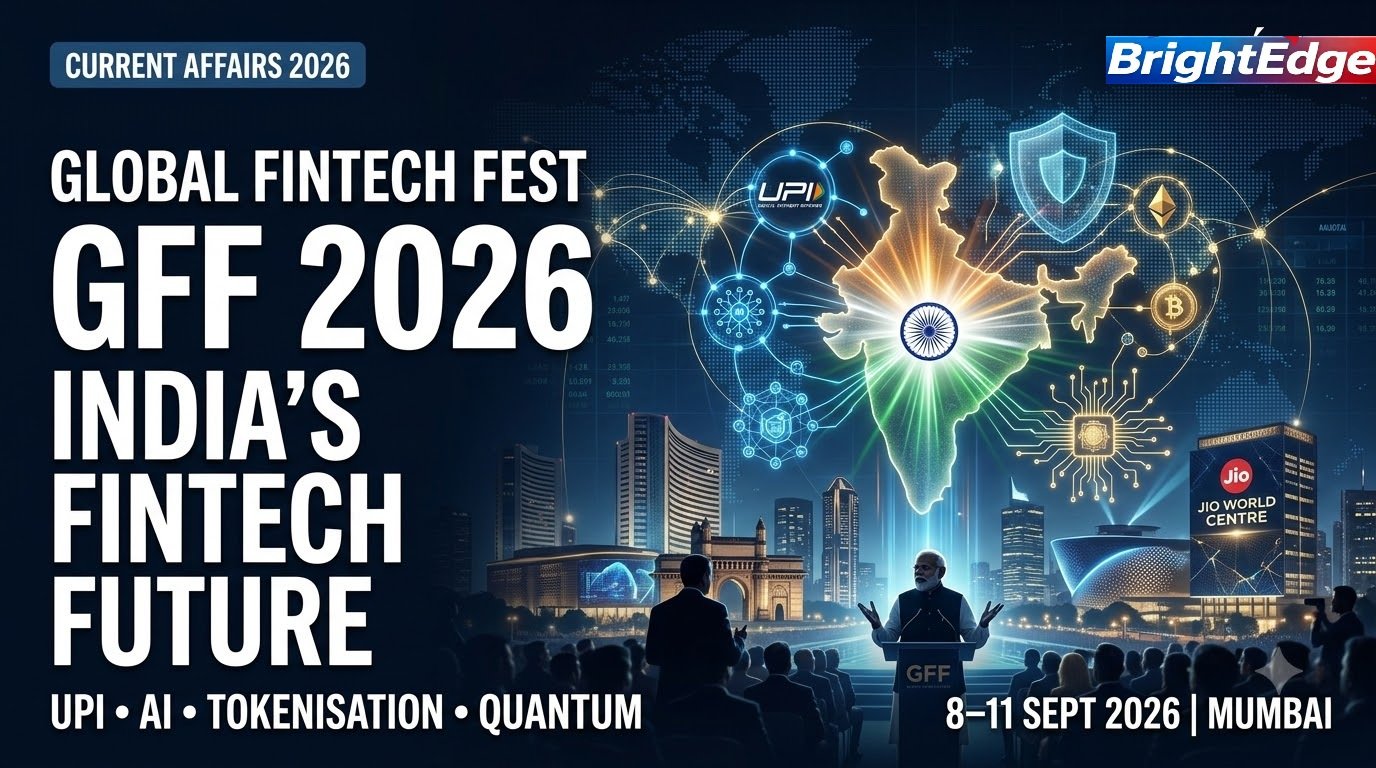
Global Fintech Fest 2026 (GFF 2026) has brought the world of financial technology to Mumbai, putting India’s digital payments revolution, UPI’s international expansion and next-generation technologies at the centre of global fintech discussions.
The 7th edition of Global Fintech Fest is being held from 8 to 11 September 2026 at Jio World Centre and Trident BKC in Mumbai.
Its central theme is “Potential to Impact: Agentic AI | Tokenisation | Quantum”, reflecting the growing convergence of artificial intelligence, programmable assets and advanced computing in financial services.
Prime Minister Narendra Modi addressed the event on September 8, calling for the expansion of India’s homegrown Unified Payments Interface (UPI) to more countries and highlighting the next phase of fintech innovation.
What is Global Fintech Fest 2026?
Global Fintech Fest is one of the world’s largest gatherings focused on fintech and the wider financial-services ecosystem.
The 2026 edition brings together policymakers, regulators, central bankers, financial institutions, technology companies, fintech entrepreneurs, investors and innovators to discuss how technology can reshape the future of finance. The official GFF platform describes the event as a global forum focused on building trusted, connected and global systems for inclusive finance.
The event’s three major technology pillars are:
- Agentic AI
- Tokenisation
- Quantum technology
Together, these technologies are expected to influence payments, lending, wealth management, capital markets, fraud prevention, cybersecurity and financial inclusion.
Modi Pushes for UPI’s Global Expansion
- One of the biggest takeaways from GFF 2026 is India’s renewed push to take UPI beyond India’s borders.
- Prime Minister Modi said UPI should be integrated with payment systems in more countries, particularly nations with significant Indian diaspora populations, strong trade relationships with India or an interest in digital cooperation.
- According to Reuters, UPI was operational in 11 countries as of the event, including Singapore, the UAE, France and Nepal. UPI processed 24.51 billion transactions worth about ₹29.82 trillion ($314 billion) in August 2026, according to the latest data cited by Reuters.
The internationalisation of UPI could have major implications for:
- Cross-border payments
- International remittances
- Indian travellers
- Overseas Indians
- Cross-border commerce
- Digital financial inclusion
The broader objective is to make international payments faster, cheaper and more interoperable.
GFF 2026’s Three Big Technology Pillars
1. Agentic AI: From Automation to Autonomous Finance
- Artificial intelligence is moving beyond chatbots and basic automation.
- The GFF 2026 framework places Agentic AI at the centre of the next generation of financial services.
- Agentic AI systems can potentially analyse information, make decisions and execute multi-step workflows with limited human intervention, subject to governance and controls.
According to GFF, Agentic AI can be used for:
- Real-time financial decision-making
- Fraud prevention
- Risk monitoring
- Regulatory compliance
- Personalised financial services
- Automated workflows
- Customer support
The key challenge will be ensuring that autonomous systems remain explainable, secure and accountable.
2. Tokenisation: Making Assets Programmable
The second pillar is tokenisation.
Tokenisation involves representing assets or rights digitally so they can potentially be transferred and programmed through digital infrastructure.
GFF highlights applications including:
- Fractional ownership
- Faster settlement
- Programmable assets
- Digital capital markets
- Interoperable money
- Greater liquidity
The concept could eventually affect everything from securities and financial assets to physical assets represented in digital form.
The broader vision is a financial system where value becomes more programmable, transferable and interoperable.
3. Quantum Technology: Preparing Finance for the Next Computing Era
The third pillar is Quantum.
Quantum technology could eventually transform areas such as:
- Cryptography
- Cybersecurity
- Risk optimisation
- Complex financial modelling
- Computational finance
For financial institutions, the quantum opportunity also comes with a major security challenge.
As quantum computing advances, financial systems may need to prepare for new forms of cyber threats. That makes quantum-safe cryptography increasingly important for protecting sensitive financial infrastructure.
Why Global Fintech Fest 2026 Matters for India
- GFF 2026 arrives at a crucial point in India’s digital-finance journey.
- India has moved from building digital payment adoption domestically to exploring how its digital public infrastructure can connect with the global financial system.
- The combination of UPI + Agentic AI + Tokenisation + Quantum technology could shape the next decade of financial innovation.
- The biggest question is no longer whether technology will transform finance.
- It is how securely, inclusively and globally that transformation can happen.
- And at GFF 2026, India is positioning itself at the centre of that conversation.