

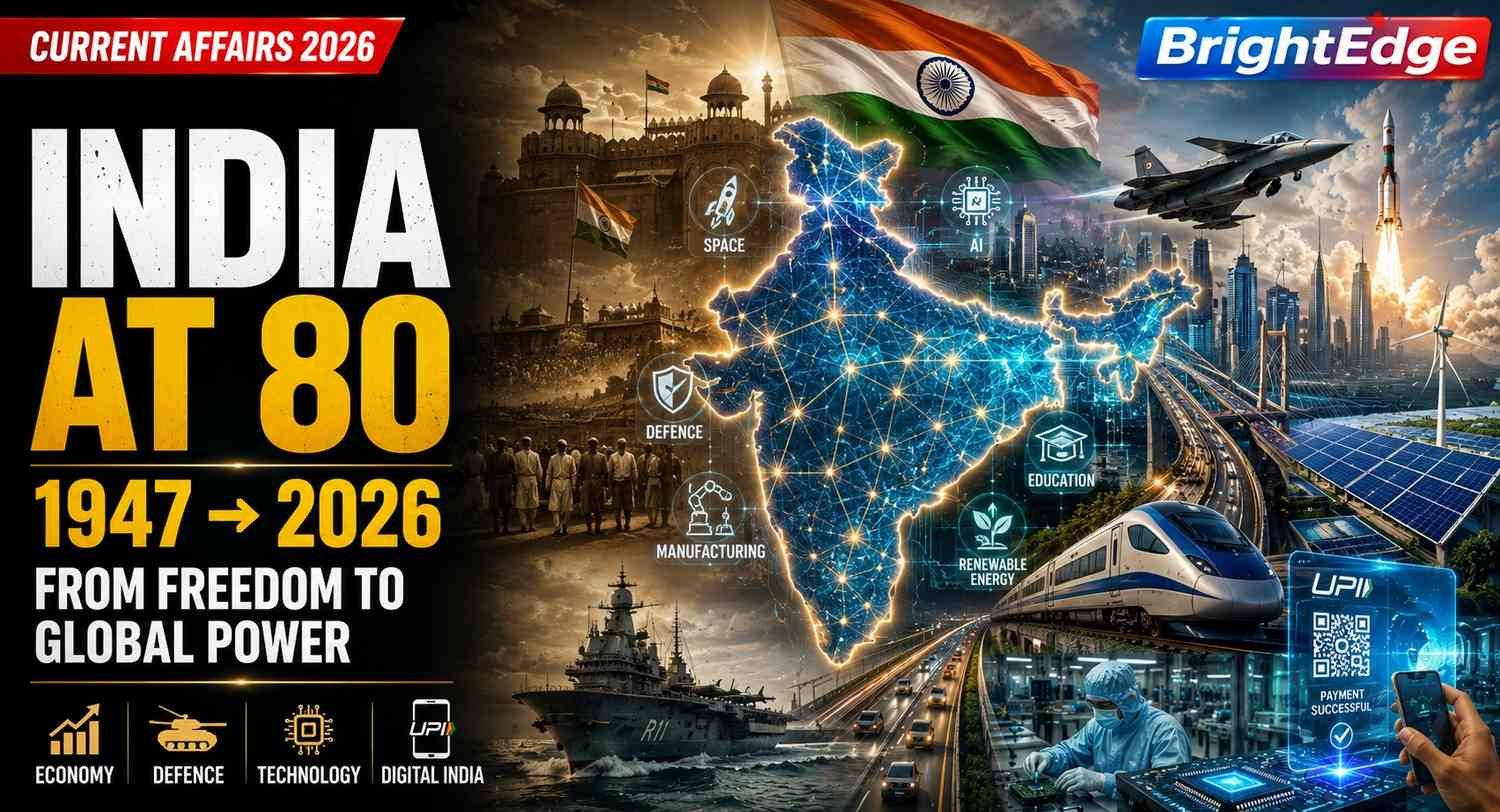
On 15 August 1947, India emerged from nearly two centuries of British colonial rule as a free nation. The country inherited poverty, low industrialisation, limited infrastructure, widespread illiteracy and the enormous challenge of uniting a deeply diverse population.
Yet India chose democracy.
- It chose constitutional government over authoritarianism, development over division, and institution-building over short-term solutions.
- On 15 August 2026, India celebrates its 80th Independence Day, completing 79 years as an independent republic-in-the-making and preparing for the centenary of independence in 2047.
- The India of 2026 is vastly different from the India of 1947—and even the India of 2016.
- The transformation is visible in its economy, roads, digital infrastructure, defence production, space programme, renewable energy, education, entrepreneurship, financial inclusion and global diplomatic influence.
- But India’s story is not simply one of rising numbers. It is the story of a country attempting to move from being a developing economy to becoming a developed, technologically capable and globally influential nation.
From a Poor Newly Independent Nation to a Major Global Economy
- At independence, India’s economy was overwhelmingly agricultural, industrial capacity was limited and per-capita income was extremely low. The country had to build its economic foundations almost from scratch.
- Over the decades, India gradually created large public institutions, expanded agriculture and industry, invested in science and technology and opened its economy through the 1991 reforms.
- The transformation accelerated in the 21st century.
- By 2025-26, India had become the world’s sixth-largest economy in nominal GDP terms, with GDP estimated at around $3.92 trillion according to figures presented to Parliament based on the IMF’s April 2026 World Economic Outlook.
- India has also remained one of the world’s fastest-growing major economies. The World Bank has described India as the fastest-growing major economy, with growth of 6.5% in FY2024-25.
- The more important story, however, is not simply India’s position in a global GDP ranking.
- It is the emergence of a huge domestic market, a rapidly expanding services sector, a growing manufacturing base, a digital economy and an increasingly entrepreneurial population.
- India’s next challenge is to convert economic scale into high-quality employment, higher productivity and significantly higher per-capita income.
The Last Decade: 2016–2026 Changed the Speed of India’s Transformation
- The decade from 2016 to 2026 has been particularly significant.
- India moved rapidly towards a model in which physical infrastructure and digital infrastructure developed together.
- The country simultaneously expanded highways, airports, railways, electricity access, banking penetration, internet connectivity and digital public infrastructure.
- The result is a very different economic environment from a decade ago.
Digital India: Perhaps the Most Visible Transformation
- One of India’s most remarkable achievements has been the creation of a large-scale digital public infrastructure ecosystem.
- Aadhaar, Jan Dhan accounts, mobile connectivity and UPI created what has become known internationally as India’s Digital Public Infrastructure model.
- The JAM Trinity—Jan Dhan, Aadhaar and Mobile—created the foundation for direct benefit transfers and digital financial inclusion.
- Then came UPI.
- When UPI began operating at scale, digital payments were still a relatively small part of everyday economic life. A decade later, UPI has become one of the world’s largest real-time digital payment systems.
- Annual UPI transactions increased from around 2 crore in FY2016-17 to more than 24,162 crore in FY2025-26.
- That is not merely a payments revolution.
- It is a transformation in how India’s citizens, small businesses, street vendors, professionals and large companies participate in the economy.
- India is increasingly exporting this digital infrastructure model to other countries as well.
Infrastructure: The India of Highways, Expressways and Modern Transport
- India’s physical infrastructure has undergone a dramatic expansion.
- The National Highway network increased from approximately 91,287 km in 2014 to 1,46,145 km in 2024.
- Even more important has been the improvement in road quality and capacity.
- Four-lane-and-above National Highways increased from around 18,371 km in 2014 to 48,422 km in 2024.
- Operational high-speed corridors also expanded dramatically.
- This infrastructure is changing the geography of economic activity.
- Industrial corridors, expressways, logistics parks, dedicated freight infrastructure, ports and multimodal connectivity are gradually reducing the traditional distance between India’s production centres and markets.
- Indian Railways has also undergone major modernisation, including extensive electrification, higher-speed corridors, station redevelopment, improved passenger services and the introduction of Vande Bharat trains.
- India’s aviation sector has expanded rapidly, connecting cities that previously had limited or no air connectivity.
- Infrastructure is increasingly becoming an economic multiplier rather than merely a government expenditure category.
From Energy Deficit to Renewable-Energy Powerhouse
- India’s energy challenge remains enormous because of its population and rapidly expanding economy.
- Yet the transformation in renewable energy has been remarkable.
- Renewable-energy installed capacity increased from about 76.38 GW in March 2014 to 274.68 GW in March 2026.
- Solar power has seen an even more dramatic transformation.
- Solar capacity rose from only 2.82 GW in March 2014 to more than 150 GW by March 2026.
- That represents an extraordinary expansion of India’s solar ecosystem.
- India is now among the world’s major renewable-energy powers.
- At the same time, India faces a difficult balancing act: it must continue expanding energy access and industrial production while reducing emissions and moving toward its long-term net-zero target.
- The challenge is therefore not simply producing more energy.
- It is producing reliable, affordable and cleaner energy at enormous scale.
Defence: From Major Importer to Emerging Defence Manufacturer
- India has historically been one of the world’s largest defence equipment importers.
- That picture is beginning to change.
- The emphasis on Atmanirbhar Bharat and indigenous defence manufacturing has expanded domestic production of aircraft, helicopters, missiles, artillery systems, naval platforms, radars, electronic systems and other military equipment.
- India’s annual defence production reached a record ₹1.78 lakh crore in FY2025-26.
- Defence exports also reached a record ₹38,424 crore in FY2025-26, compared with only ₹686 crore in FY2013-14.
- This is one of the clearest examples of India’s attempt to move from an importer to a manufacturer and eventually an exporter of sophisticated defence technology.
- The rise of indigenous systems such as the Tejas fighter aircraft, BrahMos missile, Akash missile system, advanced artillery, naval platforms and numerous electronic and unmanned systems reflects a broader change in India’s defence-industrial ecosystem.
- The objective is not autarky.
- The objective is strategic autonomy—the ability to design, manufacture, maintain and upgrade critical defence systems domestically while continuing international partnerships.
Space: From Launching Satellites to Exploring the Moon and Sun
- India’s space programme began in modest conditions.
- The early Indian space programme worked with limited budgets, basic infrastructure and enormous technological constraints.
- Yet the long-term investment in scientific institutions produced extraordinary results.
- The transformation became globally visible with Chandrayaan-3, which successfully landed near the lunar south pole in 2023.
- India subsequently demonstrated its ability to conduct sophisticated planetary and solar missions, including Aditya-L1, India’s dedicated solar observatory.
- The country’s human-spaceflight programme, Gaganyaan, is moving toward its first crewed mission, with critical human-rating technologies and propulsion systems being developed and validated.
- India is also working toward a larger space ecosystem involving private companies, launch vehicles, satellites and future human-spaceflight ambitions.
- The significance is larger than prestige.
- Space technology supports communications, navigation, agriculture, weather forecasting, disaster management, national security and economic activity.
- India’s space programme has therefore evolved from a scientific programme into a strategic and economic asset.
Technology and Electronics: From Importer to Manufacturer
- Perhaps one of the least noticed transformations is India’s electronics manufacturing revolution.
- In 2014-15, electronics production was around ₹1.9 lakh crore.
- By 2025-26, it had reached approximately ₹13.11 lakh crore.
- Mobile-phone production increased from around ₹18,000 crore in 2014-15 to roughly ₹6.27 lakh crore in 2025-26.
- Mobile-phone exports increased from approximately ₹1,500 crore to around ₹2.59 lakh crore.
- India has moved from being heavily dependent on imported mobile phones to becoming a major manufacturing and export base.
- The country is now the world’s second-largest mobile-phone manufacturer by volume.
- This transformation is important because electronics manufacturing creates links between design, components, logistics, semiconductors, software and global supply chains.
- India’s next challenge is to move further up the value chain—from assembly to components, semiconductor manufacturing, chip design, advanced electronics and original product development.
Startup India: A New Culture of Entrepreneurship
- A decade ago, India’s startup ecosystem was concentrated largely in a handful of cities.
- Startup India changed the scale of the ecosystem.
- The number of DPIIT-recognised startups increased from roughly 500 in 2016 to more than 2.23 lakh by March 2026.
- These startups have generated more than 23 lakh direct jobs.
- Even more significant is their geographic spread.
- Around half of recognised startups originate from Tier-II and Tier-III cities, showing that entrepreneurship is no longer restricted to India’s traditional metropolitan technology hubs.
- Fintech, edtech, healthtech, agritech, space technology, defence technology, artificial intelligence, logistics and climate technology are now part of India’s innovation ecosystem.
- The next decade could determine whether India evolves from a startup-rich country into a country that produces globally dominant technology companies.
Innovation: India’s Global Position Is Rising
- India’s innovation performance has also improved substantially.
- In the Global Innovation Index, India rose from 81st position in 2015 to 38th in 2025.
- That improvement reflects the growth of technology companies, startups, research institutions, digital infrastructure and innovation-focused policies.
India is increasingly competing not merely on low-cost services but on:
- Artificial intelligence
- Space technology
- Digital payments
- Biotechnology
- Pharmaceuticals
- Semiconductor technology
- Defence technology
- Fintech
- Deep-tech startups
- Renewable-energy technology
The next challenge is to increase research and development expenditure and create stronger connections between universities, laboratories and industry.
Education: From Access to Quality
- India’s education system is one of the largest in the world.
- Today, India has around 24.69 crore school students, 14.71 lakh schools and more than 1 crore teachers.
- The National Education Policy 2020 has attempted to shift the education system toward foundational learning, multidisciplinary education, vocational exposure, technology integration and greater flexibility.
- Higher-secondary enrolment has also improved over the past decade.
- The Gross Enrolment Ratio at the higher-secondary level increased from 46.37% in 2014-15 to 58.4% in 2024-25.
- India has also expanded IITs, IIMs, medical colleges, universities and digital learning infrastructure.
- Yet education remains one of India’s biggest unfinished tasks.
- The next phase must focus not merely on how many children enter school, but on what they learn, how well they learn it and whether their education makes them employable in an AI-driven economy.
- For a young country, human capital will ultimately determine whether India’s economic rise becomes sustainable.
Women: From Welfare to Women-Led Development
- India’s development story cannot be complete without the transformation in women’s participation.
- Over the past decade, government policy has increasingly moved from viewing women primarily as beneficiaries of welfare programmes toward treating women as economic participants, entrepreneurs and decision-makers.
- Financial inclusion has expanded through Jan Dhan accounts.
- Women have become central to Self-Help Groups, entrepreneurship programmes and microfinance ecosystems.
- As of January 2026, more than 1 lakh recognised startups had at least one woman director or partner.
- Programmes such as Ujjwala have also addressed household energy access and women’s health.
- The expansion of piped water through the Jal Jeevan Mission has another important dimension.
- Historically, women and girls in many rural communities spent significant time collecting water. By June 2026, more than 15.86 crore rural households had piped-water connections, compared with only 3.23 crore at the programme’s launch in 2019.
- These are not simply infrastructure statistics.
- They directly affect women’s time, health, safety and economic opportunities.
- However, India still has substantial work to do in female labour-force participation, workplace equality, safety, nutrition and representation.
Poverty and Basic Living Standards
- One of the most important measures of national development is not the number of billionaires or skyscrapers.
- It is whether ordinary citizens experience a better life.
- India has made substantial progress in reducing extreme poverty.
- According to World Bank-linked estimates, the share of India’s population living below the international extreme-poverty line of $2.15 per day declined from 16.2% in 2011-12 to 2.3% in 2022-23.
- Government programmes have expanded access to toilets, electricity, cooking fuel, bank accounts, housing, drinking water and healthcare.
- Rural sanitation coverage has moved from approximately 39% in 2014 to universal coverage under the government’s reported figures.
- Millions of households have gained access to LPG connections.
- Ayushman Bharat has expanded health-insurance coverage for economically vulnerable populations.
- The larger transformation is the shift from fragmented welfare delivery toward technology-enabled direct delivery.
India and the World: A Different Global Position
- In 1947, India emerged as a newly independent country struggling to establish itself in a world dominated by powerful industrial nations.
- Today, India sits at almost every major global table.
- It is a member of the G20, BRICS, SCO, Quad and Commonwealth, while maintaining strategic relationships with the United States, Russia, Europe, Japan, Australia, the Gulf countries, Southeast Asia and Africa.
- India’s diplomatic strategy increasingly seeks partnerships rather than permanent blocs.
- The country has also become an important voice for the Global South.
- India’s economic size, population, technology ecosystem, defence capabilities, pharmaceutical industry, space programme and strategic geography give it influence well beyond its traditional regional role.
- The world increasingly sees India not simply as a large developing country, but as one of the countries capable of influencing the direction of the global economy.
What Has Changed Most in the Last 10 Years?
| Area | Around 2016 | India in 2026 |
|---|---|---|
| Digital payments | Early-stage UPI ecosystem | One of the world’s largest real-time payment ecosystems |
| Startup ecosystem | Around 500 recognised startups | Over 2.23 lakh recognised startups |
| Defence exports | Very small | ₹38,424 crore in FY2025-26 |
| Defence production | Much smaller domestic base | ₹1.78 lakh crore in FY2025-26 |
| Solar capacity | ~9 GW range | More than 150 GW |
| National Highways | ~91,287 km in 2014 | ~1,46,145 km by 2024 |
| Electronics production | ~₹1.9 lakh crore in FY2014-15 | ~₹13.11 lakh crore in FY2025-26 |
| Innovation ranking | 81st in 2015 | 38th in 2025 |
| UPI annual transactions | ~2 crore in FY2016-17 | >24,162 crore in FY2025-26 |
| Extreme poverty | Much higher | 2.3% in 2022-23 by the cited international poverty measure |
| Space capability | Strong satellite/launch capability | Lunar landing, solar mission and human-spaceflight preparations |
The comparison illustrates one central reality: India has not simply grown larger; it has become more connected, more digital, more industrial, more capable and more globally integrated.
But India’s Journey Is Not Finished
A credible Independence Day assessment cannot celebrate achievements while ignoring the problems.
India still faces major challenges.
Jobs
- India must create millions of productive jobs for its young population.
- Economic growth must translate into employment and rising household incomes.
Per-Capita Income
- India’s total GDP is enormous, but its per-capita income remains far below that of advanced economies.
Education Quality
- Access has improved, but learning outcomes, research quality, vocational skills and employability require continued improvement.
Women’s Employment
- Women remain underrepresented in India’s formal workforce relative to the country’s potential.
Urbanisation
- Indian cities require better public transport, housing, waste management, water systems and pollution control.
Manufacturing
- India has made significant progress, but the country still needs deeper domestic supply chains and greater participation in high-value manufacturing.
Innovation
- India’s innovation ranking has improved dramatically, but R&D spending, university research and commercialisation need further strengthening.
Inequality
- Economic growth has created extraordinary wealth, but ensuring that prosperity reaches every region and social group remains a fundamental national task.
Environment
- India must simultaneously expand energy supply, industrialise, urbanise and reduce emissions.
- These challenges do not diminish India’s achievements.
- They define the next stage of India’s development.
The India of 1947, 2016 and 2026
Three dates provide an interesting way to understand India’s journey.
1947:
A newly independent, poor and largely agrarian nation fighting to build institutions.
2016:
A rapidly growing economy entering a major phase of digital transformation and global integration.
2026:
A major global economy with digital infrastructure at unprecedented scale, a growing manufacturing base, a globally competitive space programme, expanding defence production, a huge startup ecosystem and increasing diplomatic influence.
The distance between these three Indias is enormous.
The Road to 2047
The most important question is no longer:
“Can India become a major global power?”
It is increasingly:
“Can India convert its enormous scale into a prosperous, innovative and developed society for all its citizens?”
- The target of Viksit Bharat 2047 gives the country another 21 years to answer that question.
- India’s demographic scale can become its greatest advantage if young Indians receive high-quality education, productive employment and opportunities to innovate.
- Its digital infrastructure can become a global public-good export.
- Its manufacturing ecosystem can integrate deeper into global supply chains.
- Its space and defence industries can become major technology exporters.
- Its renewable-energy transition can combine development with sustainability.
- And its democratic institutions can remain the foundation of this transformation.
India at 80: The Larger Story
- India’s Independence Day is not simply a celebration of 1947.
- It is a celebration of continuity and transformation.
- The freedom struggle gave India political independence.
- The Constitution gave it democratic institutions.
- The Green Revolution strengthened food security.
- Economic reforms opened the economy.
- The IT revolution connected India to the world.
- The digital revolution changed everyday transactions.
- The infrastructure revolution is physically connecting the country.
- The startup revolution is changing the culture of entrepreneurship.
- The space and defence revolutions are expanding India’s technological sovereignty.
- And the next revolution—artificial intelligence, semiconductors, advanced manufacturing, biotechnology, quantum technology and clean energy—could determine India’s position in the second half of the 21st century.
- India is not yet a fully developed country.
- It still has enormous challenges.
- But the direction of travel is unmistakable.
- From a nation that once depended heavily on imported technology and foreign assistance, India is increasingly becoming a nation that builds, innovates, exports and shapes global standards.
- From a country whose voice was often limited in international affairs, India has become a country whose economic and strategic choices increasingly matter to the world.
- From a largely analogue economy to a digital economy processing billions of transactions, India’s transformation has occurred at extraordinary speed.
- And perhaps the most remarkable part of India’s story is this:
- The journey is not over.
- On its 80th Independence Day, India is not celebrating the completion of its development story.
- It is celebrating how far it has come—and preparing for the much larger journey ahead.
From Freedom to Capability.
From Capability to Opportunity.
From Opportunity to Prosperity.
That is the India of 2026. And that is the India that will shape 2047.
Jai Hind.