

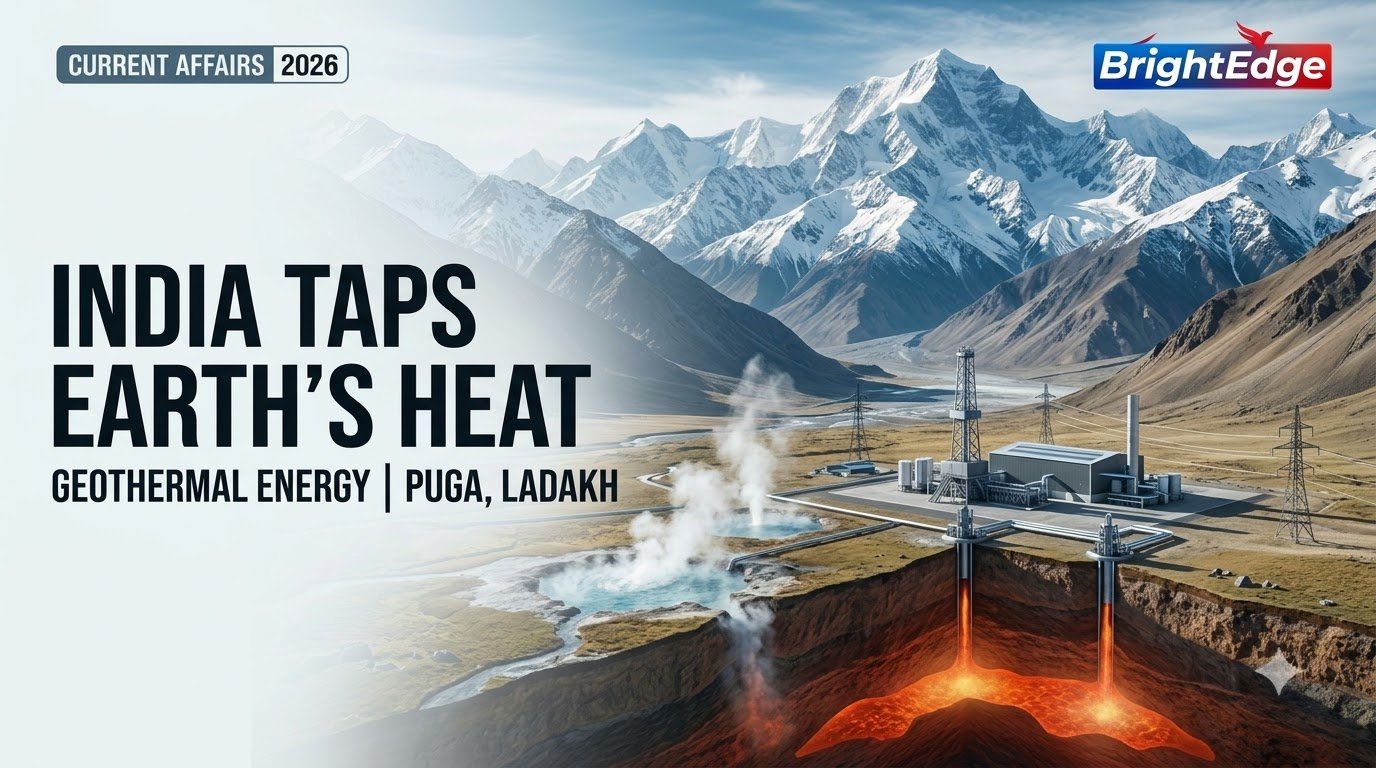
India is looking beneath the Earth’s surface for its next source of clean energy.
The commissioning of the country’s first two geothermal wells at Puga Valley in Ladakh marks an important milestone in India’s renewable-energy journey. The development follows the government’s National Policy on Geothermal Energy, notified in September 2025, and could open the door to a new source of reliable, low-carbon power.
Unlike solar and wind power, geothermal energy does not depend on sunshine or wind conditions. It taps the natural heat stored deep inside the Earth, potentially providing energy around the clock.
For India, which is rapidly expanding its renewable-energy capacity while pursuing its Net Zero emissions target for 2070, geothermal energy could become an important addition to the clean-energy mix.
What Is Geothermal Energy?
Geothermal energy is heat generated and stored inside the Earth.
In areas where underground temperatures are sufficiently high, wells can be drilled to access hot water or steam. This heat can then be used to:
- Generate electricity
- Provide heating and cooling
- Support agriculture
- Heat greenhouses
- Support aquaculture
- Develop district-heating systems
- Enable certain industrial applications
The major advantage is its continuous availability. While solar generation falls at night and wind output changes with weather conditions, geothermal resources can potentially provide a steady energy supply.
India’s Geothermal Potential
- India’s geothermal opportunity is larger than many people realise.
- The Geological Survey of India has estimated the country’s theoretical geothermal resource potential at around 10,600 MW, based on exploration involving hundreds of hot springs. Government information identifies 42 promising geothermal areas among India’s geothermal manifestations.
Potential geothermal resources have been identified across different parts of India, including:
- Ladakh
- Jammu & Kashmir region
- Himachal Pradesh
- Uttarakhand
- Gujarat
- Maharashtra
- Chhattisgarh
- Odisha
- West Bengal
- Andaman & Nicobar Islands
However, theoretical potential does not mean that the entire estimated capacity can immediately be converted into commercial electricity.
Geological conditions, drilling costs, reservoir characteristics, water availability, technology and project economics will determine how much of this potential can ultimately be developed.
Puga Valley: India’s Geothermal Energy Test Bed
- The biggest recent development has taken place at Puga Valley in Ladakh.
- Located at an altitude of more than 14,000 feet, Puga is one of India’s most promising geothermal locations because of its hot springs and underground heat resources.
- In July 2026, the ONGC Energy Centre commissioned India’s first two geothermal wells at Puga. The wells are around 1,000 metres deep and are being used to evaluate the geothermal reservoir.
- The project is intended to support a 1-MW demonstration geothermal power project, potentially marking India’s entry into geothermal electricity generation.
- This is significant not because 1 MW will transform India’s electricity system—it will not—but because demonstration projects can provide the technical and economic knowledge needed for larger commercial developments.
Geothermal vs Solar and Wind: What Makes It Different?
| Feature | Geothermal | Solar | Wind |
|---|---|---|---|
| Main resource | Earth’s heat | Sunlight | Wind |
| Weather dependent | Low | Yes | Yes |
| Available at night | Yes | No | Sometimes |
| Land requirement | Relatively low at plant site | Higher | Higher |
| Power generation | Potentially continuous | Intermittent | Variable |
| Major challenge | Exploration & drilling | Storage/intermittency | Intermittency |
| India’s potential | Large but underdeveloped | Very large | Large |
Why Geothermal Energy Matters for India
- India’s electricity demand is growing rapidly as the economy expands, industries electrify and households increasingly use electric appliances, vehicles and cooling systems.
- The country therefore needs more than one renewable-energy technology.
- Solar and wind will remain central to India’s energy transition, while batteries and other storage technologies can help manage intermittency.
- Geothermal energy could add another layer of firm, indigenous renewable generation.
- The government says geothermal resources can help diversify India’s renewable-energy portfolio while supporting the country’s Net Zero 2070 objective.
Click Here to Read: India Ranks 3rd Globally in Renewable Energy Capacity: Pralhad Joshi