

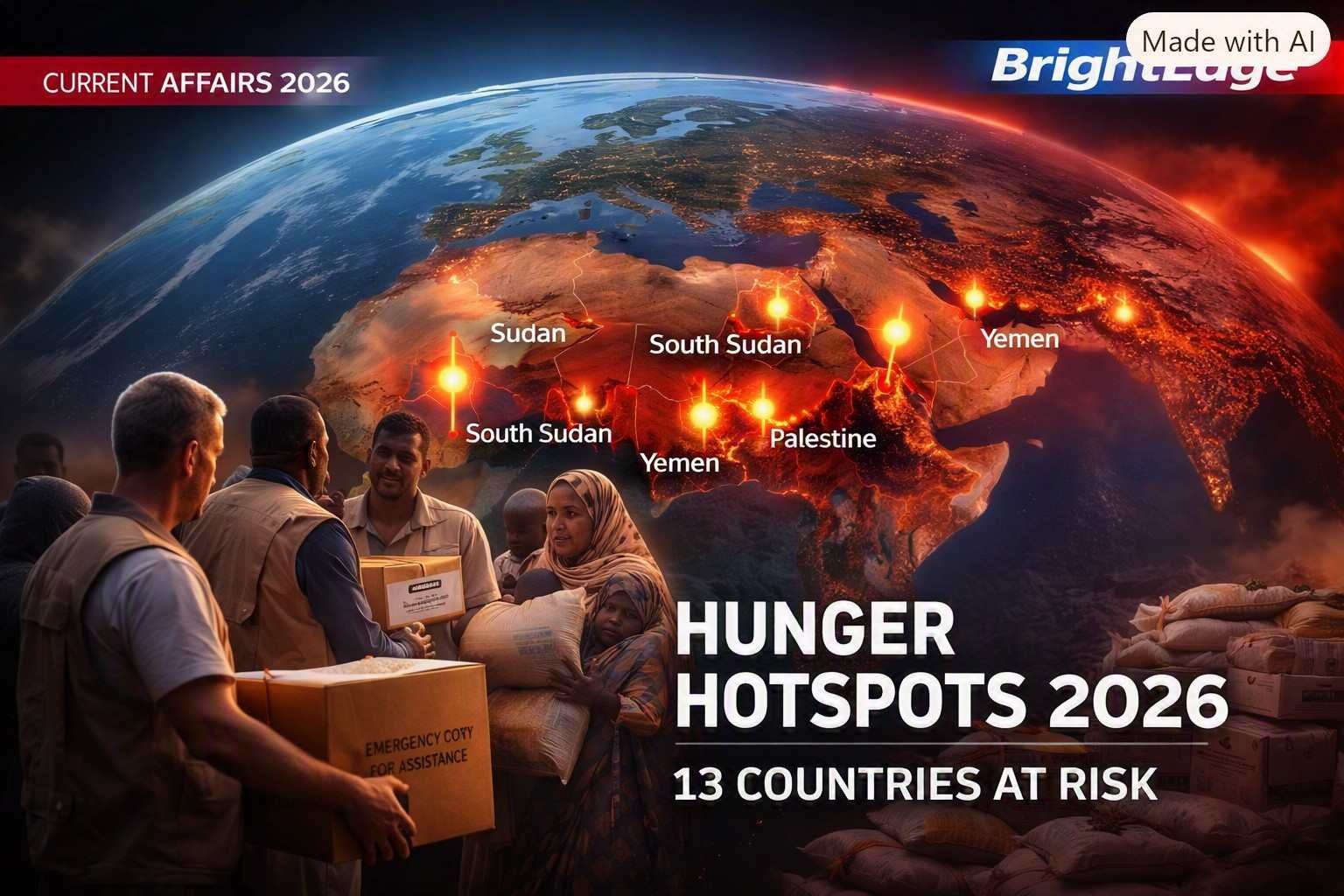
13 Countries at Risk as Global Hunger Crisis Worsens
Hunger Hotspots Report 2026: Key Highlights
- The FAO–WFP Hunger Hotspots Report 2026 has raised an urgent warning over worsening acute food insecurity in 13 countries and territories between June and November 2026.
- The report, jointly published by the Food and Agriculture Organization of the United Nations (FAO) and the United Nations World Food Programme (WFP) under the Global Network Against Food Crises, identifies Sudan, South Sudan, Yemen and Palestine as the world’s most critical hunger hotspots in terms of the severity and magnitude of hunger.
- Northeast Nigeria and Somalia have also moved into the highest-concern category as conditions deteriorate toward catastrophic levels.
What Is the Hunger Hotspots Report?
- The Hunger Hotspots report is a forward-looking early-warning assessment prepared by FAO and WFP.
- Rather than measuring hunger everywhere in the world, it focuses on locations where acute food insecurity is likely to deteriorate significantly during the outlook period.
- The objective is to identify emerging crises early enough for governments, humanitarian organizations and international donors to act before food insecurity reaches catastrophic levels.
- The latest edition covers the period June to November 2026.
Which Countries Are Hunger Hotspots in 2026?
The 13 identified hotspots are grouped into three broad levels of concern.
Highest Concern
The most serious group includes:
- Sudan
- South Sudan
- Yemen
- Palestine
- Northeast Nigeria
- Somalia
These locations face some of the world’s most severe acute food insecurity situations and, in several areas, a risk of catastrophic hunger or famine.
Very High Concern
The report places the following countries in the very-high-concern category:
- Afghanistan
- Democratic Republic of the Congo
- Haiti
Afghanistan continues to face pressure from drought, high food prices and conflict. In the Democratic Republic of the Congo, conflict, displacement and the resurgence of Ebola are adding to food-security risks. Haiti has moved from the highest-concern category to very high concern, although conditions remain fragile.
Other Hunger Hotspots
The remaining hotspots are:
- Myanmar
- Mali
- Lebanon
- Madagascar
Myanmar and Mali face worsening risks linked to conflict, economic pressures and climate variability. Lebanon was added following the escalation of hostilities in late February 2026, while Madagascar was added because of adverse and erratic weather conditions.
Sudan: The World’s Most Critical Hunger Hotspot
- Sudan remains at the centre of the global hunger emergency.
- The FAO–WFP assessment identified a risk of famine in 14 areas across North Darfur, South Darfur and South Kordofan through September 2026. The risk is expected to persist in 13 areas through the harvest period into January 2027.
- An estimated 19.5 million people, or about 41% of Sudan’s population, faced high levels of acute food insecurity through May 2026.
- The situation is projected to deteriorate further, with the number of people facing IPC Phase 5, or Catastrophe, projected to reach 200,000 across 15 areas during June–September 2026, compared with 135,000 during February–May.
Why Is Hunger Rising in Sudan?
- The crisis is being driven by conflict, displacement, disruption of livelihoods, restricted humanitarian access and damage to food-production systems.
- The report warns that without early intervention, existing food-security problems could escalate into even more severe humanitarian conditions.
South Sudan Faces Severe Food Insecurity
South Sudan is another critical hunger hotspot.
The report projects that 7.8 million people, representing approximately 55% of the population, would face Crisis or worse levels of acute food insecurity between April and July 2026.
This includes:
- 2.5 million people in Emergency conditions
- Approximately 73,000 people facing Catastrophe
- Four counties facing a risk of famine through July 2026
Conflict, displacement, economic difficulties and climate-related pressures continue to undermine food security.
Yemen: Hunger Remains Among the Worst in the World
Yemen continues to face one of the world’s most severe food-security crises.
Earlier estimates projected 18.3 million people to experience Crisis or worse levels of acute food insecurity in 2026—more than half the population.
This included approximately:
- 5.5 million people in Emergency
- 41,000 people projected to face Catastrophe in areas controlled by the Sana’a-based authorities
More recent partial analysis indicated that nearly 5.4 million people in government-controlled areas could face Crisis or worse levels of food insecurity between June and September 2026.
Northeast Nigeria Added to Highest-Concern Group
- Northeast Nigeria has emerged as another major hunger hotspot.
- The situation is particularly serious in Borno State, where approximately 15,000 people are projected to face Catastrophe-level food insecurity during June–August 2026.
- Around 2.3 million people remain internally displaced across northeastern Nigeria, adding significant pressure to already vulnerable communities.
Palestine: Gaza’s Food Crisis Remains Fragile
The situation in the Gaza Strip showed some improvement following the October 2025 ceasefire, but the FAO–WFP assessment says conditions remained extremely fragile.
Through mid-April 2026, the entire Gaza Strip faced a risk of famine.
At that time:
- 1.6 million people were acutely food insecure
- This represented 77% of the analysed population
- More than 500,000 people were in Emergency conditions
- Around 1,900 people were projected to face Catastrophe
Importantly, the report states that no projection covering June–November 2026 was available for Gaza at the time the report was drafted.
Somalia: Famine Risk Re-Emerges
- Somalia has also been moved into the highest-concern category.
- Around 6 million people were projected to face high levels of acute food insecurity between April and June 2026, including nearly 1.9 million people projected to experience Emergency-level conditions.
- A risk of famine has been identified in Burhakaba District in the Bay region.
- Multiple factors are contributing to the deterioration, including prolonged drought, record-low crop production, conflict and wider economic effects associated with the Middle East conflict.
Afghanistan, DRC and Haiti Remain Major Concerns
Afghanistan
Afghanistan remains a hotspot of very high concern because of successive droughts, high food prices and escalating conflict.
Democratic Republic of the Congo
The DRC continues to experience severe acute food insecurity because of conflict and large-scale displacement, particularly in eastern provinces.
The resurgence of Ebola adds another layer of risk because it can disrupt markets, movement and humanitarian operations.
Haiti
Haiti has moved from the highest-concern category to very high concern. The report notes some limited and localized improvements, including slower inflation and better access along certain road corridors, but stresses that conditions remain extremely fragile.
Myanmar, Mali, Lebanon and Madagascar
The remaining four hotspots face different combinations of conflict, economic instability and climate-related risks.
Myanmar and Mali are expected to experience deterioration as conflict, economic pressures and climate variability combine to increase vulnerability.
Lebanon was added following the escalation of hostilities in late February 2026.
Madagascar was added because of adverse and erratic weather conditions.
What Is Driving the Global Hunger Crisis?
The FAO–WFP report identifies several interconnected factors behind the worsening outlook.
1. Conflict and Violence
Conflict and violence remain the primary drivers of acute food insecurity in 12 of the 13 hotspots.
War can destroy farms, livestock, infrastructure and markets while forcing people from their homes and preventing humanitarian organizations from reaching vulnerable communities.
2. Climate Shocks
Droughts, floods and irregular rainfall can rapidly damage agricultural production and livestock-based livelihoods.
The report also highlights risks associated with a forecast El Niño event, which could produce uneven rainfall, drought and flooding in already vulnerable regions.
3. Economic Shocks
High food prices, economic instability and reduced purchasing power can make food inaccessible even when supplies are available.
4. Humanitarian Funding Shortfalls
The report highlights a major decline in humanitarian funding.
Funding for food assistance, emergency agricultural assistance and nutrition in food crises fell by an estimated 59% between 2022 and 2025, according to FAO and WFP.
At the same time, the number of people facing high levels of acute food insecurity across the identified hotspots has risen to approximately 266 million.
What Does IPC Phase 3, 4 and 5 Mean?
The Hunger Hotspots report uses internationally recognized food-security classifications.
IPC Phase 3 – Crisis
Households face food-consumption gaps or can meet minimum food needs only by adopting crisis-level coping strategies or depleting essential livelihood assets.
IPC Phase 4 – Emergency
Households face major food-consumption gaps associated with very high acute malnutrition or must use emergency strategies to obtain food.
IPC Phase 5 – Catastrophe/Famine
This represents the most extreme level, where households face an extreme lack of food and basic necessities despite exhausting coping strategies.
At the area level, famine classification requires extremely critical levels of acute malnutrition and mortality in addition to extreme food deprivation.
Why the Hunger Hotspots Report Matters
The Hunger Hotspots report is primarily an early-warning mechanism.
Its purpose is not simply to announce that hunger already exists. Instead, FAO and WFP attempt to identify where conditions could deteriorate so that governments and humanitarian agencies can intervene before crises become catastrophic.
The agencies are calling for:
- Immediate humanitarian assistance
- Safe and sustained humanitarian access
- Early agricultural support
- Protection of livelihoods
- Stronger social and resilience programmes
- Predictable humanitarian financing
- Greater international cooperation
FAO and WFP stress that early action can protect livelihoods and reduce the scale and cost of future humanitarian responses.
Hunger Hotspots Report 2026: Key Facts
| Parameter | Key Fact |
|---|---|
| Report | Hunger Hotspots |
| Organizations | FAO and WFP |
| Latest Outlook | June–November 2026 |
| Hotspots | 13 countries/territories |
| Highest Concern | Sudan, South Sudan, Yemen, Palestine, Northeast Nigeria, Somalia |
| Very High Concern | Afghanistan, DRC, Haiti |
| Other Hotspots | Myanmar, Mali, Lebanon, Madagascar |
| Main Driver | Conflict and violence |
| Conflict-linked hotspots | 12 of 13 |
| Sudan Famine Risk | 14 areas through September 2026 |
| Sudan IPC Phase 5 projection | 200,000 across 15 areas, June–September 2026 |
| South Sudan Crisis+ | 7.8 million projected |
| Northeast Nigeria Catastrophe | 15,000 projected in Borno State |
| Somalia Famine Risk | Burhakaba District |
| Report Frequency | Twice yearly |
Conclusion
The Hunger Hotspots Report 2026 presents a stark warning about the direction of global food insecurity in the second half of the year.
With 13 countries and territories identified as hunger hotspots, Sudan, South Sudan, Yemen, Palestine, Northeast Nigeria and Somalia face particularly serious risks. Conflict remains the dominant driver, while climate shocks, economic pressures, displacement and humanitarian funding shortages are making already fragile food systems even more vulnerable.
The central message of the FAO–WFP assessment is that early action matters. Hunger emergencies can worsen rapidly when conflict, climate shocks and economic disruption converge. Timely humanitarian assistance, agricultural support, livelihood protection and adequate financing can help prevent acute food insecurity from progressing toward catastrophic outcomes.
Sources
- FAO–WFP, Hunger Hotspots: FAO–WFP early warnings on acute food insecurity – June to November 2026 outlook.
- FAO, New FAO-WFP report warns worsening hunger puts 13 hotspots at significant risk.
- WFP, New FAO-WFP report warns worsening hunger puts 13 hotspots at significant risk.
Click Here to Read: World Water Day 2026: Theme, Importance & Water Conservation Awareness