

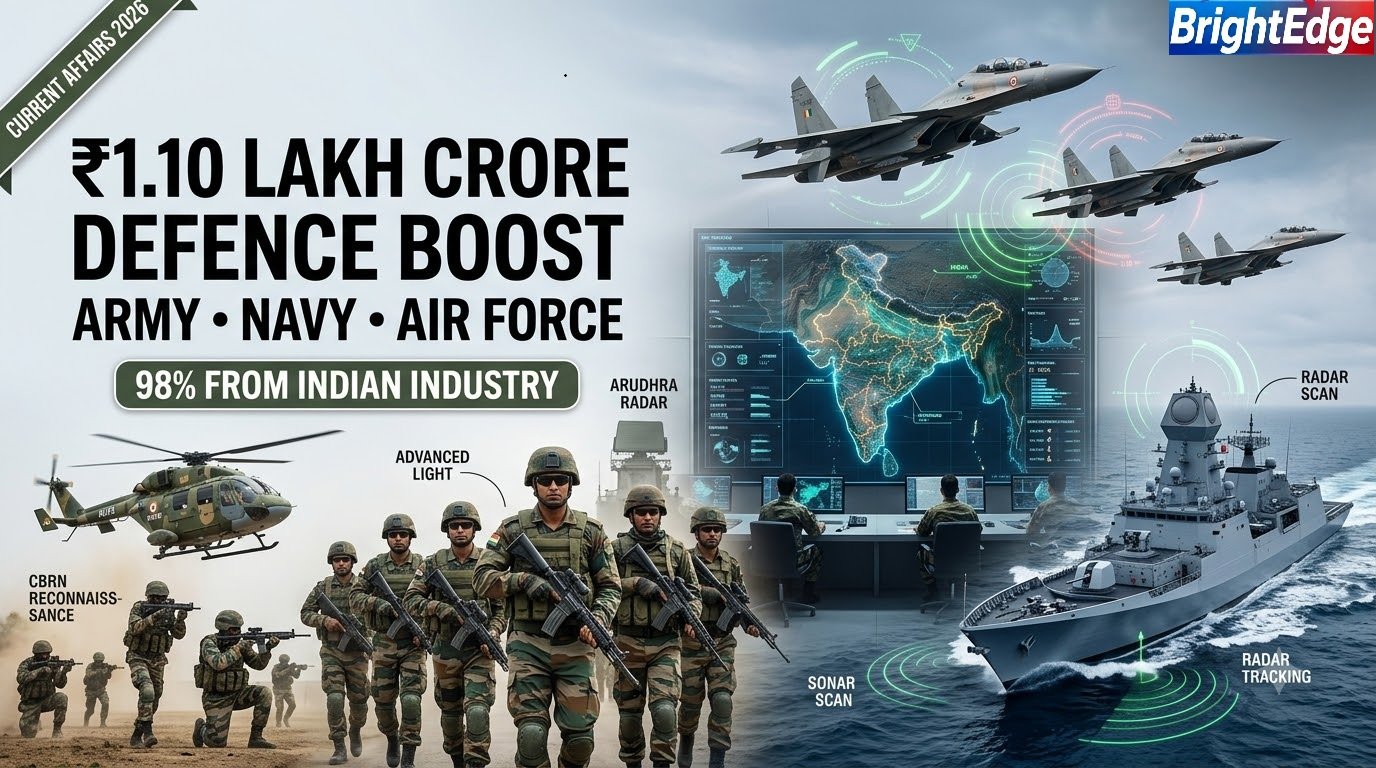
India has cleared a massive ₹1.10 lakh crore defence acquisition package aimed at strengthening the operational capabilities of the Indian Army, Indian Navy and Indian Air Force.
The Defence Acquisition Council (DAC), chaired by Defence Minister Rajnath Singh, granted Acceptance of Necessity (AoN)—the in-principle administrative approval for defence acquisitions—on 7 September 2026.
The biggest highlight is the strong domestic-manufacturing component: approximately 98% of the approved procurements are expected to be sourced from Indian industry.
The approvals cover a broad range of equipment, including CBRN reconnaissance vehicles, high-mobility vehicles, advanced light helicopters, mine-laying systems, Arudhra radars, marine gas turbines, electronic-warfare jammers and bridge systems.
Note: The Defence Acquisition Council (DAC) is the apex decision-making body of India’s Ministry of Defence for defence procurement and capital acquisitions. It was created in 2001 following the post-Kargil reforms of the national security system. The Council is chaired by the Union Defence Minister.
Acceptance of Necessity (AoN) is essentially the government’s in-principle administrative approval to proceed with a proposed defence acquisition.It is not the same as signing a final procurement contract.
🪖 Indian Army to Get Advanced Combat & Mobility Systems
The Indian Army has received approvals covering several systems designed to improve battlefield mobility, survivability and operational effectiveness.
Major Army acquisitions include:
- CBRN Recce Vehicles
- High Mobility Vehicles (HMVs)
- Self-Propelled Mechanical Mine Layers
- Advanced Light Helicopters (ALHs)
- Trawl Tanks
- Sarvatra Bridge Systems
The CBRN reconnaissance vehicles are intended to detect, identify, monitor and mark areas contaminated by chemical, biological, radiological or nuclear agents.
High Mobility Vehicles, meanwhile, are intended to strengthen logistics, mobility and operational capability, particularly in difficult terrain.
Why these systems matter
- Modern warfare increasingly requires forces to operate in complex environments where mobility, rapid deployment and battlefield awareness are critical.
- The combination of helicopters, high-mobility vehicles, mine-laying equipment and rapid bridging capability is therefore aimed at improving the Army’s ability to move personnel and equipment quickly while operating across challenging terrain.
⚓ Indian Navy Gets New Radars & Indigenous Marine Gas Turbines
The Indian Navy’s approved requirements include Arudhra radars and the design, development and subsequent procurement of Marine Gas Turbines (MGTs).
Arudhra Radar
- The Arudhra radar will replace existing air-route surveillance radars at various Naval Air Stations.
- This is expected to strengthen surveillance and air-traffic monitoring capabilities around naval aviation facilities.
Marine Gas Turbines
- The approval for the design and development of Marine Gas Turbines is particularly important from the perspective of defence indigenisation.
- Marine gas turbines are used for warship propulsion, and developing them domestically could help reduce India’s dependence on foreign suppliers for critical propulsion technology.
✈️ Indian Air Force to Receive Major Capability Upgrades
- The Indian Air Force is also included in the latest acquisition package.
- The approvals are aimed at enhancing the war-fighting capabilities of fighter aircraft, transport aircraft and helicopters.
- Among the important systems is the Ground-Based Multi-Purpose Jammer (GBMPJ).
- The system is designed to provide electronic jamming capabilities against adversary radars, adding another layer to India’s electronic-warfare capabilities.
- The approvals also include measures related to the modernisation of existing aircraft capabilities.
Sarvatra Bridge System: Faster Mobility Across Difficult Terrain
- The Sarvatra Bridge System is another important component of the Army’s approved requirements.
- Rapid bridging systems can allow military formations to cross obstacles and difficult terrain without waiting for permanent infrastructure.
98% Procurement From Indian Industry
- Perhaps the biggest economic and strategic message from the announcement is that approximately 98% of the procurements covered by the AoNs will be sourced from Indian industry.
- India’s defence modernisation strategy is increasingly moving beyond simply purchasing equipment.
- The focus is shifting toward: Design → Develop → Manufacture → Maintain → Export
- The latest approvals fit into this broader model.
- Domestic production of sophisticated military equipment can potentially strengthen India’s strategic autonomy while also creating a stronger industrial base.
🛡️ A Major Step Towards Defence Self-Reliance
India has been increasingly focusing on reducing its dependence on imported military equipment.
The latest DAC approvals reinforce this approach by placing a very high proportion of procurement with Indian industry.
The strategy has two objectives:
1. Strengthen military capability
India wants modern equipment for all three services.
2. Build a domestic defence ecosystem
India also wants the capability to design, develop and manufacture more sophisticated defence equipment domestically.
The Marine Gas Turbine development approval is particularly relevant to the second objective because it targets a critical propulsion technology.
Click Here To Read: Defence Council Clears Procurement of 114 Rafale Fighter Jets: Mother of All Defence Deals Explained
Air Marshal Tarun Chaudhry Assumes Charge as Air Officer Commanding-in-Chief, Central Air Command