

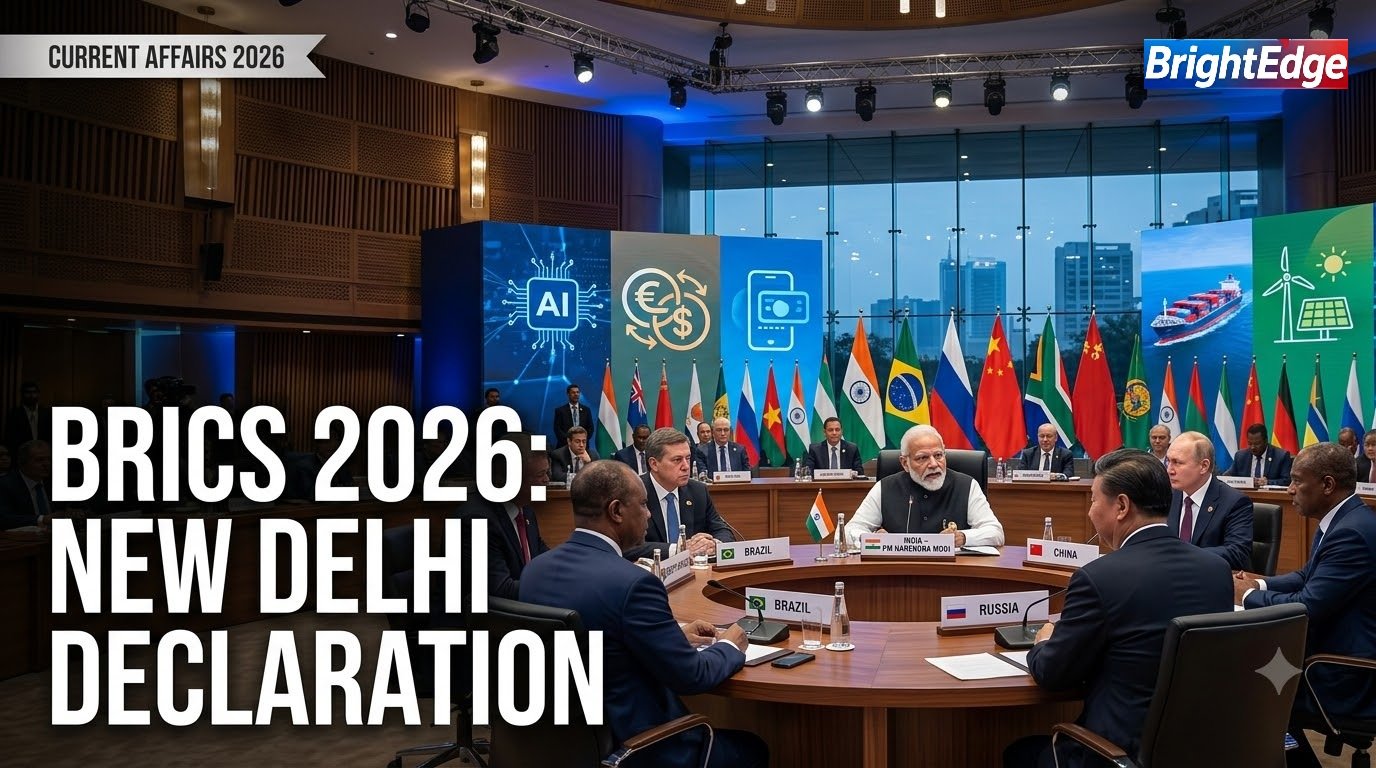
BRICS 2026 New Delhi Declaration: What Happened?
- The 18th BRICS Summit concluded in New Delhi on September 13, 2026, after leaders adopted the New Delhi Declaration 2026 during India’s BRICS Chairship.
- The summit was held under the theme “Building for Resilience, Innovation, Cooperation and Sustainability.” The declaration sets out cooperation across political and security affairs, economic and financial matters, and cultural and people-to-people exchanges.
- The declaration contains 140 paragraphs covering global governance, international trade, artificial intelligence, financial cooperation, climate change, energy, development finance, health, tourism and other areas.
Note: India’s Prime Minister, Narendra Modi congratulated China on becoming the next host of BRICS for 2027.
1. BRICS Pushes for More Inclusive Global Governance
- A major theme of the declaration is reform of global governance.
- BRICS leaders reiterated the importance of a more representative and equitable international system and called for greater participation of developing and emerging economies in global institutions.
- The declaration specifically discusses reforms involving institutions including the United Nations, IMF, World Bank and WTO. It also supports greater voice and representation for developing countries in international financial institutions.
- Prime Minister Narendra Modi, while addressing the summit, argued that the Global South should move from being a “rule-taker” to a “rule-shaper.”
2. Artificial Intelligence Gets a Major BRICS Push
- Artificial Intelligence is one of the most important technology-related themes in the declaration.
- BRICS leaders recognised AI’s potential to support economic growth and sustainable development while stressing the importance of safety, security, inclusiveness, reliability and international cooperation.
- The declaration also supports cooperation in AI science and innovation, trustworthy AI technologies and efforts to address potential risks associated with AI.
- The issue is particularly significant for India because the country hosted the AI Impact Summit in February 2026, which the declaration acknowledges as contributing to international cooperation on AI.
Why it matters
The BRICS AI agenda could encourage greater cooperation in:
- AI research
- Digital infrastructure
- AI governance
- Emerging technologies
- Data and technology capacity
- AI applications for development
3. BRICS Promotes Cross-Border Payments and Local Currencies
Financial cooperation remains another major focus.
The declaration acknowledges work by the BRICS Payment Task Force on improving cross-border payment mechanisms.
BRICS countries are continuing discussions on:
- Cross-border payment interoperability
- Payment and messaging channels
- Trade settlements
- Investments using local currencies
- Settlement and depositary infrastructure
Importantly, the declaration recognises that there is no one-size-fits-all approach and emphasises national priorities.
This means the 2026 declaration advances financial cooperation without announcing a common BRICS currency.
4. New Development Bank Gets Greater Importance
The New Development Bank (NDB) remains a key BRICS financial institution.
The declaration supports the NDB’s growing role in financing infrastructure and development projects across emerging markets and developing economies.
BRICS leaders encouraged the bank to:
- Mobilise more resources
- Expand local-currency financing
- Diversify funding sources
- Support sustainable infrastructure
- Promote economic integration
- Reduce inequalities
- Expand its membership
The declaration also welcomed the BRICS-NDB Knowledge Portal, launched under India’s 2026 Chairship, to facilitate the sharing of development experiences and policy innovations.
5. Climate Change and Sustainable Development
Climate action is another major pillar of the New Delhi Declaration.
BRICS reaffirmed its commitment to the UN Framework Convention on Climate Change (UNFCCC) and the Paris Agreement.
The declaration highlights challenges faced by emerging markets and developing economies, particularly:
- Climate vulnerability
- Adaptation financing
- Loss and damage
- Sustainable development
- Debt pressures
- Green finance
BRICS also backed cooperation on carbon markets and welcomed continued development of the BRICS Carbon Markets Partnership.
6. Energy Security and Smart Grids
The declaration links energy security with technology and digitalisation.
BRICS leaders recognised the potential of AI and advanced data analytics to improve:
- Power-grid management
- Renewable-energy integration
- Energy efficiency
- System planning
- Cyber resilience
The declaration also welcomed BRICS Guiding Principles on Smart Grids and Energy Storage and an Indian Chairship initiative concerning a BRICS Digital Centre of Excellence for Smart Grids and Energy Storage.
7. BRICS Addresses Conflicts and Global Security
The declaration expresses concern about conflicts, geopolitical tensions and increasing military spending.
BRICS leaders called for disputes to be addressed through dialogue, consultation and diplomacy and stressed the importance of protecting civilians and civilian infrastructure.
The declaration also expressed concern about nuclear risks and reaffirmed the importance of disarmament, arms control and non-proliferation.
The Middle East was particularly sensitive because BRICS includes countries with different positions and relationships in the region.
Reuters reported that the declaration called for maximum restraint amid escalating Middle East tensions while avoiding naming individual countries in that section.
8. Palestine and Gaza
The New Delhi Declaration contains substantial language concerning the Palestinian issue.
BRICS called for:
- A ceasefire and humanitarian access in Gaza
- Opposition to forced displacement of Palestinians
- Respect for international law
- Support for UNRWA
- Palestinian self-determination
- A two-state solution
- Full UN membership for Palestine
The declaration also called for respect for the legal and historical status of occupied Jerusalem and access to religious sites.
9. Trade, WTO Reform and Economic Cooperation
The declaration supports strengthening the multilateral trading system with the World Trade Organization at its core.
BRICS reiterated support for a trading system that is:
- Open
- Transparent
- Predictable
- Inclusive
- Non-discriminatory
- Rules-based
The declaration also addresses protectionist measures and trade barriers.
Economic cooperation remains structured around the Strategy for BRICS Economic Partnership, with India helping advance work toward the BRICS Economic Partnership 2030 framework.
10. Tourism, Cities, Women and People-to-People Cooperation
The declaration goes beyond geopolitics and finance.
BRICS highlighted tourism as an important source of:
- Employment
- Economic diversification
- Foreign exchange
- Local livelihoods
- Cultural exchange
- Sustainable development
It also welcomed cooperation on AI-enabled tourism, digital payments and sustainable tourism models.
Why the BRICS 2026 Declaration Matters for India
India’s 2026 BRICS Chairship placed strong emphasis on resilience, innovation, cooperation and sustainability.
The New Delhi Declaration brings together several areas that are directly relevant to India’s international and economic priorities:
- Global governance: Greater representation for emerging and developing economies.
- Technology: Cooperation on AI and emerging technologies.
- Finance: Cross-border payments, local currencies and development finance.
- Infrastructure: Greater role for the New Development Bank.
- Climate: Sustainable development and climate finance.
- Energy: Smart grids, storage and resilient energy systems.
- Trade: Strengthening multilateral trade institutions.
India’s BRICS presidency therefore placed both traditional diplomatic issues and emerging areas such as AI, digital finance and climate technology on the same agenda.
Click Here To Read: 18th BRICS Summit 2026: All Details and Significance