

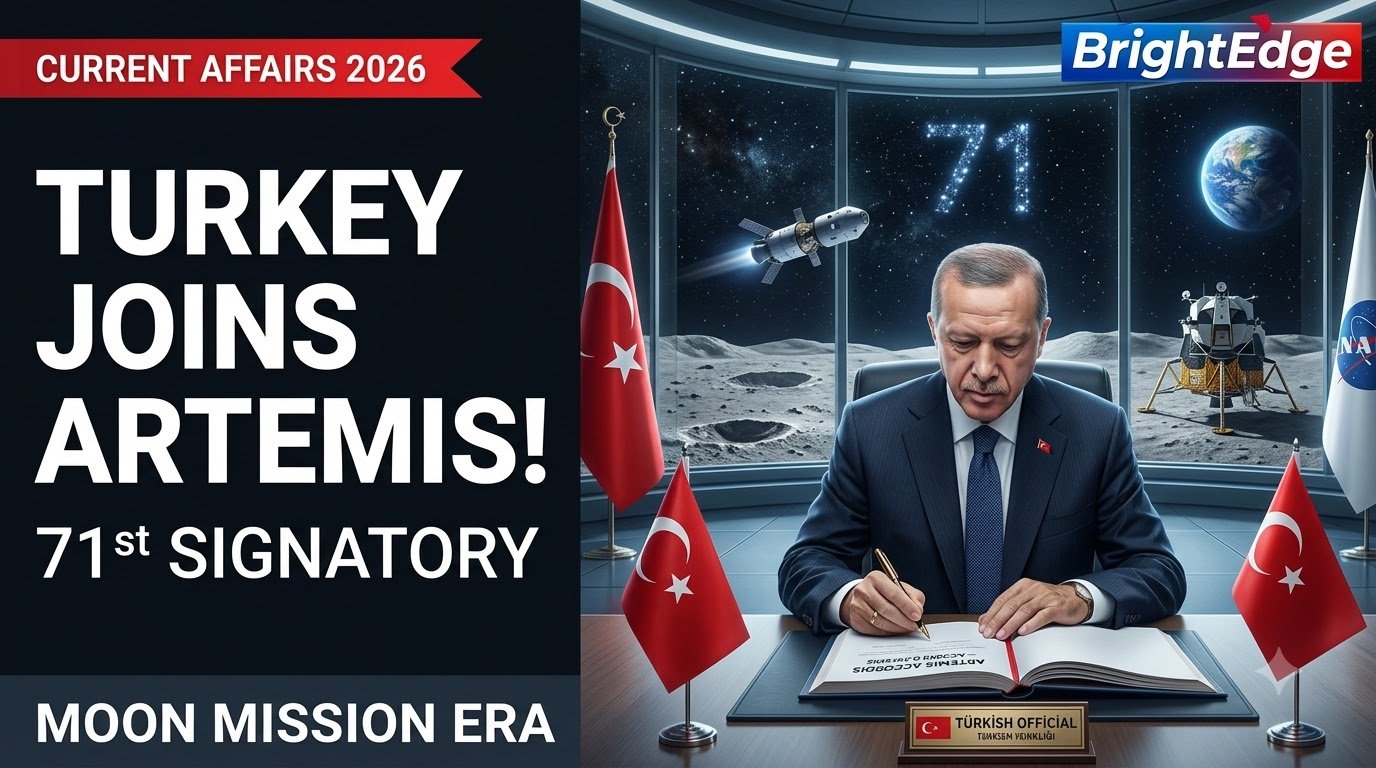
Türkiye has officially joined the Artemis Accords, becoming the 71st nation to sign the international framework for peaceful, transparent and responsible exploration of the Moon, Mars and beyond.
The agreement was signed during a ceremony at NASA Headquarters in Washington, where Turkish Minister of Industry and Technology Mehmet Fatih Kacır signed the Artemis Accords on behalf of Türkiye. NASA Administrator Jared Isaacman, Turkish Space Agency President Yusuf Kıraç and a U.S. Department of State official also participated in the ceremony.
The development comes as Türkiye expands its space programme and prepares for its first lunar mission, AYAP-1.
Turkey Becomes 71st Artemis Accords Signatory
- NASA formally welcomed Türkiye as the 71st signatory of the Artemis Accords on August 31.
- The milestone places Türkiye within an expanding international coalition focused on establishing common principles for civil space exploration.
- The Artemis Accords were established in 2020 by NASA, the U.S. Department of State and seven founding nations. They provide a framework intended to promote safe, peaceful, transparent and sustainable exploration of space.
- The number of signatories has grown rapidly in 2026. Serbia became the 69th signatory in July, Mauritius the 70th, and Türkiye the 71st.
🌙 What Are the Artemis Accords?
The Artemis Accords are a set of principles designed to guide international cooperation in civil space exploration.
They are closely associated with NASA’s Artemis programme and the broader effort to return humans to the Moon and develop sustained lunar exploration.
The principles include commitments to:
- Peaceful and transparent exploration
- Assistance to astronauts in distress
- Sharing scientific data
- Avoiding harmful interference between space activities
- Preserving historically significant lunar sites
- Mitigating orbital debris
- Responsible and sustainable space activities
NASA says the Accords reinforce existing international space-law commitments, including principles contained in the Outer Space Treaty.
🌍 A Rapidly Expanding Artemis Coalition
The Artemis Accords have expanded considerably since their creation in 2020.
The recent additions illustrate the increasingly global nature of the initiative.
| Milestone | Country | Signatory Number |
|---|---|---|
| June 2026 | Botswana | 68th |
| July 2026 | Serbia | 69th |
| July 2026 | Mauritius | 70th |
| August 2026 | Türkiye | 71st |
NASA’s official records confirm Türkiye’s signing as the 71st and latest signatory as of August 31, 2026.
Artemis Accords vs Artemis Programme: What’s the Difference?
These two terms are often confused.
Artemis Programme
NASA’s broader programme aimed at returning humans to the Moon and developing sustained lunar exploration, with longer-term ambitions extending toward Mars.
Artemis Accords
- A set of international principles governing cooperation and responsible behaviour in civil space exploration.
- Therefore, signing the Artemis Accords does not mean Türkiye has automatically joined NASA’s Artemis missions as a crewed partner.
- It means Türkiye has formally committed to the Accords’ principles and joined the growing group of signatories.
🌕 Turkey’s First Lunar Mission Is Coming
- One of the biggest reasons Türkiye’s Artemis Accords signing is attracting attention is its planned lunar mission.
- Türkiye is preparing to launch its first lunar mission, known as AYAP-1.
- NASA described Türkiye as joining the relatively small group of countries developing capabilities to send their own spacecraft to the Moon.
- The lunar programme could provide Türkiye with opportunities to develop expertise in:
- Satellite technology → Deep-space communications → Navigation → Lunar science → Space engineering
- The Artemis Accords could also provide an international framework for responsible cooperation as these capabilities develop.
Click Here to Read:
NASA Artemis II Launch: First Crewed Moon Flyby in 50 Years
Crew members of NASA’s Artemis II moon mission returned to Earth
NASA’s Anil Menon Set to Travel to International Space Station on July 14