

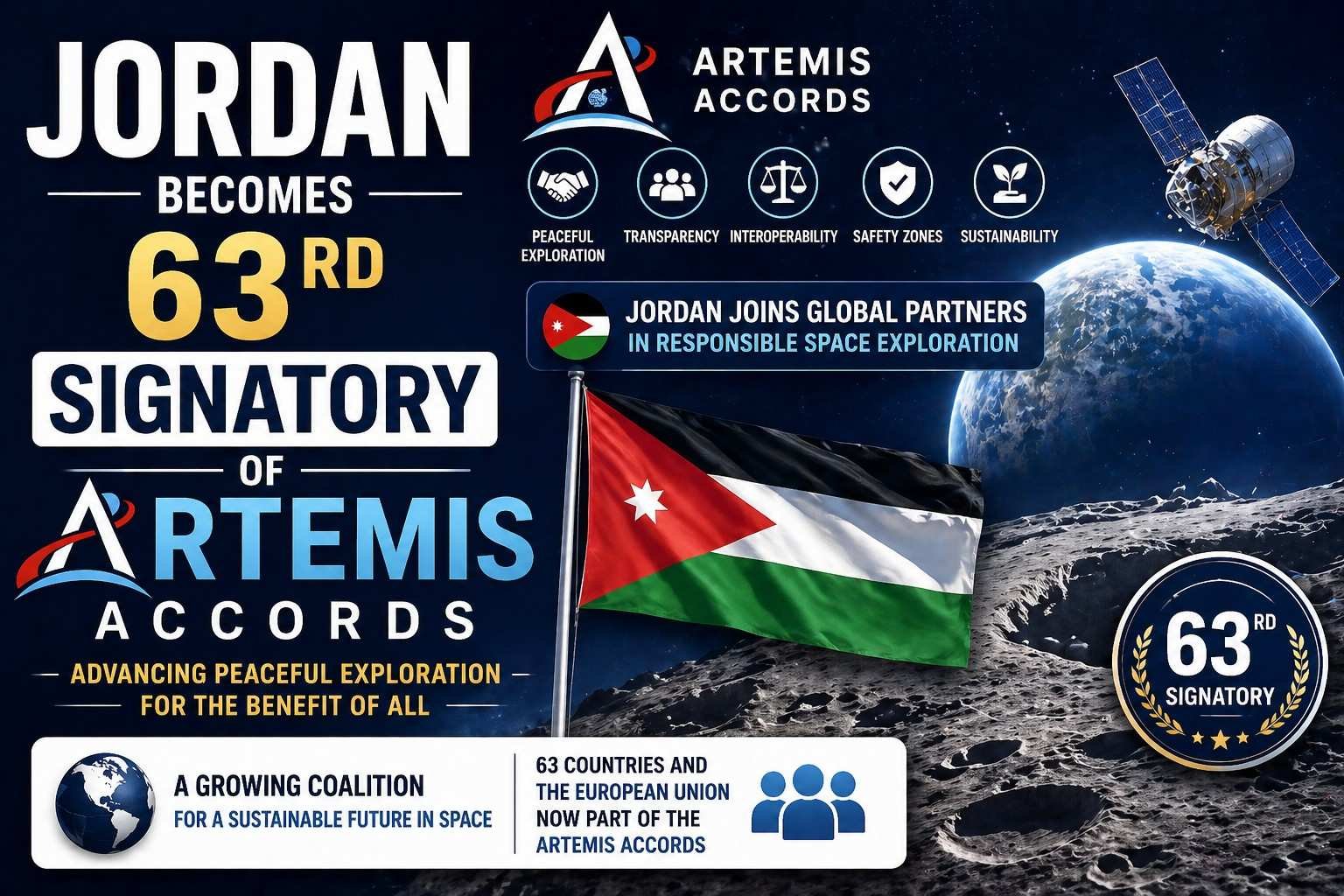
In a significant development in global space cooperation, Jordan has officially joined the Artemis Accords, becoming its 63rd signatory, according to NASA.
The agreement promotes peaceful, transparent, and cooperative exploration of the Moon, Mars, comets, asteroids, and beyond.
What are the Artemis Accords?
The Artemis Accords are a set of non-binding international principles designed to guide civil space exploration in the 21st century.
They were initially signed in October 2020.
The accords are co-led by:
- NASA
- The United States Department of State
They are based on the 1967 Outer Space Treaty.
Initial Signatories in 2020
The original eight countries were:
- Australia
- Canada
- Italy
- Japan
- Luxembourg
- United Arab Emirates
- United Kingdom
- United States
Countries Joining in 2026
Jordan is the fourth country to join the accords in 2026 after:
- Portugal – January 12
- Oman – January 26
- Latvia – April 20
10 Key Principles of the Artemis Accords
NASA outlines 10 major principles:
- Peaceful purposes
- Transparency
- Interoperability
- Emergency assistance
- Registration of space objects
- Release of scientific data
- Protecting heritage
- Utilization of space resources
- Deconfliction of activities
- Mitigating orbital debris and disposal of spacecraft
These principles promote responsible and cooperative space exploration.
Why This Matters
The Artemis Accords help establish a common political understanding among nations regarding outer space exploration and use.
It promotes:
- International cooperation
- Responsible use of space resources
- Reduction in space conflicts
- Safer future missions to Moon and Mars
Interesting Facts
- India is also a signatory of the Artemis Accords.
- The accords are non-binding but politically significant.
- They cover Moon, Mars, asteroids, and comets.
Conclusion
With Jordan becoming the 63rd signatory of the Artemis Accords, global cooperation in peaceful and transparent space exploration continues to grow. As more countries join, the framework may play a crucial role in shaping the future of lunar and Martian missions.