

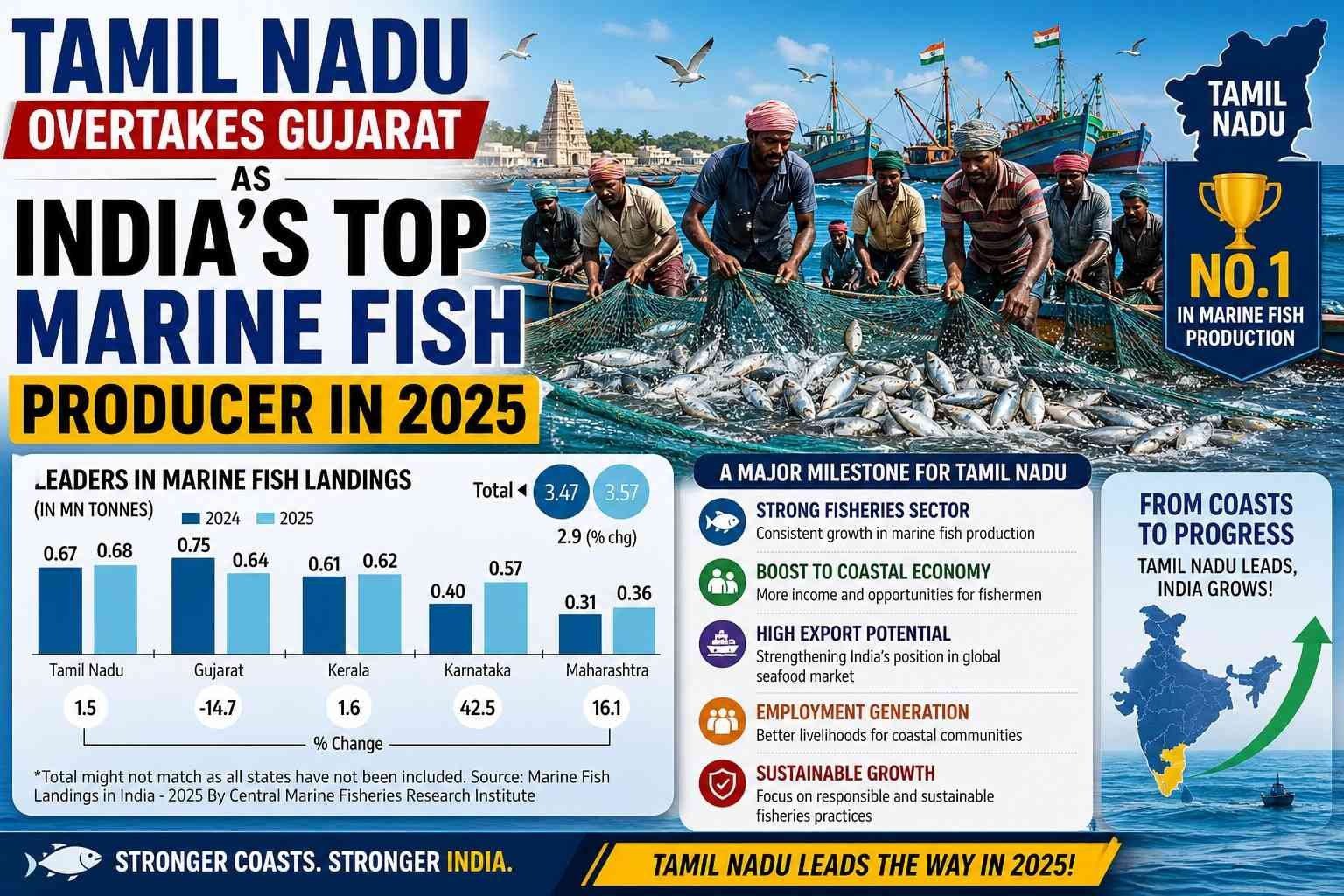
Tamil Nadu has overtaken Gujarat to become the largest marine fish producer in 2025, according to data released by the Central Marine Fisheries Research Institute, under the Indian Council of Agricultural Research.
Overall Marine Fish Production in India
- India’s total marine fish catch increased by 3%
- Reached 3.57 million tonnes in 2025
- Reflects steady growth in the fisheries sector
Why Gujarat Lost the Top Position
Despite being a consistent leader, Gujarat saw a sharp decline of ~15% in marine fish landings due to multiple disruptions:
- Adverse weather conditions (early season impact)
- Fishing bans, including mid-May restrictions under Operation Sindoor
- Extended ban period (60 to 75 days)
- Cyclonic disturbances, including Cyclone Shakti
- Reduced number of fishing days
These factors significantly impacted fishing activity along Gujarat’s coast.
Performance of Other States
- Kerala remained 3rd, with 0.62 million tonnes (↑ ~2%)
- Karnataka recorded a sharp 43% growth
- Maharashtra saw an increase of over 16%
Top Marine Fish Resources in India
- Indian Mackerel – 0.27 million tonnes (highest)
- Cephalopods – 0.25 million tonnes
- Oil Sardine – 0.25 million tonnes
Notably:
- Cephalopods grew by 25%
- Threadfin breams surged by 55% (decadal high)
Key Sector Insights
- Pelagic fish contributed 54% of total catch
- Strong growth seen in demersal fish, crustaceans, and molluscs
Economic Impact
- Value at landing centres: ₹69,254 crore (↑ 10.45%)
- Retail value: ₹97,702 crore (↑ 8.43%)
This indicates strong domestic demand and market expansion.
Why This Development Matters
This shift highlights:
- The impact of climate and weather risks on fisheries
- Importance of sustainable fishing policies
- Growing economic significance of marine fisheries
It also signals a regional rebalancing in India’s coastal economy, with Tamil Nadu emerging as a key player.
Conclusion
The rise of Tamil Nadu as India’s top marine fish producer reflects both opportunity and vulnerability in the fisheries sector. While overall production is growing, climate disruptions and regulatory factors are increasingly shaping outcomes across states.