

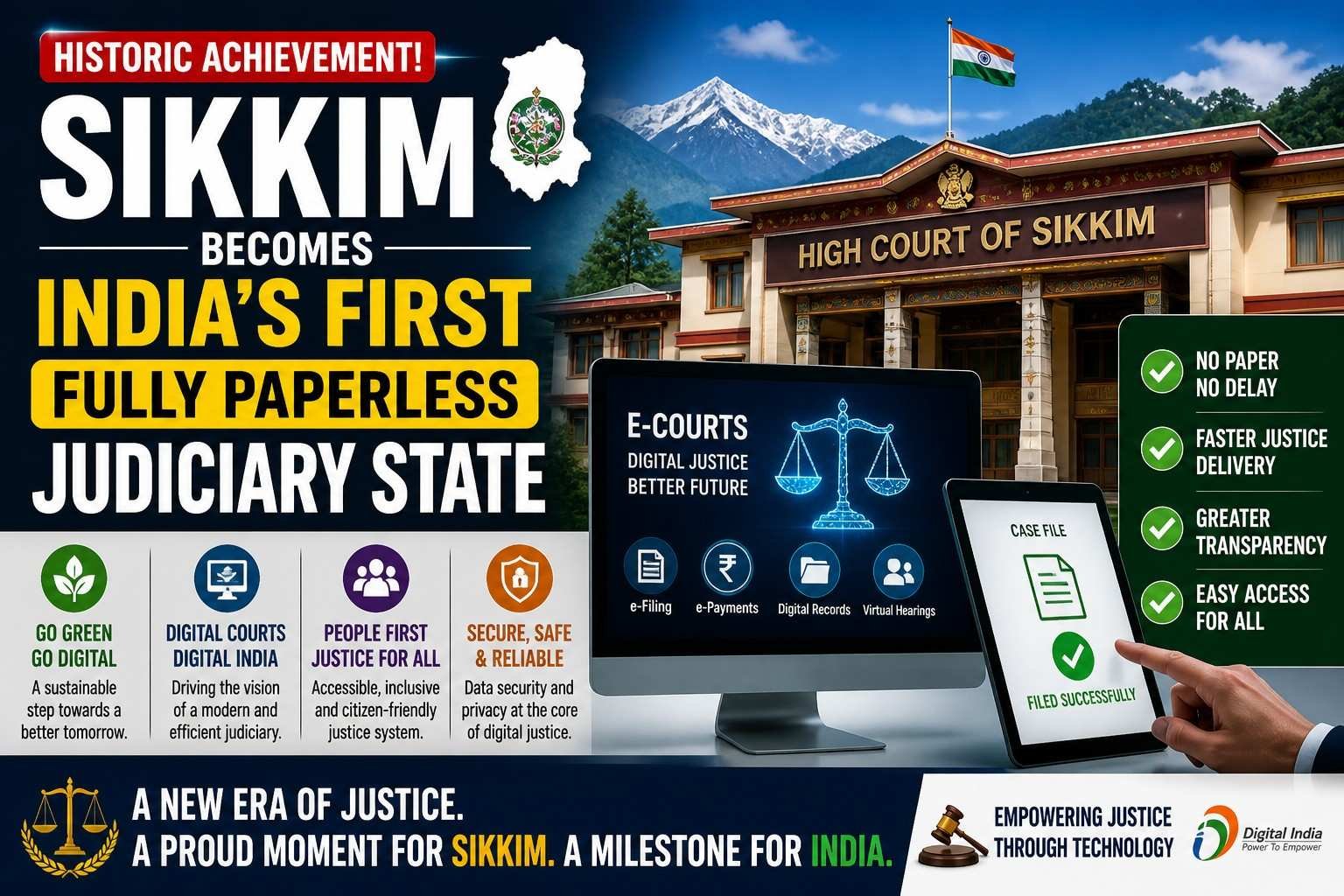
Sikkim has become the first state in India to implement a fully paperless judiciary system.
The announcement was made by Justice Surya Kant during the National Conclave on Technology and Judicial Education held in Gangtok.
What Does “Paperless Judiciary” Mean?
- E-filing of cases (no physical documents)
- Digital case records & documentation
- Virtual hearings and online proceedings
- Automated workflows for case management
This eliminates the need for physical paperwork in courts.
Key Highlights
- Declared at a national-level conclave organised by:
- High Court of Sikkim
- Sikkim Judicial Academy
- Marks a major milestone in India’s e-Courts mission
- Positions Sikkim as a leader in digital justice delivery
Role of Advanced Technology
India’s judiciary is increasingly integrating Artificial Intelligence (AI) tools:
- SUPACE → Legal research assistance
- SUVAS → Translation of judicial documents
These technologies help:
- Speed up case processing
- Improve accessibility (multi-language support)
- Enhance judicial efficiency
Benefits of a Paperless Judiciary
- Faster case disposal
- Reduction in case pendency
- Environment-friendly (less paper use)
- Better transparency & record management
- Improved access to justice (remote hearings)
Wider Significance
This development aligns with India’s push for:
- Digital India initiative
- Ease of doing business
- Judicial reforms through technology
It sets a replicable model for other states to modernise their court systems.
About Sikkim
- Sikkim is India’s least populous state.
- It became part of India in 1975
- Capital: Gangtok
- Governor: Om Prakash Mathur
- Chief Minister: Prem Singh Tamang
Conclusion
Sikkim’s transition to a fully paperless judiciary marks a transformational shift in India’s legal ecosystem. By leveraging digital tools and AI, the judiciary is moving toward a system that is faster, transparent, and citizen-friendly.