

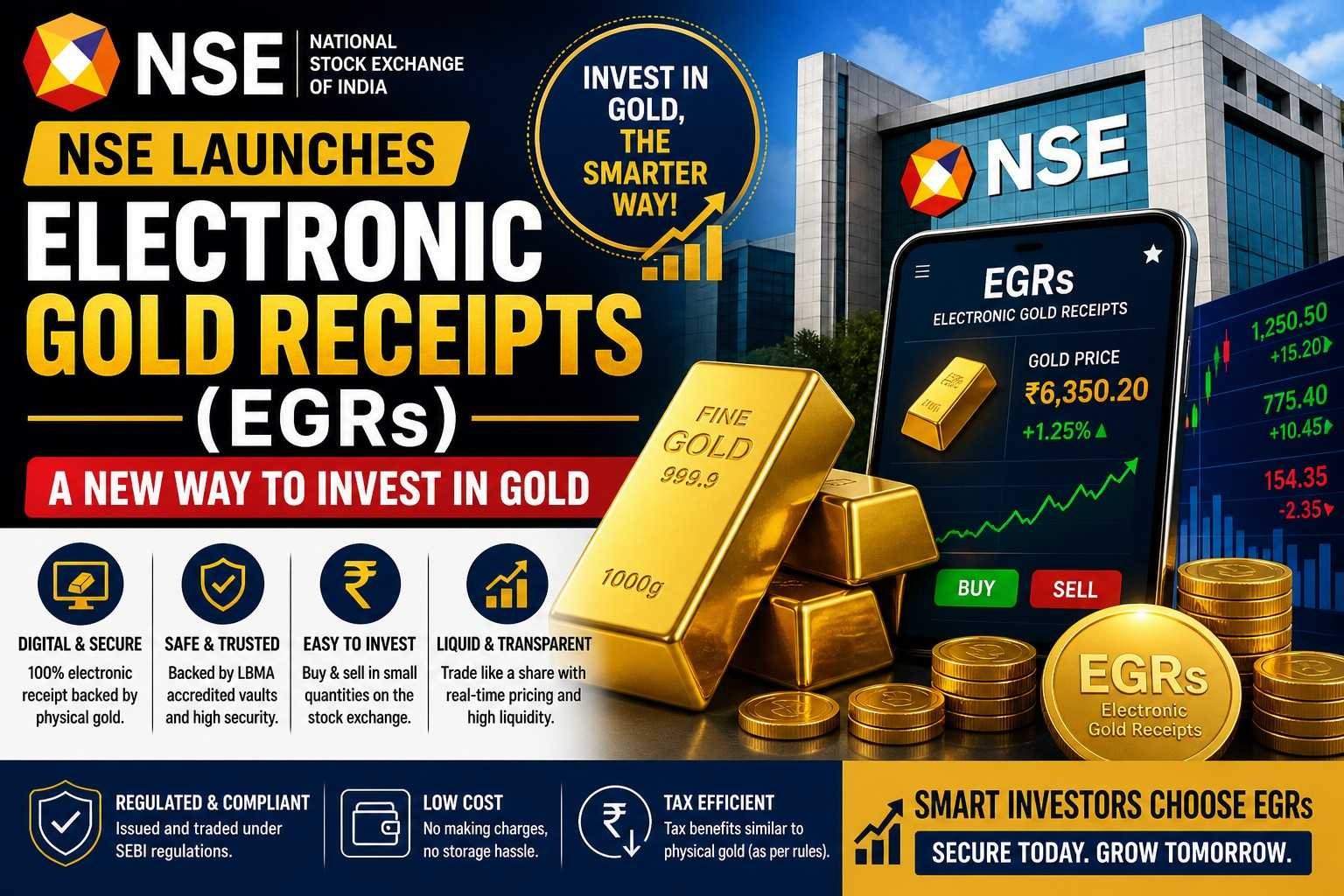
The National Stock Exchange of India has introduced Electronic Gold Receipts (EGRs)—a digital, secure, and exchange-traded way to invest in gold.
This innovation aims to bridge the gap between physical gold ownership and financial markets, making gold investment more accessible, transparent, and efficient.
What are Electronic Gold Receipts (EGRs)?
EGRs are digital certificates issued against physical gold stored in secure vaults managed by SEBI-accredited vault managers.
- They are dematerialised securities, just like shares
- Traded on the stock exchange similar to equities
- Each EGR represents a specific quantity and quality of gold
Recently, NSE successfully converted a 1000-gram gold bar into EGRs, marking the operational start of this system.
How Do EGRs Work?
- Physical gold is deposited with a regulated vault manager
- An equivalent Electronic Gold Receipt is issued in demat form
- Investors can buy/sell EGRs on the exchange
- If needed, investors can redeem EGRs for physical gold
Can You Take Physical Delivery?
Yes. Unlike many financial gold instruments:
- Investors can surrender EGRs
- Receive actual physical gold of equivalent quantity and purity
This makes EGRs a hybrid product—combining digital convenience with physical ownership.
Key Benefits of EGRs
1. No Storage Hassles
- Eliminates risk of theft, loss, or locker charges
2. Assured Purity
- Gold meets standards of:
- LBMA (London Bullion Market Association)
- BIS (Bureau of Indian Standards)
3. Easy Trading
- Buy/sell like shares on NSE
- High liquidity and flexibility
4. Small Investment Size
- Enables participation even with smaller denominations
5. Transparency & Regulation
- Fully regulated ecosystem under SEBI
Who Will Benefit?
EGRs create opportunities for:
- Retail investors (easy access to gold)
- Jewellers and refiners
- Institutional investors
- Traders seeking price discovery
They also act as a portfolio diversifier, especially during uncertain economic or geopolitical conditions.
EGR vs Gold ETF: Key Difference
| Feature | EGR | Gold ETF |
|---|---|---|
| Underlying Asset | Physical gold in vault | Fund investing in gold |
| Trading | On stock exchange | On stock exchange |
| Physical Delivery | Available | Usually not for retail |
| Structure | Direct ownership | Indirect (via fund) |
Why This Matters
India has a deep cultural and financial affinity for gold, but traditional investment comes with challenges like:
- Storage risks
- Purity concerns
- Illiquidity
EGRs solve these issues by combining:
- Safety of physical gold
- Convenience of digital trading
About NSE
- The National Stock Exchange of India (NSE) is India’s largest stock exchange and the world’s 5th largest by market capitalization.
- Founded: 27 November 1992; operations began in 1994.
- Headquarters: Bandra Kurla Complex, Mumbai, Maharashtra.
- CEO & MD: Ashishkumar Chauhan.
- Ownership: Various domestic and global financial institutions, banks, insurance companies, and individuals.
Conclusion
The launch of EGRs by NSE marks a transformational shift in gold investment in India. By integrating gold into the formal financial system, it offers investors a secure, flexible, and modern alternative to traditional gold buying.
As this ecosystem evolves, EGRs could become a key pillar of India’s commodity and financial markets.