

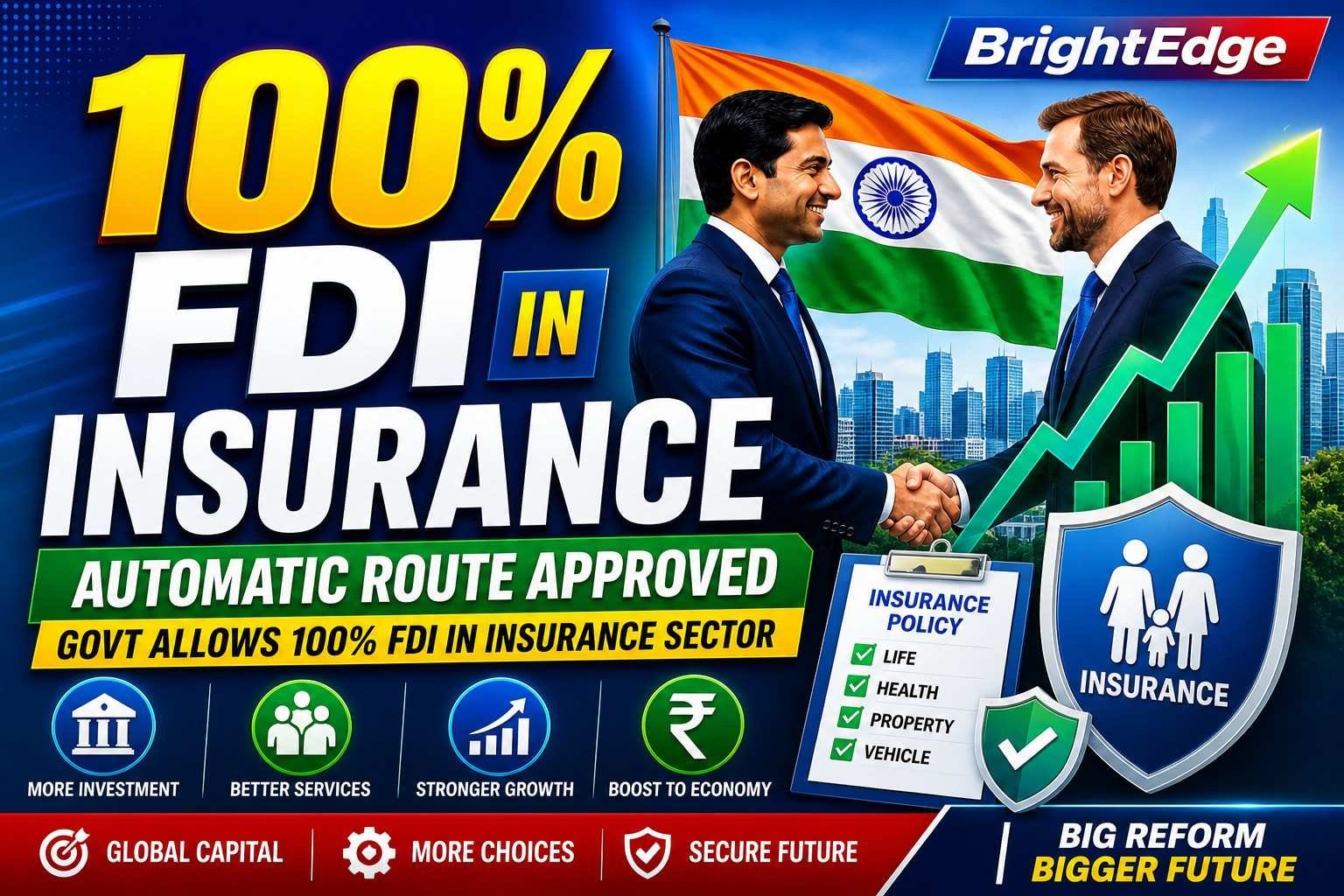
- The Government of India has notified 100% FDI in the insurance sector under the automatic route, marking a major reform aimed at boosting foreign investment and expanding the insurance market.
- Under the updated norms, insurance companies can now receive up to 100% FDI through the automatic route, removing the earlier cap of 74% and eliminating the need for prior government approval, subject to verification by the Insurance Regulatory and Development Authority of India (IRDAI).
- In contrast, LIC will continue to operate under a stricter 20% cap, governed by the LIC Act, 1956, and the Insurance Act, 1938.
- The notification also allows aggregate foreign holdings, including both FDI and portfolio investments, to reach up to 100% of the paid-up equity capital of an insurance company.
- At least one key managerial person, Chairperson, Managing Director, or CEO, must be a resident Indian citizen.
- Intermediaries with majority foreign ownership will be subject to similar leadership requirements, along with mandatory disclosures on payments made to related entities
What is FDI? (Foreign Direct Investment)
FDI (Foreign Direct Investment) means when a company or individual from one country invests money directly into a business or sector in another country with the intention of ownership, control, or long-term interest.
Types of FDI
- Greenfield Investment: Setting up a new company from scratch
- Brownfield Investment: Investing in or acquiring an existing company
FDI Routes in India
- Automatic Route:
- No prior government approval needed
- Faster and easier investment
- Government Route:
- Requires approval from the government
Why FDI is Important
- Brings foreign capital
- Transfers technology & expertise
- Creates jobs
- Boosts economic growth
What Has Changed?
- Earlier FDI cap: 74%
- Now allowed: 100% foreign investment
- Route: Automatic (no prior approval needed)
- Applies to: Insurance companies operating in India