

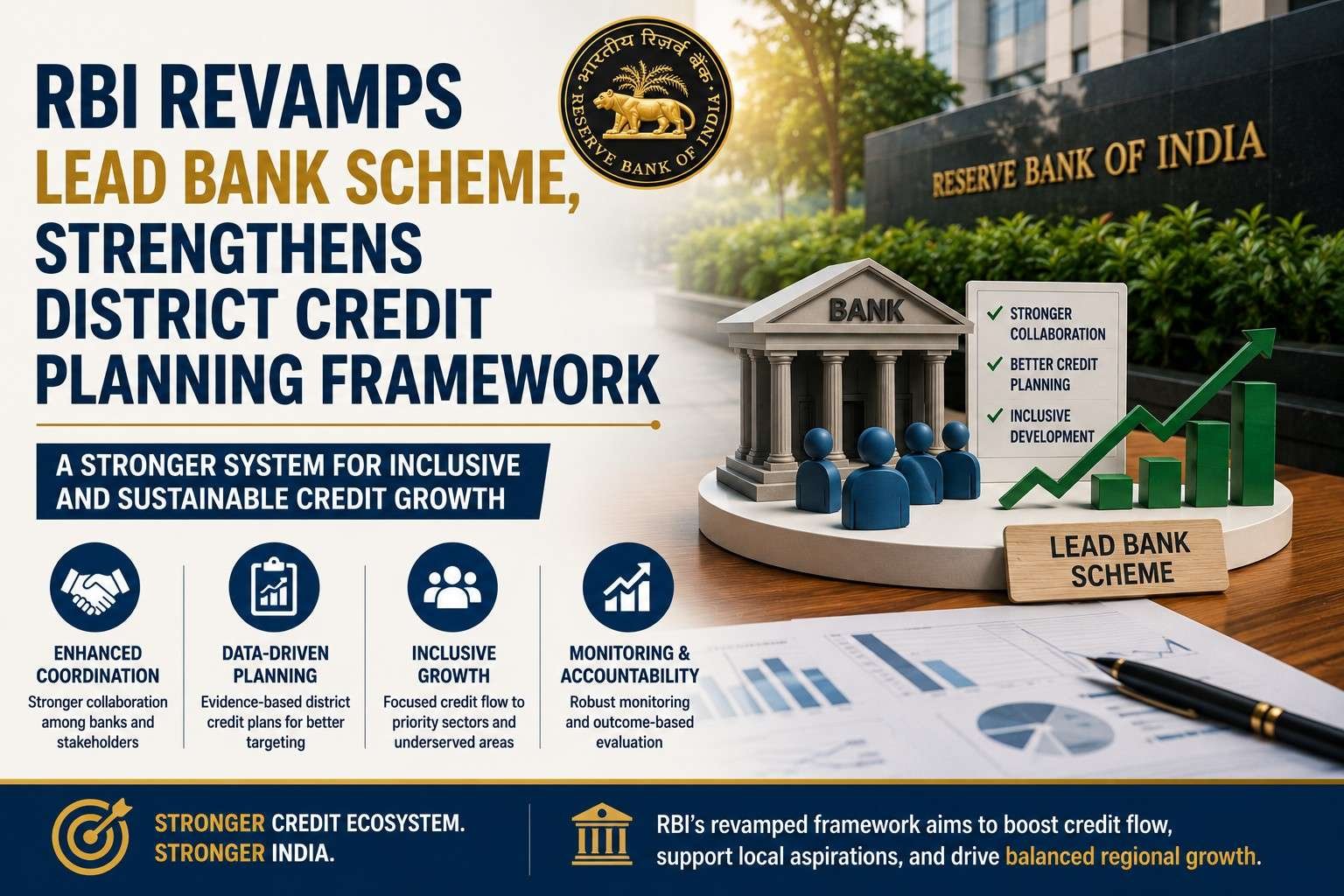
- The Reserve Bank of India (RBI) has issued revised guidelines for the Lead Bank Scheme (LBS), introducing significant changes to strengthen district-level banking coordination, improve credit delivery, and enhance financial inclusion across the country.
- The new framework replaces earlier instructions and aims to make district credit planning more effective and accountable.
What is the Lead Bank Scheme?
The Lead Bank Scheme was introduced in 1969 to ensure that banking services reach all parts of the country, especially rural and underserved areas.
Under this scheme:
- A designated bank acts as the Lead Bank for a district.
- The lead bank coordinates with other banks, government departments, and development agencies.
- It identifies local credit needs and promotes financial inclusion.
The revised framework modernizes this system to suit present-day banking requirements.
Dedicated Lead District Managers
One of the biggest changes introduced by RBI is the mandatory appointment of a dedicated Lead District Manager (LDM) for every district.
Key Guidelines
- One LDM should normally handle only one district.
- Multiple districts can be assigned only in exceptional circumstances.
- Banks must strengthen LDM offices with:
- Dedicated staff.
- Information technology infrastructure.
- Vehicles.
- Independent budgets.
This is expected to improve accountability and district-level coordination.
Block-Level Credit Planning Gets Formal Recognition
The RBI has formally recognized the role of the Block Level Bankers’ Committee (BLBC).
The BLBC will now:
- Prepare block-level credit plans.
- Review local credit requirements.
- Identify sector-specific opportunities.
These block plans will feed into:
- District Credit Plans.
- State Credit Plans.
This bottom-up approach aims to make credit planning more realistic and effective.
Uniform Timelines for Banking Committees
The RBI has introduced standard timelines for meetings of:
- Block Level Bankers’ Committees (BLBCs)
- District Consultative Committees (DCCs)
- District Level Review Committees (DLRCs)
- State Level Bankers’ Committees (SLBCs)
This will ensure Timely meetings, Faster decision-making, Better implementation.
Stronger Monitoring Systems
Lead District Managers and SLBC convenors have been directed to establish monitoring systems to ensure that decisions taken during meetings are implemented within specified timelines.
The objective is to improve:
- Accountability.
- Transparency.
- Follow-up actions.
Clear Roles for DCC and DLRC
The RBI has clearly differentiated between the two major district-level committees.
District Consultative Committee (DCC)
The DCC will function as:
- District coordination forum.
- Implementation body.
- Banking coordination platform.
District Level Review Committee (DLRC)
The DLRC will focus on:
- Reviewing credit flow.
- Assessing development activities.
- Gathering feedback from public representatives.
Members of Parliament, Members of Legislative Assemblies, and other representatives will participate in DLRC meetings.
State-Level Focus Areas
The RBI has directed State Level Bankers’ Committees (SLBCs) to focus on strategic issues related to:
- Priority sector lending.
- Financial inclusion.
- Agriculture.
- MSMEs.
- Digital payments.
Dedicated sub-committees may also be created for these sectors.
Virtual Meetings Allowed
Recognizing practical challenges, the revised framework permits virtual participation in meetings whenever physical attendance is difficult.
The new guidelines also mandate:
- Timely circulation of agenda papers.
- Prompt recording of minutes.
- Tracking of action taken reports.
This is expected to improve efficiency and participation.
Why This Reform Matters
The revised Lead Bank Scheme can help:
Improve Credit Flow
Better district-level planning can direct loans toward local economic needs.
Strengthen Financial Inclusion
Banks can identify unbanked and underserved areas more effectively.
Boost Priority Sectors
Agriculture, MSMEs, and weaker sections may receive greater credit support.
Enhance Accountability
Clear responsibilities and timelines can improve implementation.