

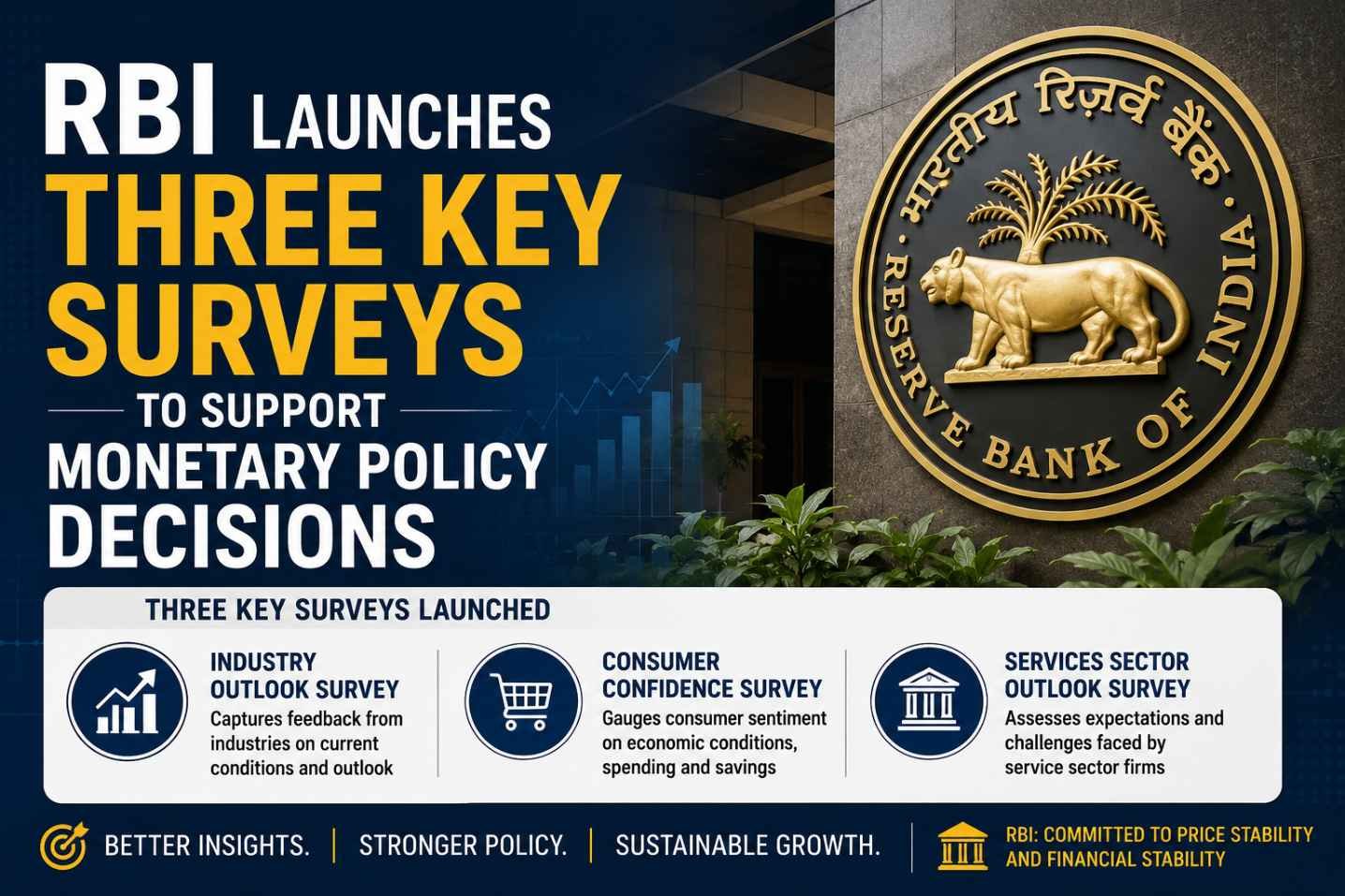
- The Reserve Bank of India (RBI) has launched three important nationwide surveys to collect critical information on inflation expectations, consumer confidence and economic conditions.
- The findings from these surveys will serve as valuable inputs for the Monetary Policy Committee (MPC) while deciding future interest rates and formulating monetary policy.
- The surveys aim to understand how households across urban, semi-urban and rural India perceive inflation, employment, income and spending trends, enabling the RBI to make more informed policy decisions.
Why Has RBI Launched These Surveys?
Monetary policy is most effective when it reflects the actual expectations and experiences of households.
Through these surveys, the RBI seeks to:
- Assess inflation expectations among consumers.
- Measure confidence in the economy.
- Track employment and income trends.
- Understand household spending behaviour.
- Improve the quality of monetary policy decisions.
The data collected helps the central bank evaluate demand conditions and inflationary pressures in the economy.
1. Inflation Expectations Survey of Households (IESH)
The Inflation Expectations Survey of Households (IESH) gathers information on how households expect prices to change in the near future.
Coverage
- Conducted across 19 cities.
What the Survey Measures
- General price movements.
- Prices of specific goods and services.
- Inflation expectations for the next three months.
- Inflation expectations for the next one year.
- Responses are based on each household’s own consumption basket.
Importance
Inflation expectations significantly influence consumer spending, savings and wage demands. If households expect higher inflation, they may alter their spending patterns, making it an important indicator for the RBI.
2. Rural Consumer Confidence Survey (RCCS)
The Rural Consumer Confidence Survey (RCCS) focuses on understanding the economic outlook of households in rural and semi-urban India.
Coverage
- Rural and semi-urban households across 31 States and Union Territories.
Areas Covered
The survey captures both the current situation and expectations for the next one year regarding:
- Overall economic conditions.
- Employment opportunities.
- Price levels.
- Household income.
- Household expenditure.
Importance
The survey provides insights into rural demand, which plays a crucial role in India’s overall economic growth and consumption.
3. Urban Consumer Confidence Survey (UCCS)
The Urban Consumer Confidence Survey (UCCS) measures the confidence levels of households living in urban areas.
Coverage
- Conducted in 19 cities.
Parameters Measured
The survey evaluates public perception regarding:
- Overall economy.
- Employment conditions.
- Price levels.
- Household income.
- Consumer spending.
Importance
Urban consumer confidence influences demand for housing, automobiles, consumer durables and other discretionary spending, making it an important indicator for economic activity.
How These Surveys Help Monetary Policy
The RBI’s Monetary Policy Committee considers several economic indicators before deciding on policy rates such as the Repo Rate.
The survey findings help policymakers understand:
- Future inflation trends.
- Consumer behaviour.
- Household confidence.
- Demand-side pressures.
- Economic sentiment across regions.
This information complements official economic data and enables evidence-based policy formulation.
Significance for the Economy
By collecting feedback directly from households, the RBI gains a clearer picture of ground-level economic conditions.
The surveys:
- Improve inflation forecasting.
- Strengthen monetary policy decisions.
- Enhance understanding of rural and urban consumption patterns.
- Support financial stability through better policy calibration.
These surveys also help the central bank monitor how previous policy decisions have influenced public expectations and economic behaviour.
Conclusion
The launch of the Inflation Expectations Survey of Households (IESH), Rural Consumer Confidence Survey (RCCS) and Urban Consumer Confidence Survey (UCCS) reflects the RBI’s continued emphasis on data-driven policymaking.
The insights generated through these surveys will play an important role in assessing inflation risks, consumer confidence and economic momentum, ultimately supporting the formulation of balanced and effective monetary policy for India’s growing economy.