

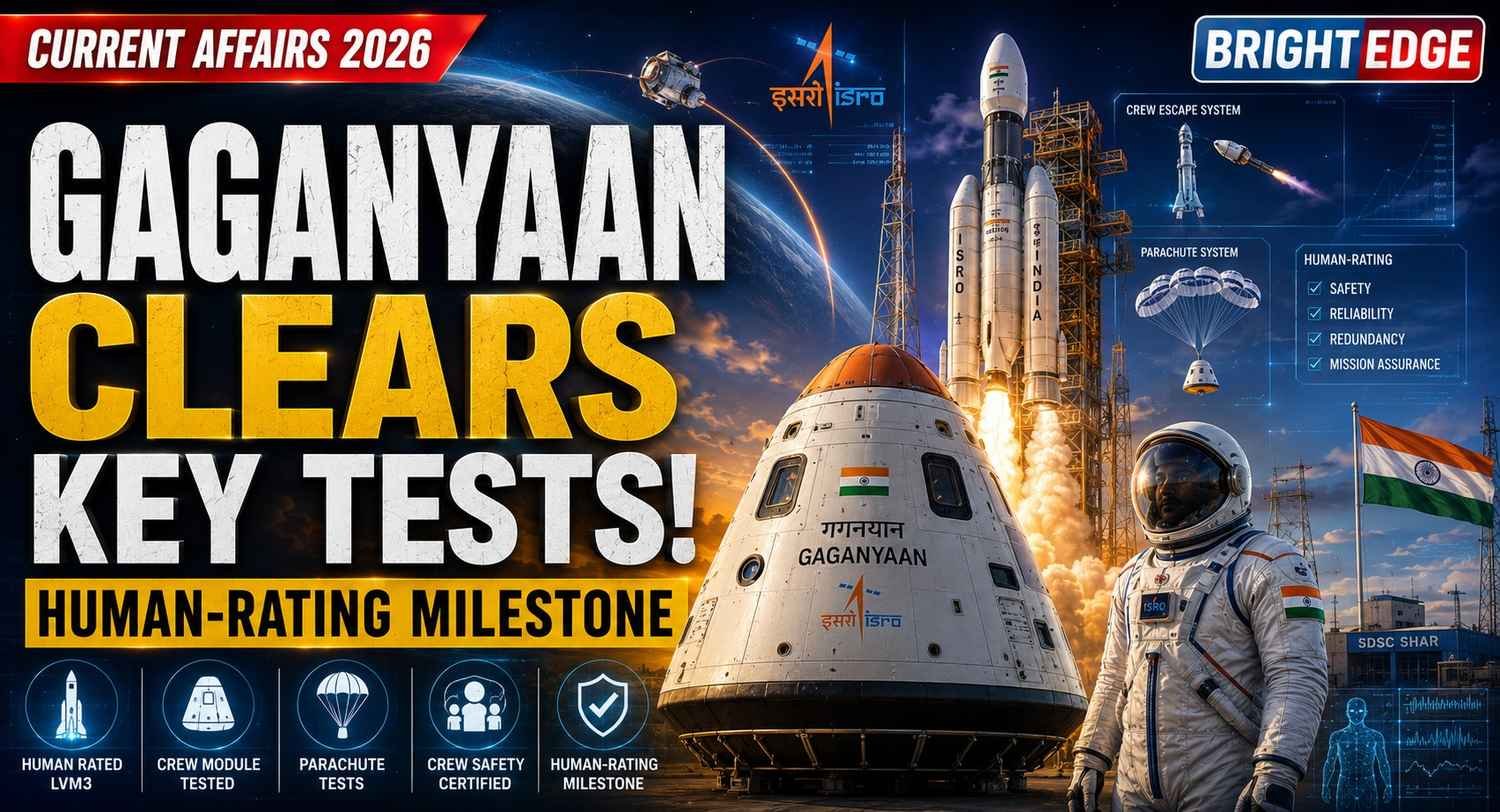
India’s ambitious Gaganyaan human spaceflight programme has moved another major step closer to reality, with ISRO achieving critical milestones required to make the mission safe for astronauts.
On August 6, 2026, Union Minister Jitendra Singh informed the Rajya Sabha that key human-rating milestones for Gaganyaan had been successfully achieved. Human rating is particularly important because a spacecraft carrying astronauts must meet significantly higher safety, reliability and redundancy requirements than an ordinary satellite-launch mission.
The latest progress comes after a series of important qualification tests conducted by the Indian Space Research Organisation (ISRO) during July 2026, including tests of the Crew Module’s flotation and separation systems, parachutes and launch-vehicle propulsion systems.
What is Gaganyaan?
- Gaganyaan is India’s human spaceflight programme designed to demonstrate the country’s capability to send Indian astronauts into low-Earth orbit and safely return them to Earth.
- The mission consists primarily of a Crew Module (CM) and a Service Module (SM). The Crew Module is designed to accommodate astronauts and incorporates crew interfaces, life-support systems, avionics, thermal protection and descent systems. The Service Module provides propulsion, power and other essential support while the spacecraft is in orbit.
- The programme places human safety at the centre of its design philosophy, with extensive testing of systems under normal as well as off-nominal conditions.
🔴 What Does “Human Rating” Mean?
Human rating means qualifying a launch vehicle and spacecraft to meet stringent requirements for carrying people.
For Gaganyaan, this involves demonstrating that critical systems can:
- Operate reliably during launch and flight
- Protect astronauts during emergencies
- Abort safely when necessary
- Maintain a habitable environment
- Survive atmospheric re-entry
- Decelerate safely during descent
- Enable safe recovery after splashdown
The standard is therefore considerably more demanding than simply demonstrating that a rocket can successfully launch an unmanned satellite.
🔥 Major Gaganyaan Milestones Achieved
1. Crew Module Uprighting System Tested
- One of the major July tests involved the Crew Module Up-righting System (CMUS).
- After splashdown in the sea, the Crew Module needs to reach and maintain an appropriate upright orientation so that crew-safety systems can function correctly.
- ISRO successfully conducted a float-inflation test using a stored cold-gas-based system designed to help upright the Crew Module after landing.
Why it matters:
A successful splashdown is not enough. The spacecraft must also remain in a safe orientation until recovery teams reach it.
2. Crew Module–Service Module Separation Tested
- ISRO also successfully conducted an umbilical separation test for the Crew Module-Service Module Connect & Disconnect System.
- This mechanism is important because different phases of the mission require the Crew Module and Service Module to separate correctly.
- A failure of a separation mechanism at the wrong stage could have serious consequences, making qualification testing essential before a crewed flight.
3. Crew Module Structural Qualification
- A further qualification test examined the Crew Module structure against loads associated with Apex Cover separation.
- Structural qualification ensures that the spacecraft can withstand expected forces without compromising the integrity of the crew compartment.
- Together, these three tests represented significant progress in qualifying the Crew Module’s systems.
🪂 Gaganyaan’s Parachute System Passes a Major Test
- Another major milestone came on July 7, 2026, when ISRO successfully conducted the Integrated Main Parachute Air Drop Test (IMAT) at the Aerial Delivery Research and Development Establishment drop zone in Sheopur, Madhya Pradesh.
- The Gaganyaan Crew Module’s deceleration system consists of 10 parachutes of four different types.
The sequence includes:
Apex Cover Separation Parachutes → Drogue Parachutes → Pilot Parachutes → Main Parachutes → Safe Splashdown
The July test specifically evaluated the main parachute’s structural integrity and design margins under the maximum expected load conditions associated with the first uncrewed Gaganyaan mission.
Why are parachutes so important?
- The spacecraft may travel at extremely high velocity during re-entry. Its speed must be reduced progressively before splashdown.
- Therefore, the parachute system is one of the most important components for bringing astronauts safely back to Earth.
🚀 Human-Rated Launch Vehicle: HLVM3
- Gaganyaan will use the Human Rated Launch Vehicle Mark-3 (HLVM3).
- The launcher is derived from India’s LVM3 platform but incorporates modifications and additional safety requirements needed for human spaceflight.
- ISRO has been qualifying its propulsion stages and structures for human-rating.
- A major recent development involved the CE20 cryogenic engine, which powers the upper stage of the LVM3. ISRO reported that human-rating qualification requirements had also been accomplished for the engine for Gaganyaan missions.
- On July 6, 2026, a flight-acceptance hot test of a CE20 engine was successfully conducted, including operation at 19.5-tonne thrust for 45 seconds and 22-tonne thrust for 25 seconds.
🛡️ Crew Escape System: A Critical Safety Layer
- Human spaceflight requires a way to protect astronauts if something goes seriously wrong during launch.
- Gaganyaan therefore incorporates a Crew Escape System (CES).
- The system is designed to rapidly move the Crew Module away from the launch vehicle during an emergency.
- ISRO has developed multiple types of motors for the Crew Escape System and has conducted static tests as part of its qualification programme.
The underlying principle is simple:
Launch emergency → Crew Escape System activates → Crew Module separates from launcher → Parachutes deploy → Controlled descent → Splashdown → Recovery
🧑🚀 Why These Tests Matter for India’s First Crewed Mission
Sending humans into space is fundamentally different from launching an unmanned spacecraft.
A satellite failure can result in the loss of an expensive payload. A crewed mission carries an even higher responsibility: human life.
Consequently, ISRO must demonstrate the reliability of interconnected systems covering:
| System | Main Purpose |
|---|---|
| HLVM3 | Launch astronauts into orbit |
| Crew Module | House and protect astronauts |
| Service Module | Propulsion, power and orbital support |
| Life Support | Maintain a habitable environment |
| Crew Escape System | Emergency astronaut protection |
| Thermal Protection | Protect spacecraft during re-entry |
| Parachutes | Slow spacecraft during descent |
| Uprighting System | Maintain safe orientation after splashdown |
| Recovery System | Retrieve astronauts after landing |
📌 Gaganyaan 2026: Key Current-Affairs Facts
Mission: Gaganyaan
Organisation: ISRO
Country: India
Mission type: Human spaceflight
Launch vehicle: Human Rated LVM3 (HLVM3)
Primary spacecraft: Crew Module + Service Module
Major 2026 tests: Crew-module qualification, parachute testing and propulsion qualification
Key objective: Demonstrate India’s capability for human spaceflight and safe astronaut recovery
ISRO’s programme also includes astronaut training infrastructure in Bengaluru covering classroom instruction, physical fitness, simulator training, flight-suit training, aero-medical training, recovery and survival training, and other mission-specific preparation.
🌍 What Gaganyaan Means for India
The importance of Gaganyaan extends beyond putting astronauts into orbit.
1. Human-spaceflight capability
It will demonstrate India’s ability to design, build, launch and recover a crewed spacecraft.
2. Advanced technology
The programme requires sophisticated developments in:
- Life-support systems
- Human-rated propulsion
- Crew escape technology
- Thermal protection
- Navigation and avionics
- Parachute systems
- Space medicine
- Recovery operations
3. Scientific ecosystem
The programme can strengthen India’s space-sector supply chain and create opportunities for universities, research institutions and private companies.
4. Future space-station ambitions
Human-spaceflight capability is also strategically important for India’s longer-term ambitions in crewed orbital missions and the proposed Bharatiya Antariksh Station.
🎯 What Happens Next?
The latest qualification achievements do not mean that Gaganyaan is already ready for its crewed launch.
Instead, they represent important steps in the larger qualification and validation process.
ISRO is continuing to test individual systems and integrate them into the overall mission architecture. The first uncrewed missions are particularly important because they allow ISRO to validate the complete mission chain before astronauts fly.
Recent tests—including parachute qualification, Crew Module systems testing and propulsion testing—are therefore building blocks toward the ultimate objective: a safe Indian human spaceflight mission.
More Upcoming Launches:
| Destination | Craft name | Launch vehicle | Year |
|---|---|---|---|
| Moon | Chandrayaan-4 | 2 × LVM3 | 2027 |
| Moon | LUPEX | H3 | 2028-29 |
| Venus | Venus Orbiter Mission | LVM3 | 29 March 2028 |
| Mars | Mars Lander Mission | LVM3 | NET 2030 |
Note:
- ISRO aims to put an Indian astronaut on the lunar surface by 2040.
- Gaganyaan mission team includes Group Captain Prasanth Balakrishnan Nair, Group Captain Ajit Krishnan, Group Captain Angad Pratap, and Wing Commander Shubhanshu Shukla.
Major Launch and Rocket Centers
- Satish Dhawan Space Centre (SDSC) SHAR (Sriharikota, Andhra Pradesh) – India’s primary orbital launch site.
- Vikram Sarabhai Space Centre (VSSC) (Thiruvananthapuram, Kerala) – The main hub for launch vehicle (rocket) development.
- India’s new major space centre is the Second Spaceport, currently under construction in Kulasekarapattinam, Thoothukudi district, Tamil Nadu.
About ISRO:
- The Indian Space Research Organisation (ISRO) is India’s national space agency.
- Headquartered in Bengaluru, Karnataka.
- Founded on August 15, 1969
- Founding Father: Dr. Vikram Sarabhai
- Parent Agency: Department of Space, Government of India
- Current Chairman: V. Narayanan (2026)