

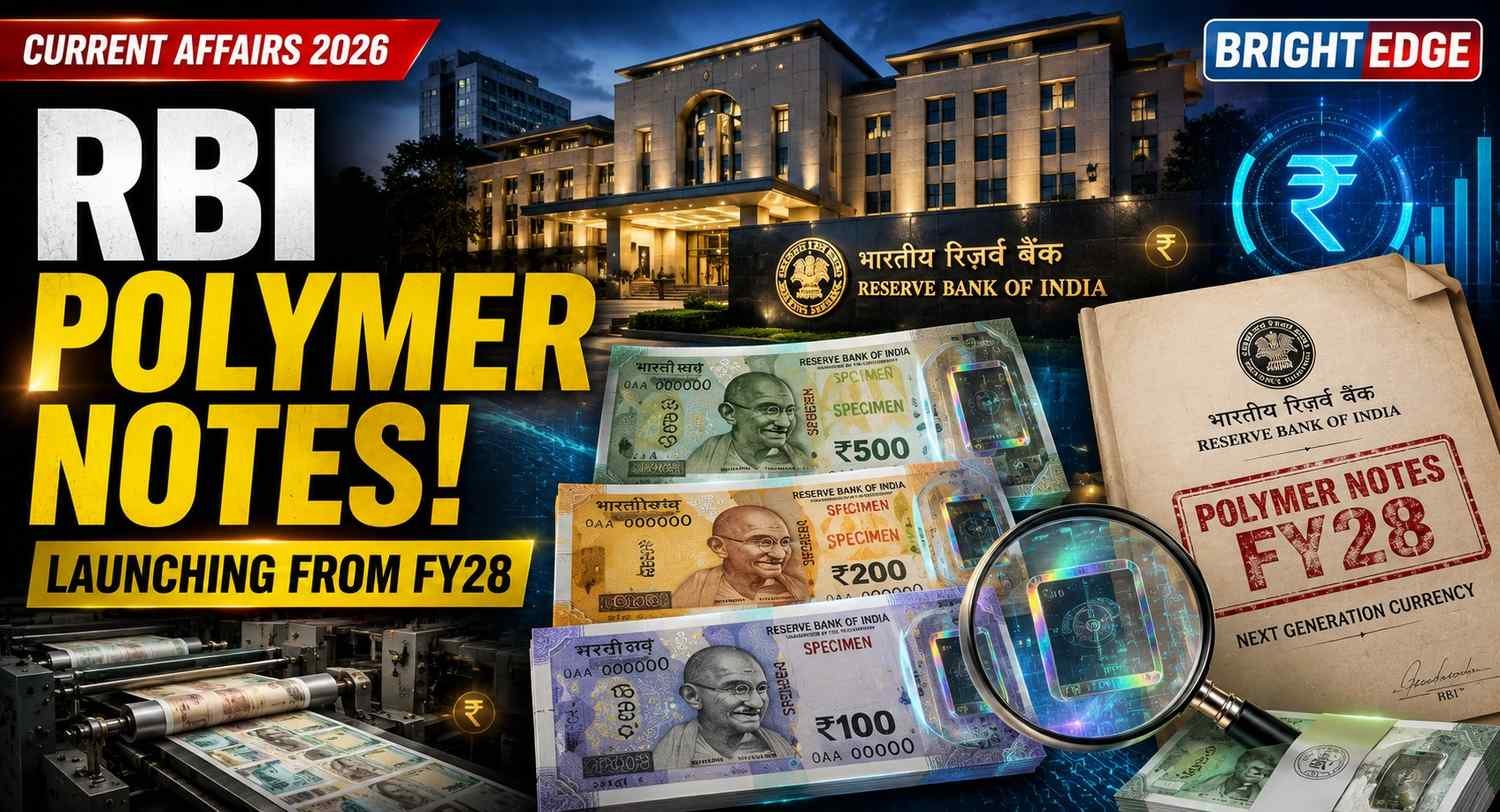
The Reserve Bank of India (RBI) is preparing to introduce polymer banknotes from the financial year 2027–28 (FY28) as part of its long-term strategy to modernize India’s currency system. Polymer notes are expected to be more durable, secure, cleaner, and resistant to counterfeiting than conventional cotton-paper banknotes.
The move places India among several countries that have already adopted polymer currency to improve note quality and reduce replacement costs.
Why is RBI Introducing Polymer Banknotes?
India prints billions of currency notes every year.
Paper notes often suffer from:
- Quick wear and tear
- Dirt accumulation
- Moisture damage
- Counterfeiting
- High replacement costs
Polymer notes aim to address these challenges by offering a longer lifespan and enhanced security features.
What are Polymer Banknotes?
- Polymer banknotes are made from a special plastic film called biaxially oriented polypropylene (BOPP) instead of cotton-based paper.
- Unlike ordinary plastic, polymer used in currency is highly durable, flexible, waterproof, and difficult to counterfeit.
Major Features of Polymer Notes
- Transparent security window
- Advanced holograms
- Colour-shifting inks
- Micro-lettering
- Raised printing for visually impaired persons
- UV fluorescent features
- Better resistance to dirt
- Waterproof surface
- Longer lifespan
- Improved durability
Benefits of Polymer Banknotes
1. Longer Life
Polymer notes typically last 2–4 times longer than paper notes.
2. Better Security
Advanced security features make counterfeiting significantly more difficult.
3. Waterproof
Polymer notes resist water damage, making them suitable for India’s diverse climatic conditions.
4. Cleaner Currency
Their smooth surface absorbs less dirt, bacteria, and moisture.
5. Lower Replacement Cost
Although initial production costs are higher, fewer replacements over time can reduce overall lifecycle costs.
6. Environment-Friendly
Longer circulation life means fewer notes need to be produced and destroyed.
Possible Challenges
- Higher manufacturing cost initially
- Requirement of new printing technology
- Public adaptation period
- ATM calibration updates
- Cash handling machine modifications
Countries Already Using Polymer Notes
Several countries have successfully adopted polymer currency, including:
- Australia
- Canada
- United Kingdom
- New Zealand
- Singapore
- Vietnam
- Romania
- Brunei
- Nigeria
- Mexico
Australia was the first country to introduce polymer banknotes nationwide.
Expected Impact on India
The introduction of polymer banknotes is expected to:
- Reduce counterfeit currency circulation
- Improve durability of Indian currency
- Enhance public confidence
- Lower long-term currency management costs
- Strengthen India’s currency security ecosystem
Will Existing Notes Become Invalid?
No. Existing paper banknotes are expected to remain legal tender until the RBI announces any phased replacement strategy. Polymer notes are likely to be introduced gradually.
Significance for Banking & Economy
The initiative aligns with India’s broader objectives of:
- Modernizing the financial system
- Strengthening currency security
- Improving cash management efficiency
- Reducing operational costs
- Supporting a robust payment ecosystem
Key Highlights
- RBI plans polymer banknotes from FY28.
- Polymer notes are made from durable plastic film.
- Longer lifespan than traditional paper notes.
- Enhanced anti-counterfeit security features.
- Waterproof and dirt-resistant.
- Lower replacement costs over time.
- Existing paper notes expected to remain valid during transition.
- India joins the global trend toward advanced currency technology.