

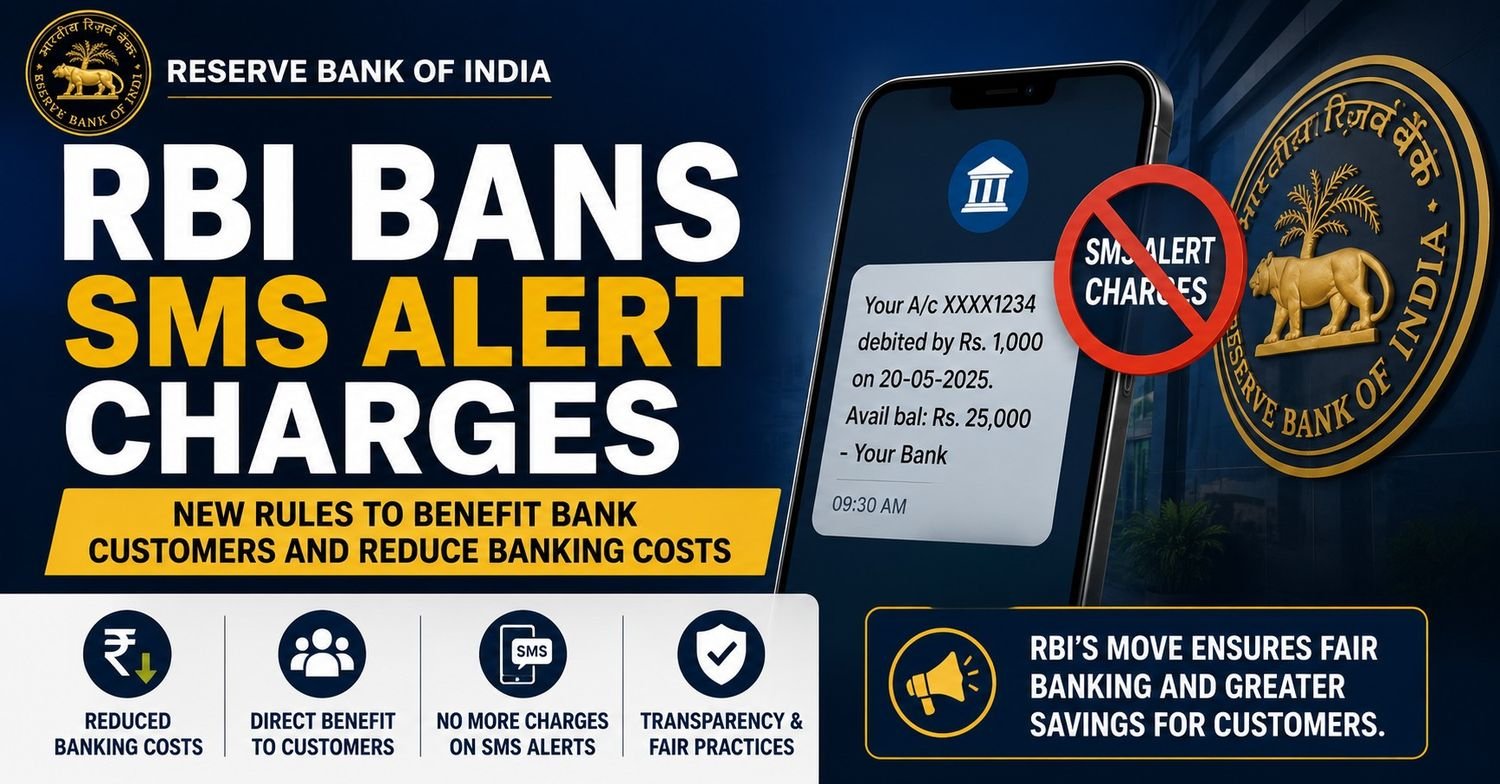
- The Reserve Bank of India (RBI) has introduced new customer-friendly guidelines prohibiting banks from charging customers separately for SMS alerts sent for regulatory, compliance, awareness and promotional purposes.
- The move is expected to provide relief to millions of bank customers while impacting banks’ fee income. According to industry estimates, lenders could collectively lose nearly ₹300 crore annually in SMS-related charges.
- The revised directions are also expected to accelerate the adoption of alternative digital communication channels such as mobile app notifications, WhatsApp and Rich Communication Services (RCS).
RBI Prohibits Separate Charges for Certain SMS Alerts
Under the revised directions issued on June 24, 2026, banks are no longer permitted to levy standalone charges for SMS alerts sent for:
- Regulatory compliance.
- Customer awareness.
- Service-related communication.
- Promotional information covered under the RBI guidelines.
Earlier, many banks charged customers around ₹15–18 per quarter for SMS alert services.
The RBI’s decision aims to strengthen customer protection and reduce unnecessary banking charges.
Banks May Lose Significant Fee Income
The removal of SMS alert charges is expected to reduce banks’ non-interest income.
Industry estimates suggest:
- A large bank with nearly 50 million fee-paying customers could lose hundreds of crores annually in SMS-related revenue.
- Across the banking sector, the overall impact could be around ₹300 crore in annual fee income.
While customers benefit directly, banks may need to absorb these costs or redesign their pricing strategies.
Banks May Recover Costs Through Other Channels
Although separate SMS alert charges are no longer allowed, banks may adjust their cost structures in other ways.
Possible alternatives include:
- Account maintenance charges.
- Minimum balance requirements.
- Package-based banking services.
- Other permissible service fees.
Any such charges would still need to comply with applicable RBI regulations and transparency requirements.
SMS Alerts Below ₹500 Become Optional
- Another important change under the revised framework is that banks are no longer required to send mandatory SMS alerts for transactions of ₹500 or below.
- Instead, sending alerts for these low-value transactions has become optional.
- This move is expected to significantly reduce the volume of commercial SMS traffic generated by banks.
Shift Towards Digital Notifications
The RBI has also allowed banks to use modern digital communication channels for transaction alerts below ₹500.
These include:
- Mobile app push notifications.
- In-app alerts.
- Google Rich Communication Services (RCS).
- WhatsApp notifications.
The flexibility is expected to improve customer engagement while reducing communication costs.
Large Banks Likely to Continue SMS Alerts
Despite the relaxation, several major private sector banks are expected to continue sending SMS alerts even for low-value transactions.
Banks with strong digital banking platforms may choose to maintain these alerts because they:
- Enhance customer experience.
- Improve fraud detection.
- Build customer confidence.
- Support transaction monitoring.
The decision will largely depend on each bank’s customer service strategy.
Impact on Telecom Companies
The RBI’s revised framework is expected to have a significant impact on telecom operators as well.
Since banking alerts account for a large share of commercial SMS traffic, optional alerts for transactions below ₹500 could substantially reduce message volumes.
The increasing use of:
- Push notifications.
- WhatsApp.
- RCS messaging.
may further reduce dependence on traditional SMS services over time.
Benefits for Customers
The revised rules are expected to provide several advantages:
- Lower banking charges.
- Greater transparency.
- More flexible communication options.
- Improved digital banking experience.
- Better customer protection.
The move aligns with the RBI’s broader objective of promoting customer-centric banking and digital innovation.
Conclusion
The RBI’s latest directions on SMS alert charges represent another important step towards enhancing customer protection in India’s banking system. While banks may experience a reduction in fee income and telecom operators could see lower SMS volumes, customers stand to benefit from reduced charges, greater transparency and more modern digital communication options.