

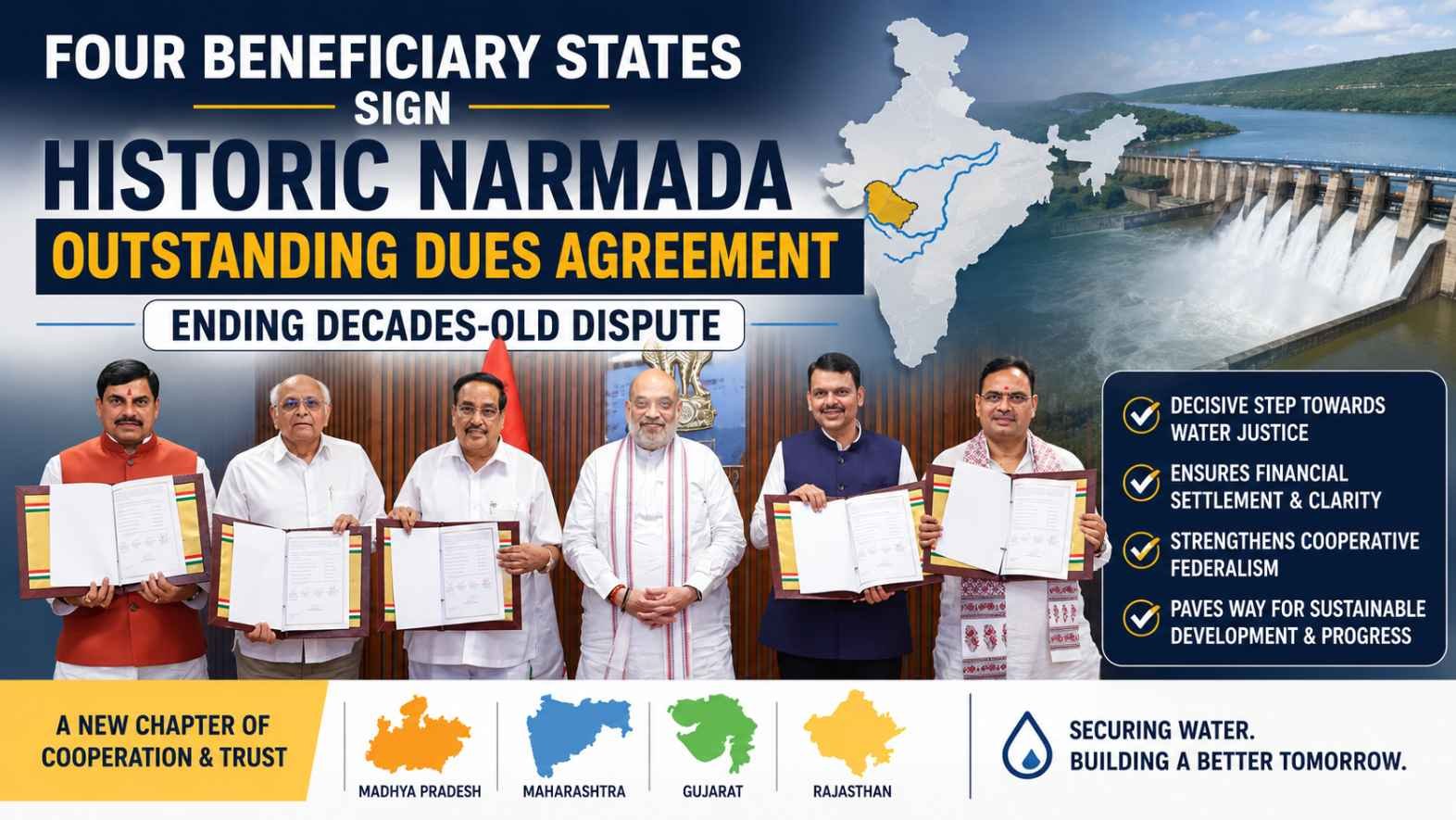
- In a major step towards strengthening cooperative federalism and resolving long-pending inter-state water issues, Gujarat, Madhya Pradesh, Maharashtra and Rajasthan have signed a historic agreement to settle outstanding dues related to projects under the Narmada Water Disputes Tribunal (NWDT) Award.
- The agreement was signed in New Delhi in the presence of Union Home Minister Amit Shah and Union Jal Shakti Minister C. R. Patil, bringing closure to financial disputes that had remained unresolved for decades.
Four States Sign Historic Agreement
The agreement was signed by the Chief Ministers of:
- Madhya Pradesh – Dr. Mohan Yadav
- Gujarat – Bhupendra Patel
- Maharashtra – Devendra Fadnavis
- Rajasthan – Bhajan Lal Sharma
Senior officials from the Central Government and the four participating states also attended the event.
According to the Ministry of Home Affairs, the agreement marks a significant milestone in resolving outstanding financial obligations linked to major Narmada basin projects.
What is the Narmada Water Disputes Tribunal (NWDT)?
The Narmada Water Disputes Tribunal (NWDT) was constituted by the Central Government in 1969 under the Inter-State River Water Disputes Act.
After extensive deliberations, the Tribunal delivered its Award in 1979, which determined:
- Water allocation among the four beneficiary states.
- Sharing of hydroelectric power generated from the Sardar Sarovar Project.
- Cost-sharing responsibilities for major Narmada projects.
While the Award settled water-sharing arrangements, several financial issues remained unresolved for decades.
Which Pending Issues Have Been Resolved?
The new agreement settles long-pending dues relating to:
- Cost-sharing for the Sardar Sarovar Project
- Cost-sharing for the Indira Sagar Project
- Resettlement and Rehabilitation (R&R) expenditure
- Compensation for submerged land
- Interest liabilities on project borrowings during construction
These outstanding issues had remained unresolved despite the operational success of the projects.
Significance of the Agreement
The Ministry of Home Affairs described the pact as a historic settlement that resolves decades-old financial disputes among the beneficiary states.
The agreement is expected to:
- Eliminate pending financial liabilities.
- Strengthen inter-state cooperation.
- Improve coordination in river basin management.
- Enhance cooperative federalism.
- Facilitate smoother implementation of future water resource projects.
Benefits of the Narmada Projects
The Home Minister highlighted the transformative impact of the Narmada projects across beneficiary states.
According to him:
- Water has reached drought-prone regions.
- Electricity generation has benefited multiple states.
- Agricultural productivity has improved.
- Farmers’ incomes have increased.
- Land values have appreciated in irrigated regions.
He particularly noted that although Rajasthan receives a relatively smaller share of Narmada waters, the areas supplied have witnessed remarkable economic transformation.
Role of Jal Shakti Ministry
Amit Shah also appreciated the efforts of Union Jal Shakti Minister C. R. Patil in facilitating dialogue and helping achieve consensus among the participating states.
The Ministry played a key role in coordinating negotiations and finalising the settlement.
Why This Agreement Matters
Inter-state river disputes often involve complex legal, financial and administrative challenges.
Resolving these long-pending dues:
- Removes uncertainty surrounding major infrastructure projects.
- Encourages cooperative governance.
- Improves financial transparency.
- Creates a stronger framework for future river management initiatives.
The agreement is also expected to strengthen confidence among states in resolving disputes through dialogue rather than prolonged litigation.
Conclusion
The signing of the Narmada Outstanding Dues Agreement marks the successful resolution of one of India’s longest-pending inter-state financial disputes linked to river development projects. By settling decades-old liabilities associated with the Sardar Sarovar and Indira Sagar projects, Gujarat, Madhya Pradesh, Maharashtra and Rajasthan have demonstrated the importance of cooperative federalism in addressing complex water resource challenges and ensuring sustainable development for millions of people dependent on the Narmada basin.