

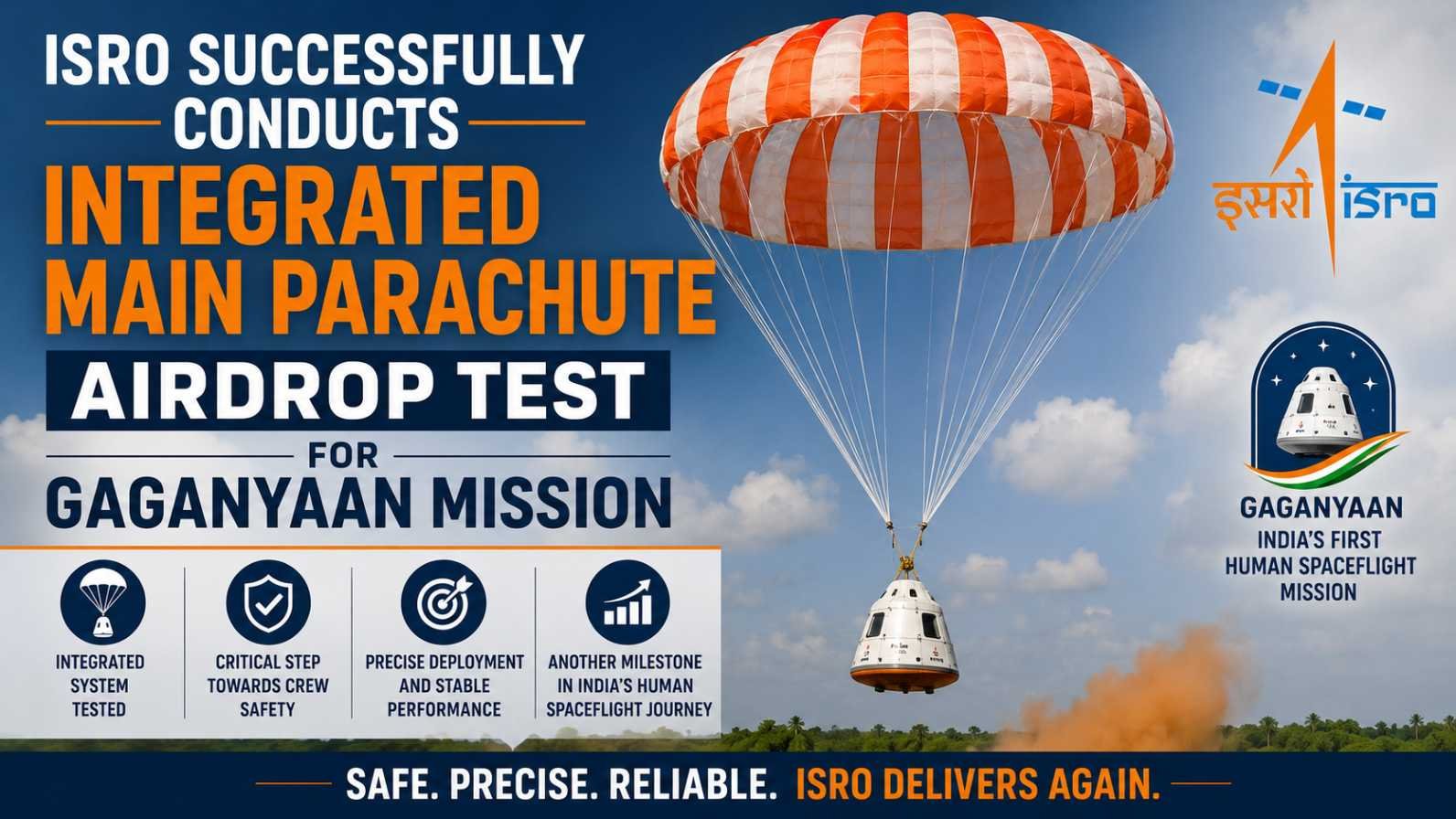
- The Indian Space Research Organisation (ISRO) has achieved another major milestone in India’s first human spaceflight programme by successfully conducting the Integrated Main Parachute Airdrop Test (IMAT-05) for the Gaganyaan Mission. The successful test validates one of the most critical systems responsible for ensuring the safe return of astronauts to Earth.
- Conducted at the Aerial Delivery Research and Development Establishment (ADRDE) drop zone in Sheopur, Madhya Pradesh, the test marks a significant step toward the country’s first uncrewed Gaganyaan G1 Mission.
Critical Test for Safe Astronaut Landing
- The objective of the Integrated Main Parachute Airdrop Test was to verify the structural integrity, performance, and design margins of the Main Parachute under maximum expected load conditions that the Crew Module will experience during its descent.
- The successful completion of IMAT-05 provides ISRO with greater confidence in the reliability of the parachute recovery system that will safely bring astronauts back to Earth after their mission.
Test Conducted Using Indian Air Force IL-76 Aircraft
- During the trial, a simulated payload consisting of a single main parachute assembly attached to a dummy mass was dropped from an altitude of approximately 2.5 kilometres.
- The payload was released from an Indian Air Force IL-76 transport aircraft, replicating the conditions expected during the actual recovery phase of the Gaganyaan mission.
Complex Multi-Stage Descent Successfully Demonstrated
The parachute deployment followed a carefully planned sequence designed to ensure stability and controlled descent.
The sequence included:
- An Extractor Parachute initiating deployment.
- A Drogue Parachute stabilising the falling payload and reducing oscillations.
- Deployment of the Main Parachute once the required conditions were achieved.
- Controlled deceleration of the payload to a safe terminal velocity before landing.
This successful sequence confirmed the effectiveness of the integrated recovery system under operational conditions.
Gaganyaan Crew Module Uses 10 Parachutes
ISRO’s Gaganyaan Crew Module features an advanced 10-parachute deceleration system, designed to ensure maximum safety during splashdown.
The recovery sequence includes:
1. Apex Cover Separation
- 2 Apex Cover Separation Parachutes
- Remove the protective cover from the parachute compartment.
2. Stabilisation Phase
- 2 Drogue Parachutes
- Stabilise and slow the Crew Module after atmospheric re-entry.
3. Main Recovery Phase
- 3 Pilot Parachutes
- Extract the Main Parachutes.
4. Final Landing
- 3 Main Parachutes
- Reduce the Crew Module’s descent speed for a safe splashdown in the sea.
This multi-layered recovery system ensures redundancy and enhances astronaut safety during the final stage of the mission.
Fifth Successful Integrated Test
The latest trial was the fifth Integrated Main Parachute Airdrop Test (IMAT-05) conducted by ISRO as part of the qualification programme for the Gaganyaan Mission.
Each successive test validates different operational scenarios and strengthens confidence in the overall recovery system before the first uncrewed flight.
Why This Test Matters
The parachute recovery system is one of the most critical components of any human spaceflight mission.
A successful deployment ensures that:
- Astronauts experience safe deceleration.
- The Crew Module remains stable during descent.
- Splashdown occurs within safe landing parameters.
- Recovery teams can quickly retrieve the Crew Module from the sea.
The successful IMAT-05 significantly reduces technical risks associated with the mission.
About the Gaganyaan Mission
- Gaganyaan is India’s first indigenous human spaceflight programme being developed by ISRO.
- The mission aims to demonstrate India’s capability to safely send astronauts into low Earth orbit and bring them back safely using an entirely indigenous spacecraft and recovery system.
- Before the crewed mission, ISRO will conduct a series of uncrewed demonstration missions, beginning with Gaganyaan G1, to validate all critical onboard systems, including life support, navigation, propulsion, escape mechanisms, and recovery technologies.
A Major Step Towards India’s Human Spaceflight Dream
The successful completion of the Integrated Main Parachute Airdrop Test marks another significant achievement in India’s ambitious human spaceflight programme.
With every successful qualification test, ISRO moves closer to launching the Gaganyaan mission, which will place India among the select group of nations capable of independently sending humans into space.