

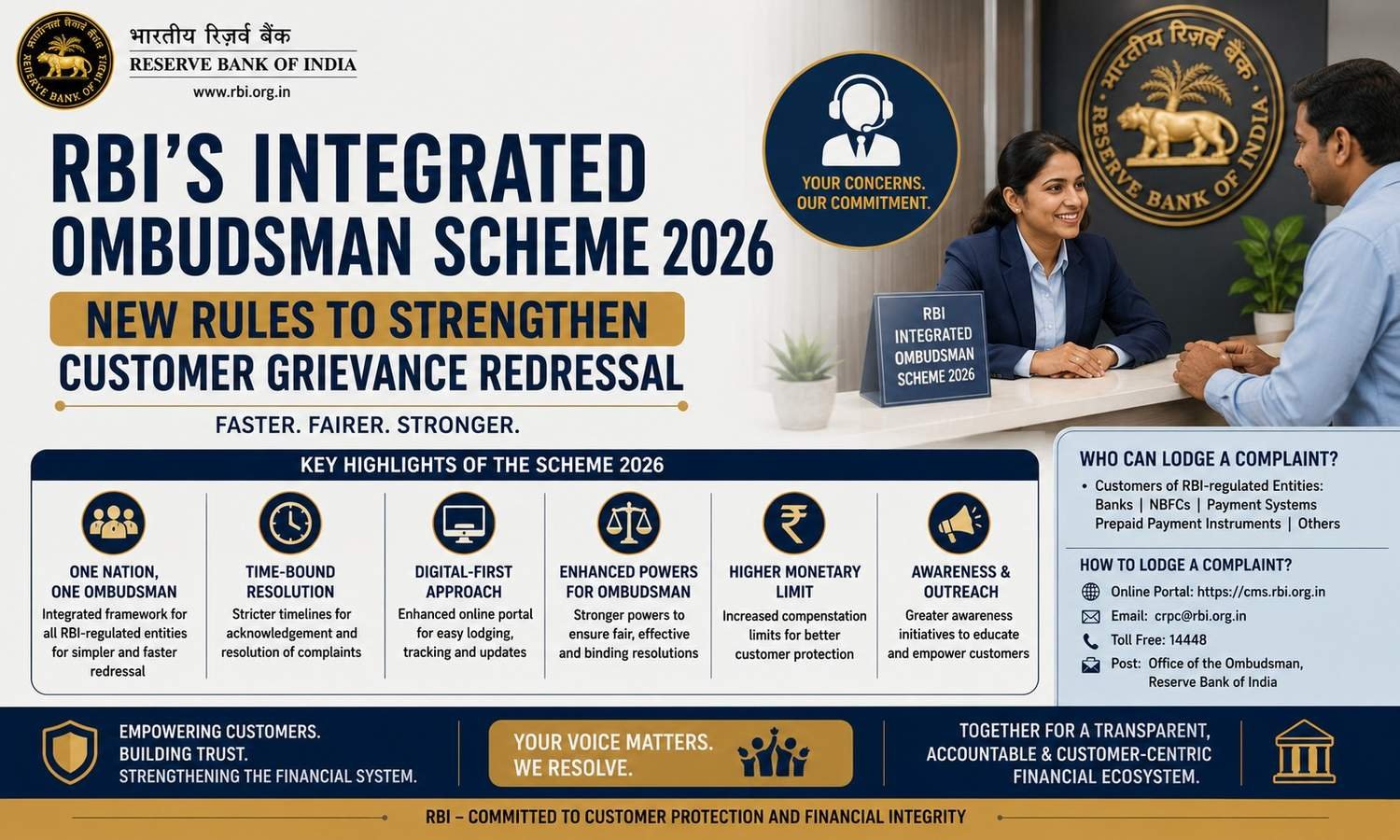
- To tackle the rising surge of digital banking complaints, the RBI officially rolled out the revamped Reserve Bank–Integrated Ombudsman Scheme (RB-IOS), 2026 on July 1.
- This isn’t just a minor regulatory tweak; it is a massive structural shift forcing Indian banks, NBFCs, and fintech companies to completely overhaul how they handle customer frustration.
- Here is a human-friendly breakdown of what the new RBI Ombudsman regime means, why it’s a big deal, and how it directly impacts you.
What is RB-IOS 2026?
- The 2026 framework replaces the older 2021 model.
- At its heart, the scheme offers a cost-free, fast, and neutral mechanism to resolve consumer complaints regarding “deficiencies in service.”
- However, the biggest change is its scope.
- The RBI has cast a much wider net, pulling almost every corner of the modern Indian financial ecosystem under a single, unified umbrella.
Who is covered?
All Commercial Banks (Public, Private, and Foreign)
Cooperative Banks & Regional Rural Banks (RRBs)
NBFCs (Both deposit-taking and specified non-deposit-taking)
Prepaid Payment Instrument (PPI) Issuers (Like mobile wallets)
Payment System Participants & Credit Information Companies (CICs)
Instead of juggling different rules for your bank account, your credit card, and your digital wallet, you now have a single, streamlined framework for the entire financial system.
No More “Escaping to the RBI”: The First-Level Pressure
- The RBI is sending a very clear message to lenders: Clean up your own mess.
- Under the new rules, customers must still approach their specific bank or financial institution first. Only if the lender fails to give a satisfactory response within the prescribed timeline can the issue be escalated to the RBI Ombudsman.
- This creates immense pressure on banks to achieve first-level resolution.
- The Operational Reality: Banks can no longer afford to let complaints drag on. If too many issues escalate to the central bank, it triggers heavy regulatory scrutiny and potential penalties. The goal now is to solve the problem at the very first point of contact.
From Customer Care to AI-Driven “Grievance Tech”
Because manual customer support desks simply cannot keep pace with millions of UPI and digital transactions, the RBI’s pressure is forcing banks to rapidly invest in advanced technology.
To survive this regulatory shift, banks are moving toward technology-led grievance management:
AI-Powered Categorization: Using machine learning to automatically sort and prioritize urgent complaints (like fraud or major unauthorized debits) ahead of general inquiries.
Predictive Analytics: Analyzing data to catch recurring service failures—such as a specific app feature glitching—and fixing it before hundreds of customers file a complaint.
Centralized Monitoring Dashboards: Giving top management a real-time view of how quickly branches and digital support teams are closing issues.
Why This is Now a Boardroom Problem
Historically, customer complaints were viewed by banks as a minor operational headache handled by a siloed department. Not anymore.
The RBI has made it clear that customer service and compliance are directly tied to a bank’s governance standards. Persistent failures, slow turnaround times, or a high volume of escalated Ombudsman cases will now attract:
Strict supervisory attention.
Heavy financial penalties.
Potential restrictions on expanding business or launching new products.
Because of this, customer satisfaction metrics are moving from the call center dashboard straight to the Board of Directors’ boardroom tables.
The Key Takeaway
- For consumers, RB-IOS 2026 is a massive win.
- It ensures greater accountability, faster resolution timelines, and forces financial institutions to fix their broken customer support systems.
- For banks and fintechs, customer service is no longer just a compliance checkbox.
- Going forward, the speed, transparency, and empathy with which a bank resolves your problems will become its biggest competitive advantage.
- Lenders with smooth, tech-driven resolution systems will thrive, while those relying on sluggish, outdated methods will face severe regulatory heat.