

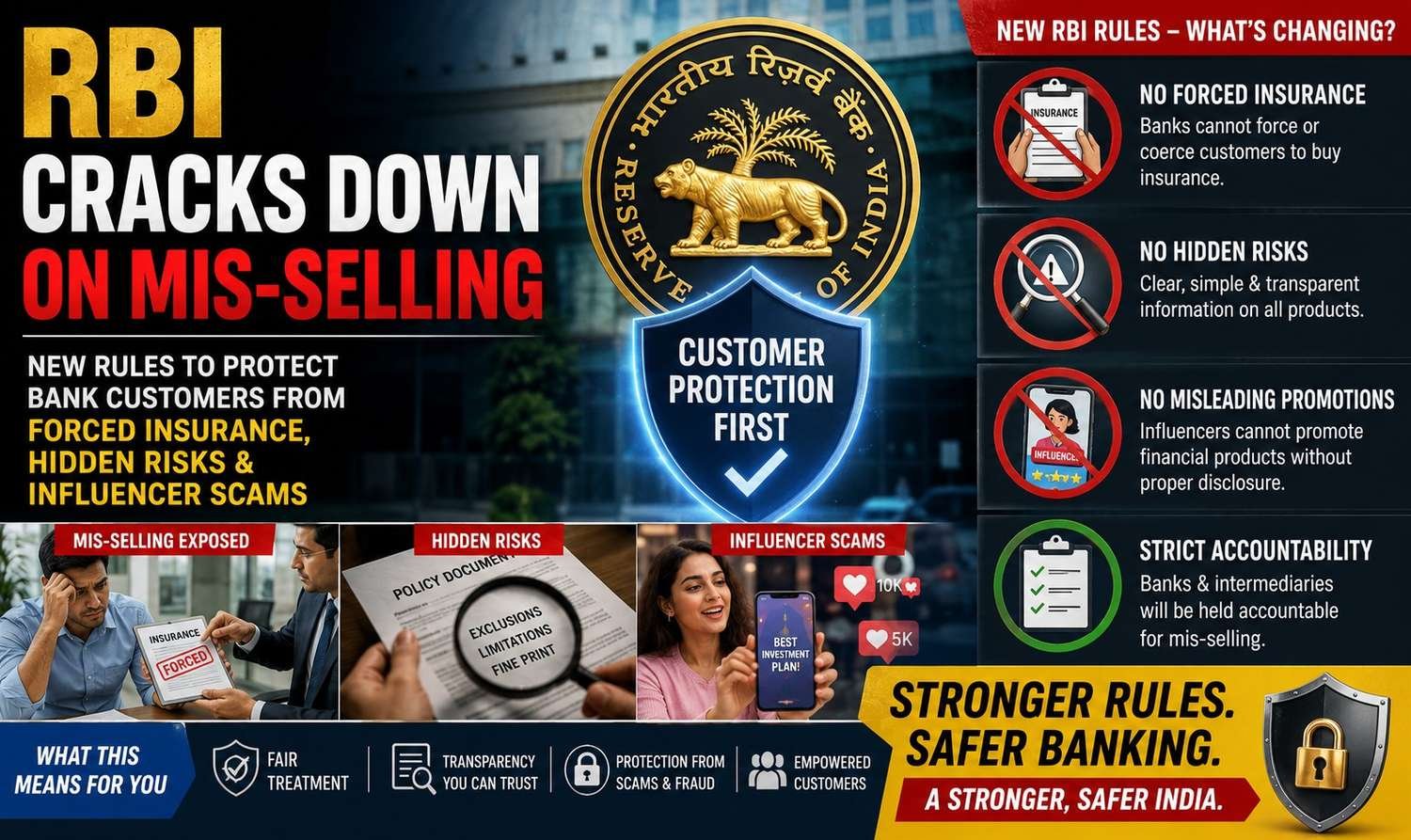
- The Reserve Bank of India (RBI) has introduced a comprehensive framework to curb the mis-selling of financial products by banks, NBFCs and other regulated entities.
- The new rules, which will come into effect from January 1, 2027, aim to ensure that customers are sold only suitable financial products with full transparency and informed consent.
- The framework also makes banks responsible for the actions of their agents, digital marketers and even social media influencers involved in promoting financial products.
- For customers, this means stronger protection against forced insurance, misleading claims, unsuitable investments and aggressive sales practices.
What is Mis-selling According to RBI?
- The RBI has broadened the definition of mis-selling to cover several practices commonly experienced by customers. Mis-selling includes:
Selling Unsuitable Products
- Banks or financial institutions cannot sell products that do not suit a customer’s financial needs, income level, risk appetite, investment goals and personal circumstances.
- For example, selling a high-risk investment product to a conservative investor may amount to mis-selling.
Misleading or Incomplete Information
- Providing false claims, hidden charges, incomplete disclosures, misleading returns or benefits will now fall under the regulator’s scrutiny.
Selling Without Proper Consent
- A signature on a form or clicking an online checkbox will no longer automatically protect banks.
- Consent must be Clear, Explicit, Properly recorded and Based on full disclosure
Forced Bundling of Products
- Banks cannot compel customers to purchase one product as a condition for availing another service. For instance:
- A bank cannot force a borrower to buy a particular insurance policy along with a home loan.
- Customers must have genuine freedom of choice.
Banks Responsible for Agents and Influencers
- One of the biggest changes in the new framework is that banks and NBFCs cannot escape liability by blaming third parties.
- The RBI has adopted a “principle-based and channel-agnostic” approach, meaning regulated entities remain responsible for sales conducted through Bank employees, Insurance agents, Outsourced sales teams, Digital marketing firms, Affiliates, Social media influencers and Online platforms.
- If a financial influencer exaggerates returns or hides risks while promoting a product, the bank or NBFC associated with the promotion may be held accountable.
No More Forced Insurance and Product Bundling
Many customers complain that they are compelled to buy:
- Insurance policies with loans
- Investment products with savings accounts
- Credit cards with additional financial services
Under the new rules:
- Banks cannot force customers to buy additional products.
- Purchase of one product cannot become a precondition for another service unless specifically allowed under regulations.
- Customers must be informed about:
- Product features
- Charges and fees
- Risks involved
- Lock-in periods
- Exit conditions
This is expected to improve transparency and reduce unfair sales practices.
Incentives Cannot Encourage Aggressive Selling
The RBI has also targeted incentive structures that encourage employees or agents to push unsuitable products.
Banks:
- Can continue to reward employees based on performance.
- Cannot design incentive systems that encourage mis-selling or aggressive sales tactics.
The goal is to ensure that sales targets do not compromise customer interests.
What Happens If Mis-selling Is Proven?
- The new framework provides strong remedies for customers.
- If a financial product is found to have been mis-sold:
Customers May Receive a Full Refund
- The lender may be required to refund the entire amount paid by the customer, cancel the transaction, compensate customers for losses arising from the sale.
- This marks a major shift from earlier practices where customers often struggled to prove they had been misled.
Conclusion
- The RBI’s new mis-selling framework marks a major shift in India’s consumer protection landscape.
- By holding banks accountable for their agents, influencers and digital channels, restricting forced bundling and empowering customers with refund rights, the regulator has strengthened safeguards against unfair sales practices.
- As financial products become more complex and digital sales channels expand, these rules could play a crucial role in making banking and financial services more transparent, fair and customer-centric.