

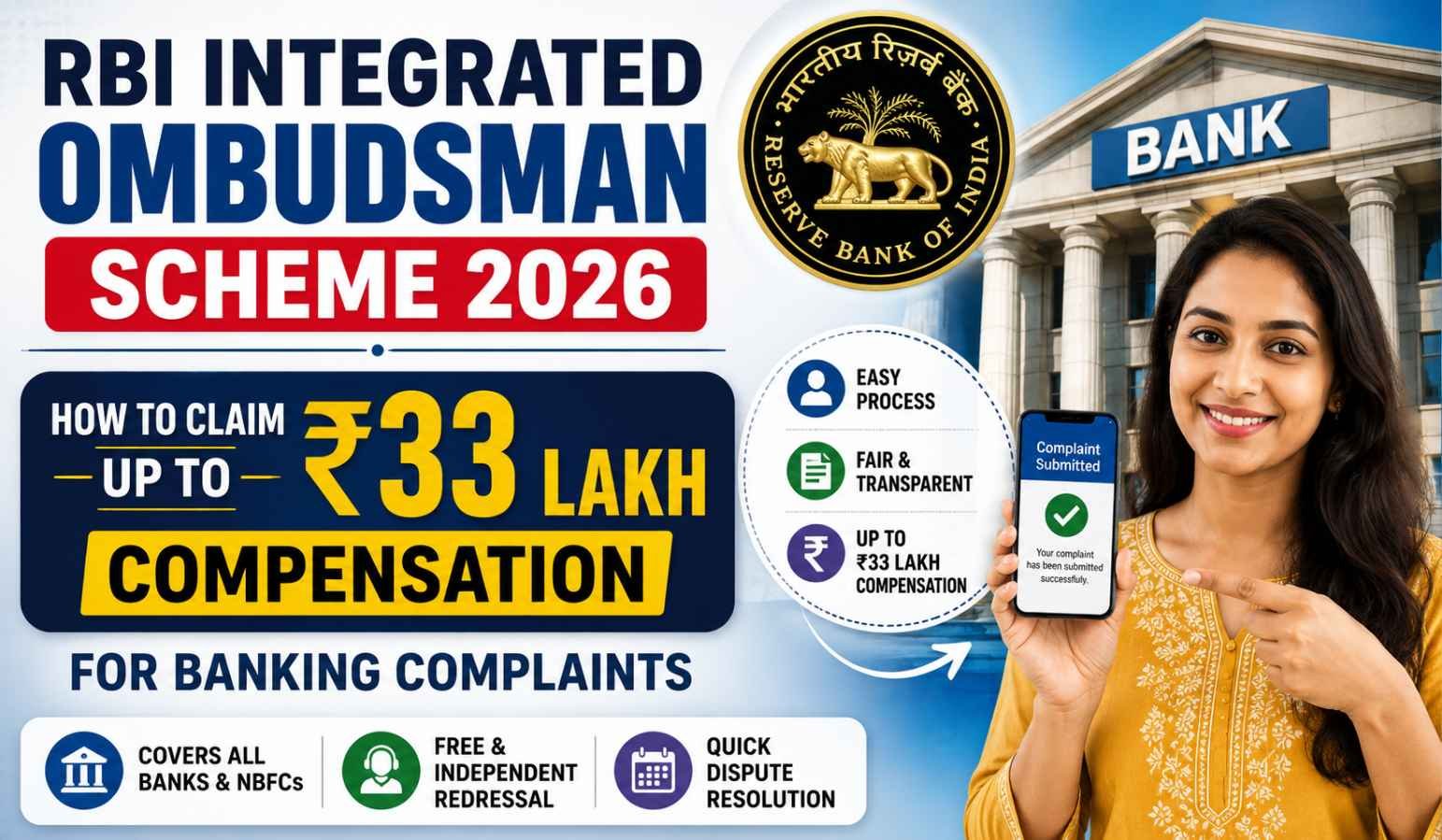
- The Reserve Bank of India (RBI) has strengthened customer protection by introducing the Reserve Bank – Integrated Ombudsman Scheme (RB-IOS), 2026, which came into effect on July 1, 2026.
- The revamped grievance redressal framework offers customers a free and independent mechanism to escalate complaints against banks and other regulated financial institutions when their issues remain unresolved or they are dissatisfied with the response received.
- One of the most discussed features of the new framework is the provision for compensation of up to ₹33 lakh.
- However, experts clarify that this is not a fixed payout, but the maximum compensation that may be awarded in deserving cases based on proven financial loss and hardship.
Key Highlights
- RBI Integrated Ombudsman Scheme effective from July 1, 2026.
- Compensation of up to ₹33 lakh in eligible cases.
- Customers must first complain to the concerned bank or financial institution.
- Ombudsman acts as an independent dispute resolution authority.
- Covers banks, NBFCs, prepaid payment issuers, credit information companies, and other RBI-regulated entities.
- Documentation and evidence are critical for successful claims.
What is the RBI Integrated Ombudsman Scheme 2026?
- The RBI Integrated Ombudsman Scheme (RB-IOS), 2026 is an Alternative Dispute Resolution (ADR) mechanism that allows customers to seek redress against deficiencies in banking and financial services without approaching a court.
- The scheme aims to provide a faster, transparent, and cost-free resolution process for complaints involving regulated entities.
Which Institutions Are Covered?
The scheme applies to complaints against:
- Commercial Banks
- Small Finance Banks
- Payments Banks
- Cooperative Banks (where applicable)
- Certain NBFCs
- Non-bank Prepaid Payment Instrument (PPI) issuers
- Credit Information Companies
- Other entities regulated by the RBI
This broad coverage ensures that customers across India’s financial ecosystem have access to a common grievance redressal platform.
Can You Really Get ₹33 Lakh Compensation?
Yes—but only in exceptional cases where the customer can prove actual losses.
The compensation has two components:
1. Financial Loss Compensation
The RBI Ombudsman may award up to ₹30 lakh for consequential financial losses caused due to a deficiency in service by the regulated entity.
Examples include:
- Wrongful account freeze
- Unauthorized transactions
- Delayed settlement causing financial losses
- Incorrect loan processing
- Service failures resulting in monetary damage
2. Compensation for Harassment
In addition, the Ombudsman may award up to ₹3 lakh towards:
- Mental anguish
- Harassment
- Time spent pursuing the complaint
- Litigation or related expenses
The total compensation can therefore reach ₹33 lakh, depending on the facts of the case.
Important: ₹33 Lakh Is Not a Guaranteed Payout
Experts caution customers against assuming that every successful complaint will result in a large compensation.
The Ombudsman evaluates:
- Nature of the service deficiency
- Documentary evidence
- Actual financial loss
- Hardship suffered
- Causal link between the bank’s actions and the loss
Compensation is awarded only when these elements are clearly established.
When Can You Approach the RBI Ombudsman?
Customers cannot directly file a complaint with the RBI Ombudsman.
They must first:
Step 1: Submit a complaint to the concerned bank or regulated entity.
Step 2: Wait for:
- The complaint to be rejected, or
- No response within the prescribed time, or
- An unsatisfactory response.
Step 3: Only then can the complaint be escalated to the RBI Ombudsman under the scheme.
Why Documentation Is So Important
According to experts, documentation often determines whether a complaint succeeds.
Customers should preserve:
- Emails
- SMS alerts
- Complaint acknowledgement numbers
- Screenshots
- Transaction records
- Bank statements
- Correspondence with the institution
Strong documentation enables the Ombudsman to quantify financial losses accurately.
Example: How Compensation May Be Awarded
Consider a situation where a customer’s account is mistakenly frozen because of a KYC-related error.
As a result:
- Salary is delayed.
- EMIs bounce.
- Penalty charges are imposed.
- Credit score suffers.
If the customer can produce evidence linking these losses to the bank’s delay, the Ombudsman may award compensation covering both the financial impact and the inconvenience caused.
Common Mistakes Customers Should Avoid
Experts say many complaints fail because applicants:
- File vague complaints.
- Do not mention transaction details.
- Omit complaint reference numbers.
- Fail to quantify financial losses.
- Approach the RBI before completing the bank’s internal grievance process.
- Submit insufficient documentary evidence.
A clear, well-documented complaint significantly improves the chances of success.
Documents Required Before Filing
Customers should keep the following ready:
- Copy of the original complaint submitted to the bank.
- Complaint acknowledgement/reference number.
- Account, card, loan, or transaction details.
- Bank’s response (if received).
- Emails and communication records.
- Screenshots and supporting documents.
- Statement explaining:
- Financial loss suffered.
- Compensation sought.
Why the New Scheme Matters
As digital banking and online payments continue to grow rapidly, customer disputes involving:
- UPI transactions
- Online banking
- Credit cards
- Digital lending
- Payment wallets
are becoming more common.
The RBI’s updated Ombudsman framework encourages regulated entities to improve grievance resolution while giving customers an independent mechanism when internal processes fail.
Benefits of the RBI Integrated Ombudsman Scheme
The scheme offers several advantages:
- Free complaint resolution.
- No legal fees.
- Faster dispute settlement.
- Independent review.
- Wider coverage across financial institutions.
- Better consumer protection.
- Greater accountability among regulated entities.
Conclusion
The RBI Integrated Ombudsman Scheme 2026 strengthens consumer rights by providing an accessible and independent platform for resolving disputes with banks and other regulated financial institutions. While the scheme allows compensation of up to ₹33 lakh, the amount awarded depends entirely on the customer’s ability to demonstrate actual financial loss and hardship caused by a deficiency in service.
Maintaining proper documentation, following the prescribed complaint process, and presenting a clear case are essential for a successful outcome.