

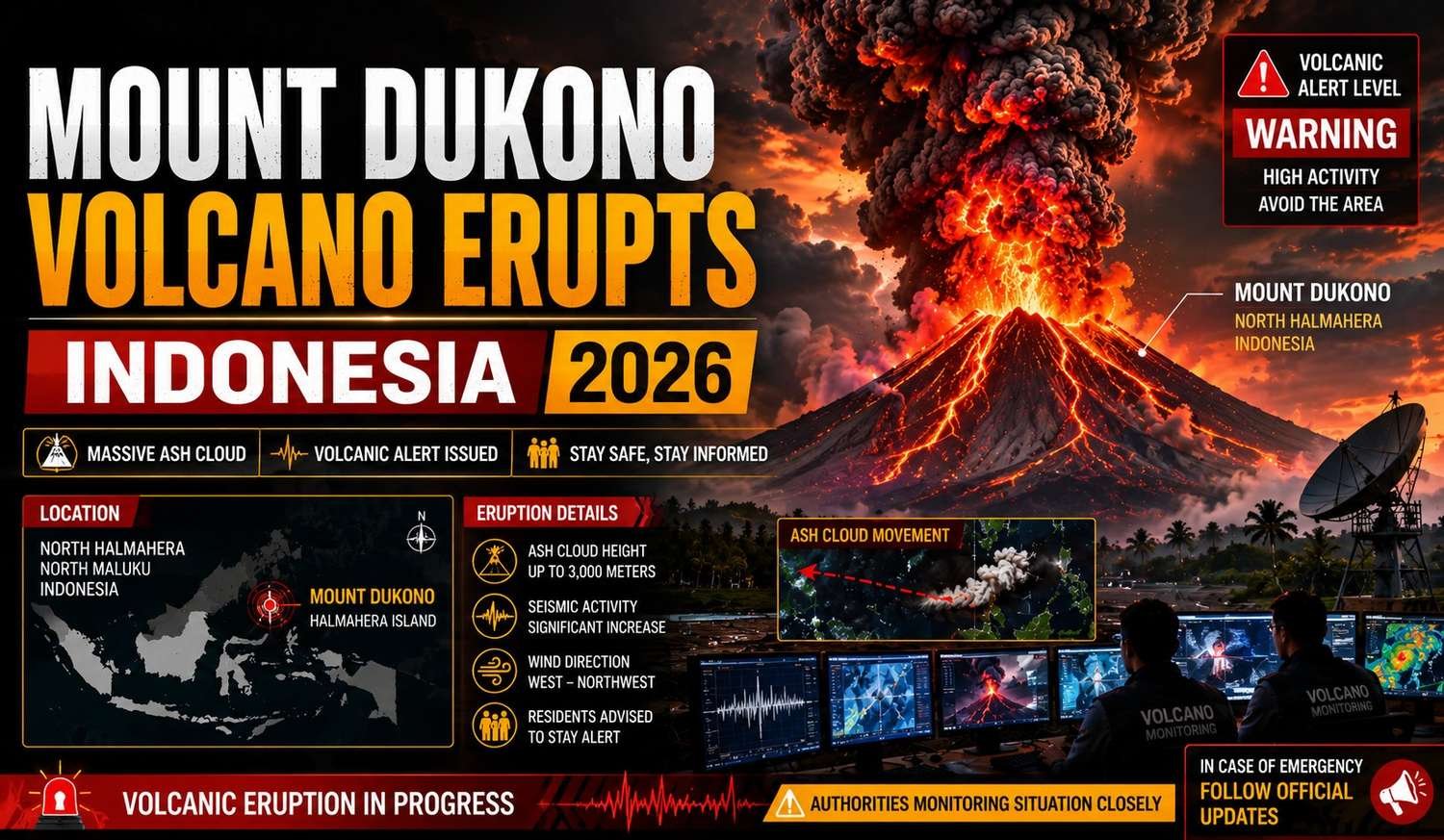
Indonesia’s Mount Dukono volcano has erupted once again, sending massive ash clouds high into the atmosphere and prompting authorities to issue volcanic activity warnings. The eruption occurred in the North Halmahera region of Indonesia, an area known for intense volcanic activity due to its location along the Pacific Ring of Fire.
The dramatic eruption attracted global attention as thick smoke, ash plumes, and lava activity were observed around the volcano.
Massive Ash Plume Reported
According to volcanic monitoring agencies, the eruption released a large ash column visible from several kilometers away. Authorities warned nearby residents and aviation operators about potential risks caused by volcanic ash dispersion.
Ash clouds from volcanic eruptions can:
- Disrupt air travel
- Affect respiratory health
- Reduce visibility
- Damage crops and local ecosystems
Monitoring teams continue to track ash movement and volcanic intensity.
Location of Mount Dukono:
Mount Dukono is located on Halmahera Island in North Maluku Province, Indonesia. It is one of the country’s most active volcanoes and has experienced frequent eruptions over the years.
Indonesia is home to more than 100 active volcanoes because it lies on the Pacific Ring of Fire, a tectonically active region prone to earthquakes and volcanic eruptions.
Authorities Issue Safety Warnings
Local disaster management authorities advised residents and tourists to avoid the danger zone surrounding the volcano. Emergency teams and volcanic monitoring agencies remain on alert to assess further risks.
Officials recommended:
- Wearing face masks to avoid ash inhalation
- Staying away from restricted zones
- Following official evacuation guidelines
- Monitoring weather and emergency updates
Environmental and Aviation Impact
Volcanic eruptions can significantly impact nearby communities and the environment. Heavy ashfall may affect agriculture, water supplies, transportation, and wildlife habitats.
Aviation authorities are also closely monitoring the situation because volcanic ash can damage aircraft engines and reduce flight safety.
Importance of Volcanic Monitoring
Indonesia has one of the world’s most advanced volcanic monitoring systems due to its high number of active volcanoes. Scientists continuously observe seismic activity, ash emissions, gas levels, and ground movements to provide early warnings and reduce disaster risks.
Experts emphasize that effective disaster preparedness and public awareness are essential in minimizing the impact of volcanic eruptions.
Conclusion
The eruption of Mount Dukono highlights Indonesia’s ongoing geological activity and the importance of disaster monitoring systems. Authorities continue to monitor the volcano closely while urging residents to remain alert and follow safety advisories.