

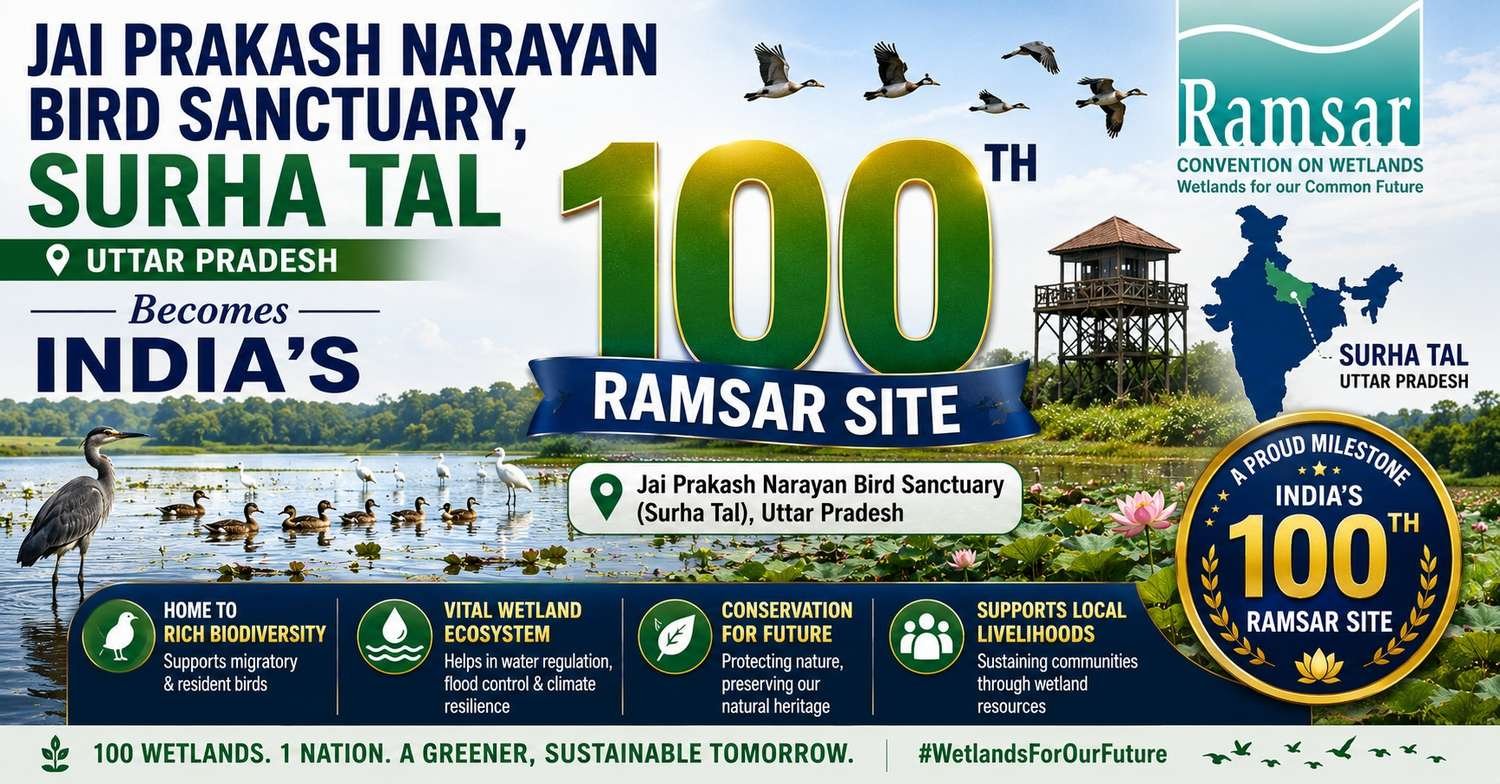
On the occasion of World Environment Day 2026, India achieved a major milestone by adding the Jai Prakash Narayan Bird Sanctuary (Surha Tal) in Uttar Pradesh to the list of Ramsar Sites (Wetlands of International Importance). With this addition, India now has 100 Ramsar Sites, the highest number in Asia and the third-highest globally after the United Kingdom and Mexico.
About Jai Prakash Narayan Bird Sanctuary (Surha Tal)
- Located in Ballia district, Uttar Pradesh.
- Declared a bird sanctuary in 2002.
- A natural perennial oxbow lake formed by an old meander of the Ganga River.
- Serves as an important wintering ground for migratory birds along the Central Asian Flyway.
- Supports irrigation, groundwater recharge, fisheries, and biodiversity.
- Home to more than 220 plant species, 66 fish species, reptiles, amphibians, and several threatened species.
What Are Wetlands?
According to the Ramsar Convention on Wetlands, wetlands are:
Areas of marsh, fen, peatland, or water, whether natural or artificial, permanent or temporary, with water that is static or flowing, fresh, brackish, or salt.
Examples include:
- Lakes
- Marshes
- Swamps
- Mangroves
- Floodplains
- Estuaries
- Coastal lagoons
Indian Definition
Under the Wetlands (Conservation and Management) Rules, 2017, wetlands exclude:
- River channels
- Paddy fields
- Drinking-water tanks
- Aquaculture ponds
- Salt pans
- Irrigation structures
Ramsar Convention: Background
Key Facts
- Adopted in 1971 in Ramsar.
- Came into force in 1975.
- First international treaty dedicated to a specific ecosystem.
- India joined in 1982.
Three Pillars of the Convention
- Conservation of wetlands of international importance.
- Wise use of all wetlands.
- International cooperation on shared wetlands and migratory species.
First Indian Ramsar Sites
- Chilika Lake
- Keoladeo National Park
The addition of Surha Tal as India’s 100th Ramsar Site reflects the country’s growing emphasis on biodiversity conservation, climate resilience, water security, and sustainable ecosystem management. Wetlands are among the most productive ecosystems on Earth and play a critical role in environmental protection and known .