

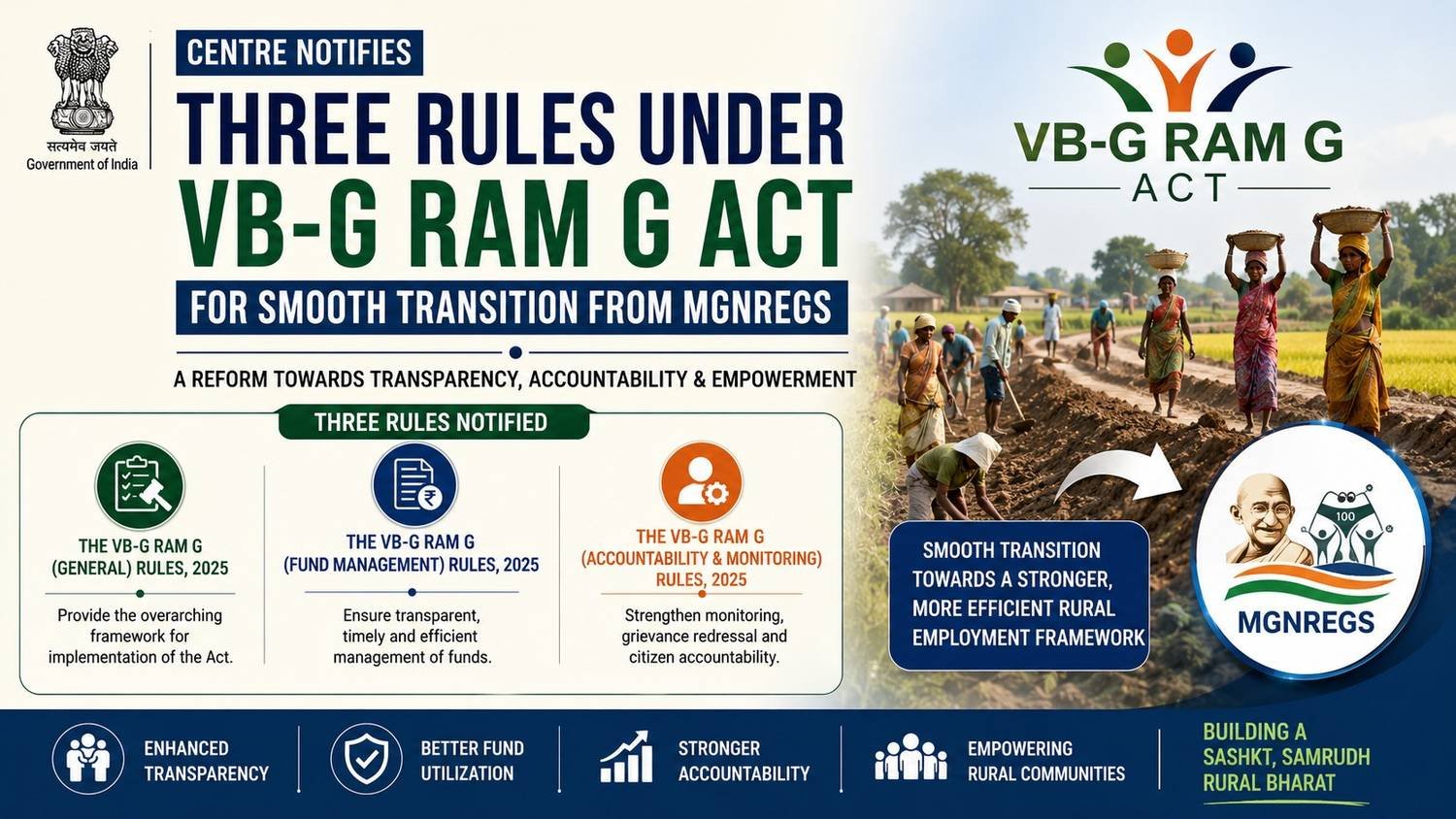
- The Central Government has notified three important sets of rules under the Viksit Bharat–Guarantee for Rozgar and Ajeevika Mission (Gramin) [VB-G RAM G] Act, 2025, providing the legal and administrative framework for the transition from the Mahatma Gandhi National Rural Employment Guarantee Scheme (MGNREGS) to the country’s new rural employment guarantee programme.
- Issued by the Ministry of Rural Development through Gazette notifications dated July 1, 2026, the rules came into force immediately upon publication.
- The notifications cover the transition mechanism, payment of wages and unemployment allowance, and expenditure beyond the Centre’s normative allocation.
Smooth Transition from MGNREGS
The first set of rules—Transitional Provisions Rules—lays down the roadmap for migrating from MGNREGS to the VB-G RAM G framework.
Key provisions include:
- State governments must verify all pending MGNREGS liabilities up to June 30, 2026.
- Eligible dues must be settled before the transition.
- Audited Utilisation Certificates must be submitted within 180 days, with an extension of up to 90 days possible under special circumstances.
- The Centre will continue to finance liabilities incurred under MGNREGS until June 30.
The rules ensure that no eligible beneficiary loses entitlements during the shift to the new employment guarantee system.
Existing Works and Job Cards to Continue
To avoid disruption in rural employment, the government has allowed ongoing MGNREGS projects to continue under the new Act.
Important transition measures include:
- Existing MGNREGS works will continue without interruption.
- e-KYC verified MGNREGS Job Cards will remain valid until new Gramin Rozgar Guarantee Cards are issued.
- Physical and digital employment records will be transferred.
- Assets created under MGNREGS will remain protected and continue under the new framework.
These measures aim to ensure administrative continuity while implementing the new law.
DBT Becomes Mandatory for Wage Payments
- The second notification focuses on payment mechanisms under the VB-G RAM G Act.
- The government has made Direct Benefit Transfer (DBT) mandatory for Wage payments and Unemployment allowance.
- Payments will be credited directly into beneficiaries’ bank or post office accounts.
- The rules further specify:
- Cash payments are prohibited except in extraordinary situations specifically approved by the Central Government.
- All transactions must be processed electronically through the scheme’s Management Information System (MIS) or another notified digital platform.
- Payments will primarily use the Aadhaar Payment Bridge System (APBS) or other approved authentication mechanisms.
- The objective is to improve transparency, reduce leakages and ensure faster payments.
New Funding Rules Introduced
The third notification establishes the financial framework for the implementation of the new scheme.
The rules provide that:
- The Central Government will bear 100% of the expenditure for Union Territories without legislatures.
- States spending beyond their approved normative allocation must record such expenditure separately through the designated MIS.
- Component-wise and source-wise reporting will distinguish Central and State expenditure.
- All financial data will become part of the scheme’s audit and financial management system.
This framework is intended to improve fiscal transparency and accountability.
VB-G RAM G Act Comes into Force
- The rules operationalise the VB-G RAM G Act, 2025, which officially came into effect on July 1, 2026, replacing the MGNREGS framework with a broader rural employment and livelihood guarantee programme.
- The formal rollout of the Act was launched in Tirupati district, Andhra Pradesh, by Union Agriculture and Rural Development Minister Shivraj Singh Chouhan along with Andhra Pradesh Chief Minister N. Chandrababu Naidu.
- The government says the new framework is designed to modernise rural employment delivery while improving transparency, digital governance and financial management.
Conclusion
- The notification of the three rules marks a major step in implementing the VB-G RAM G Act across the country. By providing clear procedures for transition, digital wage payments and financial management, the Centre aims to ensure continuity of rural employment while introducing a more technology-driven and transparent governance framework.
- As states begin implementing the new rules, the focus will remain on ensuring timely payments, seamless migration from MGNREGS and effective delivery of employment opportunities in rural India.