

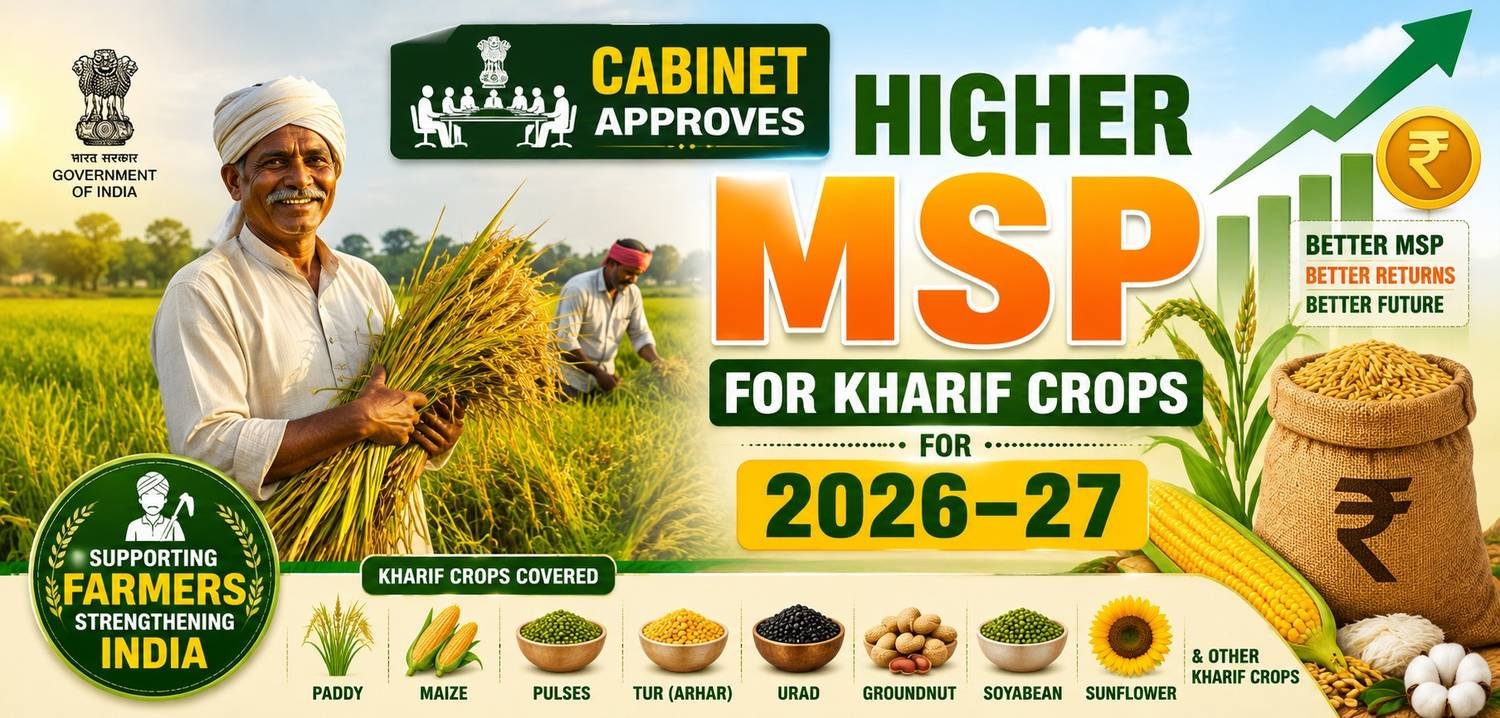
- The Cabinet Committee on Economic Affairs (CCEA), chaired by Prime Minister Narendra Modi, has approved an increase in the Minimum Support Prices (MSP) for 14 Kharif crops for the 2026–27 marketing season.
- The move aims to ensure better remuneration for farmers and encourage crop diversification towards pulses, oilseeds, and nutri-cereals.
Major MSP Hike Announced
The government announced the highest increase in MSP for:
- Sunflower Seed – increase of ₹622 per quintal
- Cotton – increase of ₹557 per quintal
- Nigerseed – increase of ₹515 per quintal
- Sesamum – increase of ₹500 per quintal
The revised MSPs are intended to provide farmers with returns of at least 1.5 times the cost of production, in line with the Union Budget 2018–19 commitment.
Revised MSP for Major Kharif Crops (2026–27)
| Crop | MSP 2026-27 (₹/quintal) | Increase over 2025-26 |
|---|---|---|
| Paddy (Common) | 2441 | ₹72 |
| Bajra | 2900 | ₹125 |
| Maize | 2410 | ₹10 |
| Tur/Arhar | 8450 | ₹450 |
| Moong | 8780 | ₹12 |
| Urad | 8200 | ₹400 |
| Groundnut | 7517 | ₹254 |
| Sunflower Seed | 8343 | ₹622 |
| Soybean | 5708 | ₹380 |
| Sesamum | 10346 | ₹500 |
| Nigerseed | 10052 | ₹515 |
| Cotton (Medium Staple) | 8267 | ₹557 |
Highest Profit Margins for Farmers
The expected margins over production cost are:
- Moong – 61%
- Bajra – 56%
- Maize – 56%
- Tur/Arhar – 54%
For the remaining crops, the estimated margin is around 50%.
Push for Pulses, Oilseeds and Nutri-Cereals
The government stated that it continues to encourage cultivation of:
- Pulses
- Oilseeds
- Nutri-cereals (Shree Anna)
by offering comparatively higher MSP increases to reduce import dependence and improve nutritional security.
Objective Behind MSP Increase
The enhanced MSPs are expected to:
- Improve farmers’ income
- Ensure price stability
- Encourage diversified cropping
- Strengthen food and nutritional security
- Support rural economic growth
The decision also reflects the government’s broader strategy to make agriculture more sustainable, profitable, and resilient.