

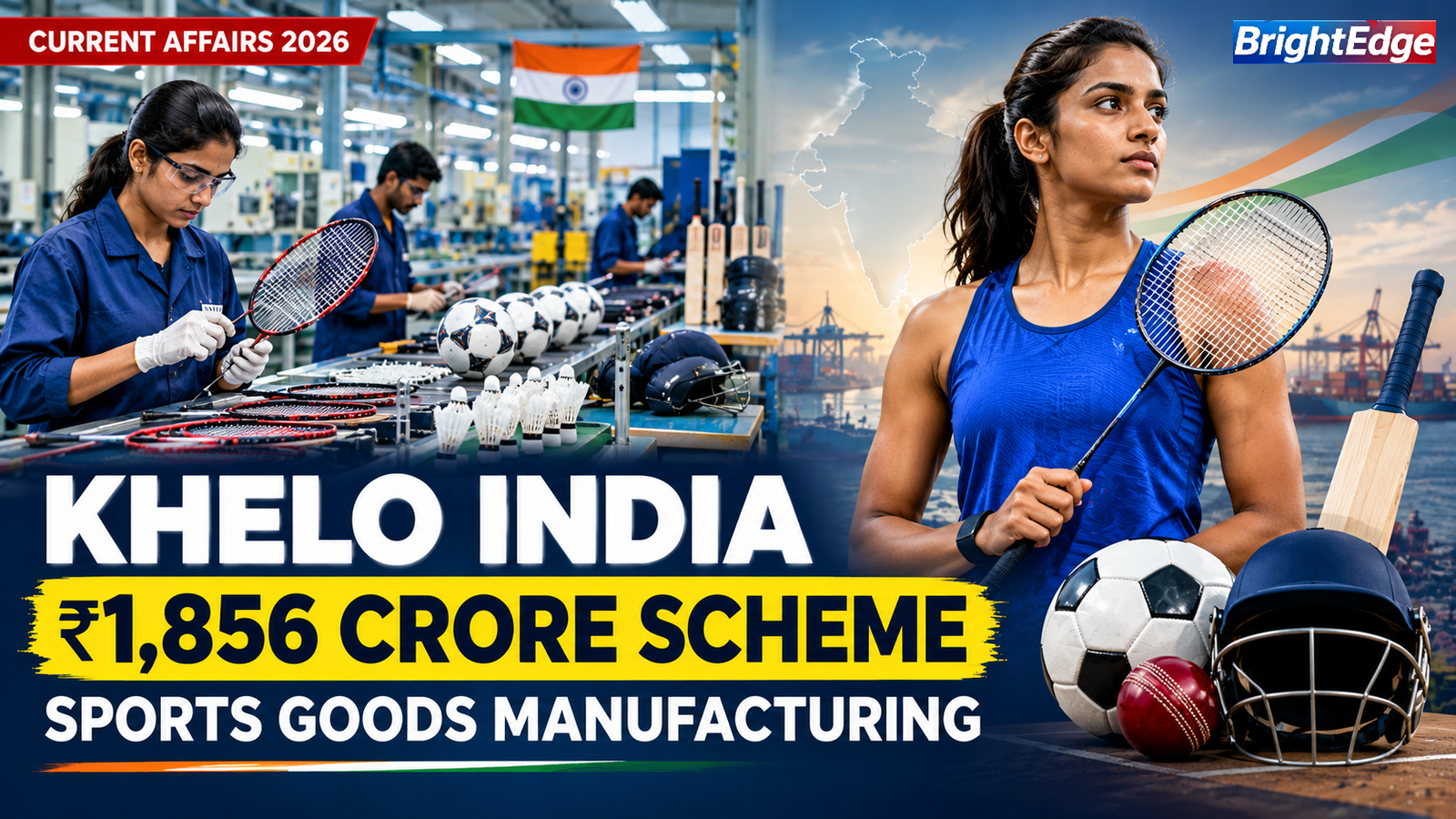
The Union Cabinet, chaired by Prime Minister Narendra Modi, has approved the Khelo India Sports Goods Manufacturing Scheme with a total outlay of ₹1,856.67 crore for the period FY 2026–27 to FY 2033–34. Announced in the Union Budget 2026–27, the scheme aims to strengthen India’s sports goods manufacturing industry, encourage investment, promote research and innovation, improve product quality and expand exports.
Khelo India Sports Goods Manufacturing Scheme: Key Highlights
| Particular | Details |
|---|---|
| Scheme name | Khelo India Sports Goods Manufacturing Scheme |
| Approval date | 28 October 2026 |
| Approving authority | Union Cabinet |
| Chairperson of the Cabinet meeting | Prime Minister Narendra Modi |
| Total financial outlay | ₹1,856.67 crore |
| Implementation period | FY 2026–27 to FY 2033–34 |
| Nodal ministry | Ministry of Youth Affairs and Sports |
| Primary objective | Strengthen domestic sports goods manufacturing |
| Major beneficiaries | Manufacturers, MSMEs, start-ups, suppliers and skilled workers |
| Key interventions | Manufacturing zones, investment support, certification, R&D, skilling and exports |
| Policy alignment | Make in India, Atmanirbhar Bharat and Khelo Bharat Niti 2025 |
Source: Press Information Bureau, Government of India.
What Is the Khelo India Sports Goods Manufacturing Scheme?
- The Khelo India Sports Goods Manufacturing Scheme is a government initiative designed to strengthen the entire value chain of India’s sports goods industry.
- Rather than focusing only on sporting participation and athletic performance, the scheme addresses the industrial side of sports by encouraging manufacturers to produce high-quality equipment, adopt modern technologies, develop new products and meet international standards.
- The programme aims to bring manufacturers, suppliers, testing facilities, research institutions and design centres into a more integrated ecosystem.
- It also seeks to strengthen existing manufacturing clusters and provide opportunities for smaller businesses to improve their production capabilities.
- The initiative is aligned with the broader objectives of Make in India, Atmanirbhar Bharat and Khelo Bharat Niti 2025.
1. Sports Goods Manufacturing Zones to Create Integrated Industrial Hubs
One of the major components of the scheme is the development of dedicated Sports Goods Manufacturing Zones (SGMZs).
These zones are intended to bring different parts of the manufacturing process together in one location. Planned facilities and participating enterprises may include:
- Sports goods manufacturers and component suppliers.
- Product testing and quality-assessment facilities.
- Design and prototyping centres.
- Ancillary enterprises and supporting industries.
- Shared industrial infrastructure.
The zones will be developed through convergence with existing industrial infrastructure under the BHAVYA Scheme and industrial parks associated with the National Industrial Corridor Development Corporation (NICDC).
2. ₹1,130 Crore for Investment and Manufacturing Support
The scheme allocates a combined ₹1,130 crore to Anchor Investment Support and Turnover Linked Support.
These two components are intended to encourage new investment and support the expansion of domestic manufacturing capacity.
Anchor Investment Support
- This component is designed to encourage leading domestic and international manufacturers, brands and retail chains to establish manufacturing facilities in designated Sports Goods Manufacturing Zones.
- The objective is to attract investment while helping develop a network of suppliers and ancillary businesses around major manufacturers.
Turnover Linked Support
- The turnover-linked component is intended to incentivise higher production, capacity expansion and sustained manufacturing growth.
- Together, these interventions are expected to help strengthen domestic production, increase value addition within India and improve the competitiveness of Indian sports goods in international markets.
- The government expects the measures to support private investment, employment opportunities and a reduction in dependence on imported products.
3. Support for MSMEs and Existing Manufacturing Clusters
- Micro, small and medium enterprises play an important role in India’s sports goods manufacturing industry.
- The scheme recognises the importance of existing manufacturing clusters and aims to improve their infrastructure and production capabilities.
- Support will be provided for upgrading manufacturing clusters, including the development of common facilities and shared infrastructure.
- Such facilities can help smaller enterprises access resources that may be difficult or expensive to establish individually.
- The broader objective is to improve manufacturing efficiency, encourage modern production practices and enable smaller businesses to participate more effectively in domestic and international supply chains.
4. ₹105 Crore for International Quality Certification
- Quality certification is another important component of the scheme.
- The government has earmarked ₹105 crore to support manufacturers in obtaining and renewing certifications from International Sports Federations.
- International certification can be important for products used in organised competitions, where equipment must satisfy specified performance, safety and technical standards.
- The support is intended to help Indian manufacturers improve product quality, build confidence among buyers and gain access to international markets.
- It also encourages manufacturers to move towards higher-value products rather than competing solely on price.
5. Research, Development and Innovation
The scheme places emphasis on research, product design and technology adoption.
Support is planned for establishing Centres of Excellence at premier educational and research institutions. These centres will promote research in areas such as:
- Sports equipment engineering.
- Advanced materials and material sciences.
- Protective sports gear.
- Product design and prototyping.
- Advanced manufacturing technologies.
Research and development activities will also be encouraged through convergence with the Anusandhan National Research Foundation.
Start-ups will receive dedicated support aligned with the Startup India initiative to encourage the development, testing, validation and commercialisation of new products and technologies.
These interventions are intended to strengthen domestic innovation and help Indian companies develop products that meet evolving international requirements.
6. Skill Development and Employment Opportunities
- Sports goods manufacturing requires workers with skills in production, material handling, product finishing, quality control, machinery operation and related technical processes.
- The scheme will support skill development initiatives in collaboration with the Ministry of Skill Development and Entrepreneurship and relevant industry stakeholders.
- Training is intended to align workers’ capabilities with the changing requirements of the manufacturing sector.
- By strengthening production facilities and encouraging new investment, the scheme is expected to create employment opportunities across manufacturing, supplier networks, testing, design and related services.
- The scale of employment generated will depend on investment, implementation and the growth of participating businesses.
7. Export Promotion and Global Market Access
- Expanding India’s presence in international sports goods markets is a key objective of the programme.
- The scheme envisages dedicated branding, outreach and market-development initiatives, with efforts linked to the Export Promotion Mission.
- These measures aim to improve the visibility of Indian sports goods, strengthen access to overseas markets and help domestic manufacturers reach international buyers.
- Better product quality, internationally recognised certification, improved design capabilities and stronger manufacturing infrastructure could help Indian businesses compete in a wider range of product categories.
- The long-term objective is to position India as a globally competitive centre for sports goods design, development and manufacturing.
Key expected benefits
Reduced import dependence: Expanding domestic production could help Indian buyers access a wider range of locally manufactured equipment.
Support for MSMEs: Cluster upgrades and shared infrastructure can help smaller manufacturers improve their capabilities.
Higher product quality: Certification and testing support can help businesses meet international standards.
Innovation and technology: Research centres and start-up support can encourage new materials, designs and production methods.
Employment opportunities: Manufacturing expansion may create jobs across factories, supplier networks and supporting services.
Export growth: Improved product quality and market-development support could help Indian businesses reach more overseas customers.
These are the scheme’s intended outcomes; their eventual scale will depend on implementation and industry participation.
Connection with Make in India and Atmanirbhar Bharat
- The scheme supports the broader objective of increasing domestic manufacturing and strengthening Indian participation in global supply chains.
- Under the Make in India approach, the emphasis is on encouraging investment and production within the country. Atmanirbhar Bharat seeks to strengthen domestic capabilities and reduce avoidable external dependence.
- By supporting manufacturing zones, supplier networks, research, certification and export promotion, the scheme brings these objectives into the sports goods sector.
Click here to read: PM Viksit Gram Swaraj Yojana Approved
Click here to read: PM Jan Dhan Yojana Completes 12 Years