

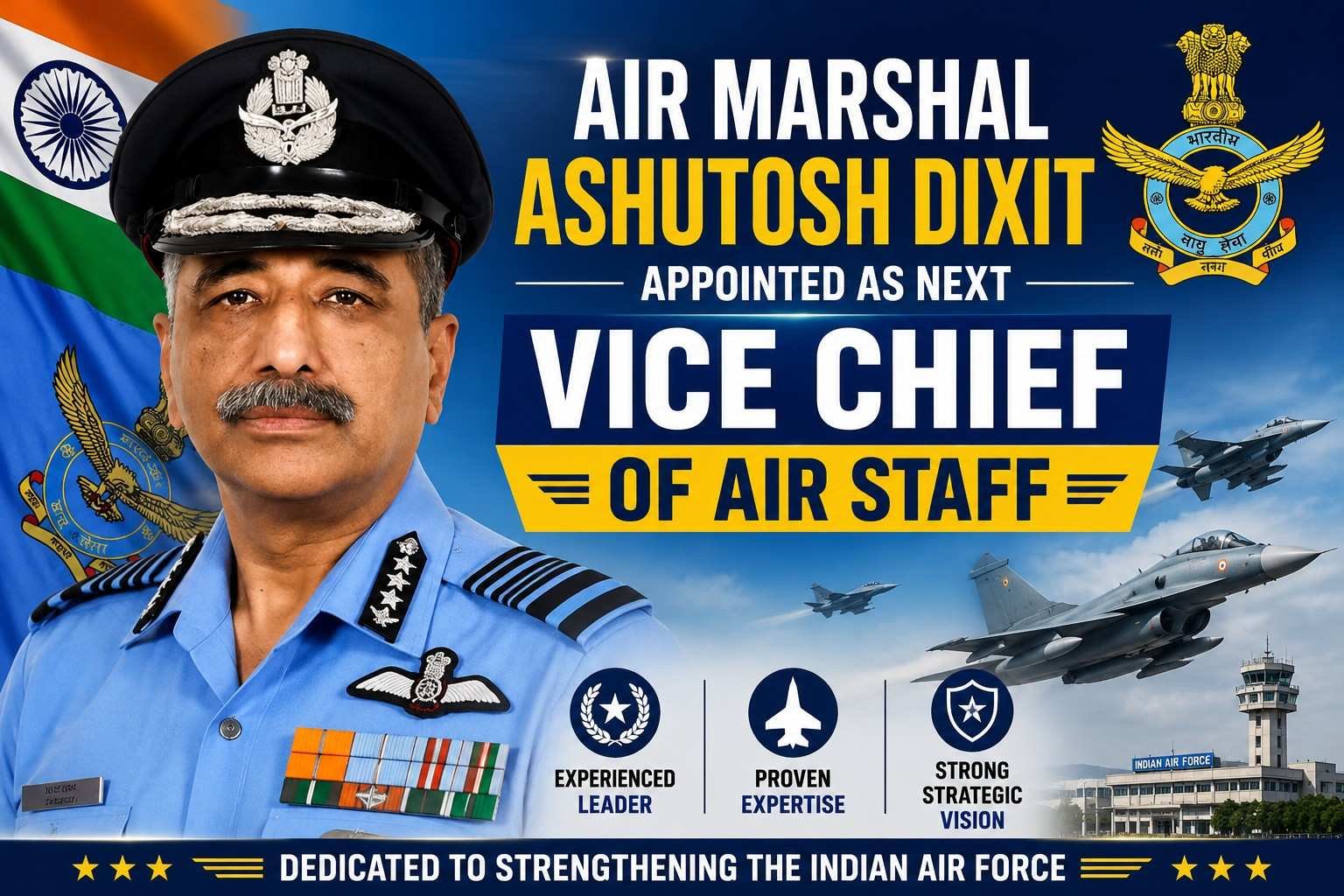
- Air Marshal Ashutosh Dixit has been appointed as the next Vice Chief of the Air Staff (VCAS) of the Indian Air Force (IAF).
- Currently serving as the Chief of Integrated Defence Staff (CISC) at the Headquarters Integrated Defence Staff, he will assume his new responsibilities on July 1, 2026.
- A highly accomplished fighter pilot and experimental test pilot, Air Marshal Dixit brings nearly four decades of operational, training, and strategic experience to one of the most important leadership positions in the Indian Air Force.
Distinguished Military Career
- Air Marshal Dixit was commissioned into the fighter stream of the Indian Air Force on December 6, 1986, after graduating from the National Defence Academy (NDA), Khadakwasla.
- Over the course of his illustrious career, he has served in a variety of operational, instructional, and staff appointments.
- He is an alumnus of the Defence Services Staff College in Bangladesh and the National Defence College in New Delhi.
- His professional expertise includes qualifications as a Flying Instructor and an Experimental Test Pilot.
- With more than 3,300 flying hours, Air Marshal Dixit has flown over 20 different aircraft types, including frontline fighter aircraft such as the Mirage-2000, MiG-21, and Jaguar.
Contribution to Tri-Service Jointness
- As Chief of Integrated Defence Staff, Air Marshal Dixit played a key role in strengthening coordination and integration among the Army, Navy, and Air Force.
- His tenure coincided with the Ministry of Defence’s efforts to enhance joint military planning and move towards the implementation of integrated theatre commands.
- His contribution to improving interoperability among the three services is considered significant in India’s ongoing military reforms.
Role in Indigenous Defence Development
- Throughout his career, Air Marshal Dixit has actively supported indigenous defence projects and force modernisation initiatives.
- During his tenure at Air Headquarters, he contributed to efforts aimed at strengthening India’s indigenous fighter aircraft programmes and enhancing combat capabilities.
- As Commanding Officer of the Flight Test Squadron at the Aircraft and Systems Testing Establishment (ASTE), Bengaluru, he led several important testing and development projects.
- These included avionics upgrades for the Jaguar and MiG-27 fighter aircraft, supporting the modernization of the Indian Air Force’s combat fleet.
Leadership and Operational Excellence
- While commanding a premier Fighter Training Base in the Southern Air Command, Air Marshal Dixit’s leadership earned the base recognition as the best training establishment in the command.
- Later, as Director of Air Staff Requirements, he played a crucial role in planning and conducting the trials for the Medium Multi-Role Combat Aircraft (MMRCA) programme, one of India’s most significant fighter aircraft acquisition initiatives.
Significance of the Appointment
- Air Marshal Dixit’s appointment comes at a time when the Indian Air Force is focusing on capability enhancement, indigenous defence production, force modernization, and greater jointness among the armed forces.
- His extensive operational experience and expertise in defence planning are expected to contribute significantly to the future development of the Air Force.
Key Highlights
- Air Marshal Ashutosh Dixit appointed as the next Vice Chief of Air Staff.
- Currently serving as Chief of Integrated Defence Staff (CISC).
- Will assume office on July 1, 2026.
- Commissioned into the Indian Air Force in December 1986.
- Qualified Flying Instructor and Experimental Test Pilot.
- Has over 3,300 flying hours on more than 20 aircraft types.
- Played an important role in indigenous fighter development and force modernization.
- Contributed significantly to strengthening tri-service jointness and military integration.