

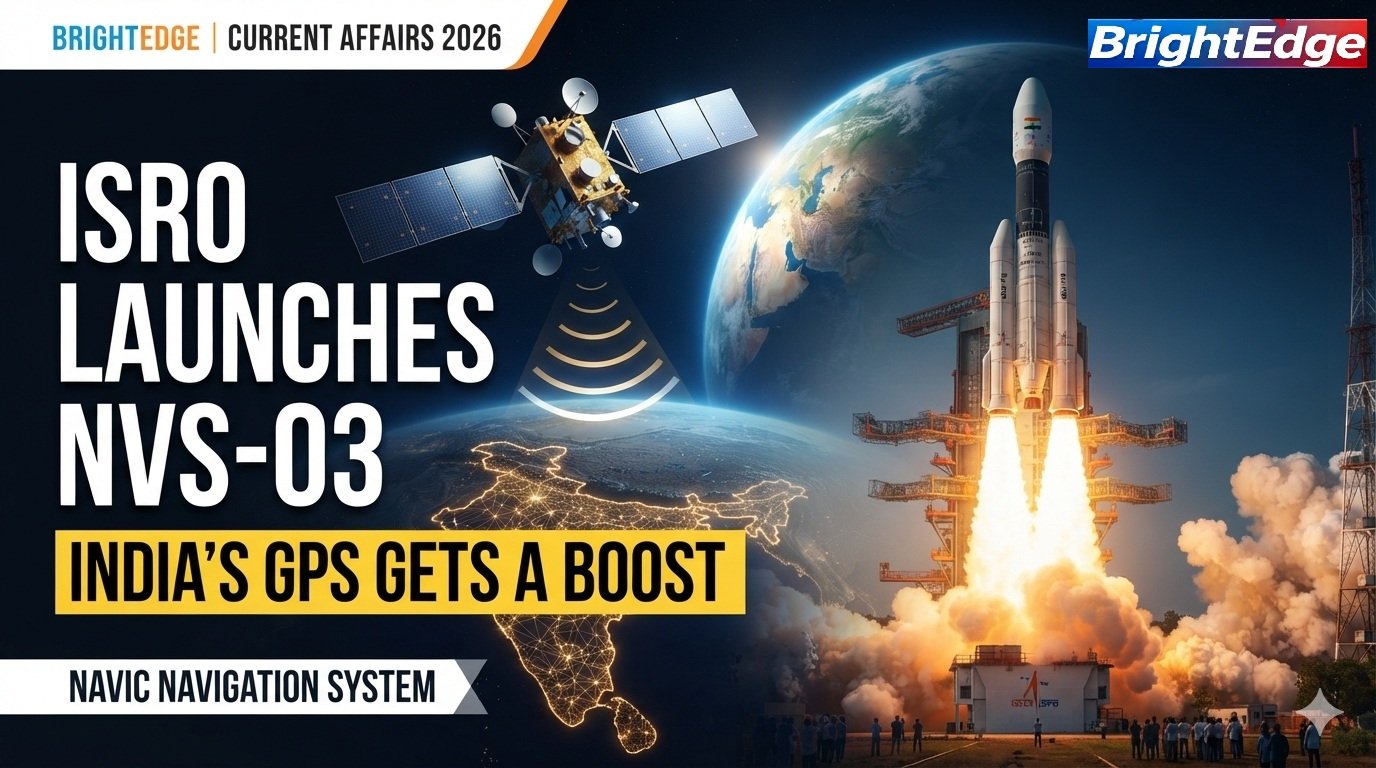
The Indian Space Research Organisation (ISRO) has successfully launched its next-generation navigation satellite, NVS-03, aboard the Geosynchronous Satellite Launch Vehicle GSLV-F18, strengthening India’s indigenous satellite navigation capabilities.
The satellite was launched on October 30, 2026, at 11:51 PM IST from the Second Launch Pad of the Satish Dhawan Space Centre (SDSC-SHAR) in Sriharikota, Andhra Pradesh.
The GSLV-F18 mission successfully injected the approximately 2,250-kg NVS-03 satellite into its designated Geosynchronous Transfer Orbit (GTO). The mission marks an important milestone in India’s efforts to strengthen its independent regional navigation system, Navigation with Indian Constellation (NavIC).
NVS-03 is equipped with an indigenous atomic clock and introduces the L1 frequency signal alongside the existing L5 and S-band signals, improving the capabilities and potential civilian applications of India’s navigation system.
ISRO NVS-03 Satellite Launch: Key Highlights
- Mission: GSLV-F18/NVS-03
- Launch Date: October 30, 2026
- Launch Time: 11:51 PM IST
- Launch Vehicle: GSLV-F18
- Satellite: NVS-03
- Satellite Weight: Approximately 2,250 kg
- Launch Site: Satish Dhawan Space Centre, Sriharikota, Andhra Pradesh
- Launch Pad: Second Launch Pad (SLP)
- Orbit: Geosynchronous Transfer Orbit (GTO)
- Navigation System: Navigation with Indian Constellation (NavIC)
- Key Technology: Indigenous atomic clock
- New Navigation Signal: L1 frequency band
- Organisation: Indian Space Research Organisation (ISRO)
What Is the NVS-03 Satellite?
- NVS-03 is the third satellite in India’s second-generation Navigation Satellite Series developed to strengthen the Indian Regional Navigation Satellite System (IRNSS), operationally known as NavIC.
- The satellite is designed to ensure continuity, improve availability and enhance the reliability of India’s indigenous satellite-based positioning, navigation and timing services.
- NVS-03 carries an indigenous atomic clock along with procured atomic clocks. It also introduces the L1 frequency signal in addition to the existing L5 and S-band signals.
- These technological improvements are expected to strengthen NavIC’s compatibility with modern navigation receivers and expand its applications in civilian, commercial and strategic sectors.
What Is NavIC? India’s Indigenous Alternative to GPS
- Navigation with Indian Constellation (NavIC), formerly known as the Indian Regional Navigation Satellite System (IRNSS), is India’s independent regional satellite navigation system developed by ISRO.
- It provides Positioning, Navigation and Timing (PNT) services across India and approximately 1,500 kilometres beyond the country’s geographical boundaries.
- NavIC was developed to reduce India’s dependence on foreign satellite navigation systems and provide reliable positioning and timing services for civilian and strategic applications.
NavIC provides two types of services:
1. Standard Positioning Service (SPS):
This service is available to civilian users and supports applications such as road navigation, transportation, smartphones, marine navigation and location-based services.
2. Restricted Service (RS):
This is an encrypted navigation service intended for authorised strategic and security-related users.
Five Important Features of the NVS-03 Satellite
1. Indigenous Atomic Clock
- One of the most important features of NVS-03 is its indigenous atomic clock.
- Atomic clocks provide extremely precise time measurements, which are essential for satellite navigation. Navigation receivers calculate their position by measuring the time taken by satellite signals to reach them.
- The indigenous atomic clock strengthens India’s technological independence in satellite navigation.
2. Introduction of the L1 Frequency Band
- NVS-03 introduces the L1 frequency signal alongside the existing L5 and S-band signals.
- The L1 frequency is widely used by global satellite navigation systems and is supported by many modern navigation receivers.
- Its introduction is expected to improve NavIC’s interoperability with other navigation systems and expand its potential civilian and commercial applications.
3. Strengthening India’s Independent Navigation Capabilities
- NavIC provides an independent regional navigation capability, reducing India’s strategic dependence on foreign navigation infrastructure.
- It is particularly important for applications involving national security, transportation, disaster management and critical infrastructure.
4. Improved Civilian and Commercial Applications
The additional L1 signal is expected to expand NavIC’s compatibility with modern navigation devices.
Potential applications include:
- Smartphone navigation.
- Vehicle tracking systems.
- Maritime navigation.
- Aviation-related applications.
- Location-based services.
- Precision agriculture.
- Surveying and mapping.
5. Strengthening India’s Strategic Infrastructure
- Reliable Positioning, Navigation and Timing services are essential for defence operations, transportation networks, telecommunications and financial infrastructure.
- NVS-03 represents another important step towards strengthening India’s independent space-based navigation infrastructure.
What Is GSLV-F18?
- The Geosynchronous Satellite Launch Vehicle (GSLV) is one of ISRO’s major launch vehicles, developed to place satellites into Geosynchronous Transfer Orbit (GTO).
- GSLV-F18 represents the 20th flight of India’s Geosynchronous Satellite Launch Vehicle.
- The rocket successfully carried NVS-03 from Sriharikota and injected the satellite into its designated transfer orbit.
- The mission also demonstrated ISRO’s ability to conduct successive GSLV missions with a short turnaround time.
NavIC vs GPS: Key Differences
| Parameter | NavIC | GPS |
|---|---|---|
| Full Form | Navigation with Indian Constellation | Global Positioning System |
| Developed By | ISRO, India | United States |
| Country | India | USA |
| System Type | Regional Navigation System | Global Navigation System |
| Coverage | India and approximately 1,500 km beyond its borders | Global |
| Primary Purpose | Independent regional navigation | Worldwide navigation |
| Key Applications | Transport, defence, disaster management and navigation | Transport, aviation, defence and navigation |
Previous and Upcoming NVS Satellite Missions
ISRO is developing a second-generation series of navigation satellites to strengthen the NavIC constellation.
| Satellite | Launch Date | Launch Vehicle | Status |
|---|---|---|---|
| NVS-01 | 29 May 2023 | GSLV-F12 | Operational |
| NVS-02 | 29 January 2025 | GSLV-F15 | Not operational |
| NVS-03 | 30 October 2026 | GSLV-F18 | Successfully launched |
| NVS-04 | Upcoming | To be announced | Under development |
| NVS-05 | Upcoming | To be announced | Under development |
Note: Successful launch and satellite commissioning are separate stages. NVS-03 must complete its post-launch orbital operations and commissioning before entering regular navigation service.
Why Is the NVS-03 Mission Important for India?
- The NVS-03 mission is significant because India’s NavIC constellation requires additional operational satellites to ensure continuity and reliability of navigation services.
- The earlier NVS-02 satellite, launched in January 2025, could not reach its intended operational orbit because of a propulsion-system-related issue.
- The successful launch of NVS-03 is therefore an important step towards strengthening the constellation.
- The mission also highlights India’s growing capabilities in indigenous space technology, satellite navigation and precision timekeeping.
Also,
Click here to read: ISRO’s Big Space Expansion
Click here to read: ISRO GSLV-F17 Launches EOS-05