

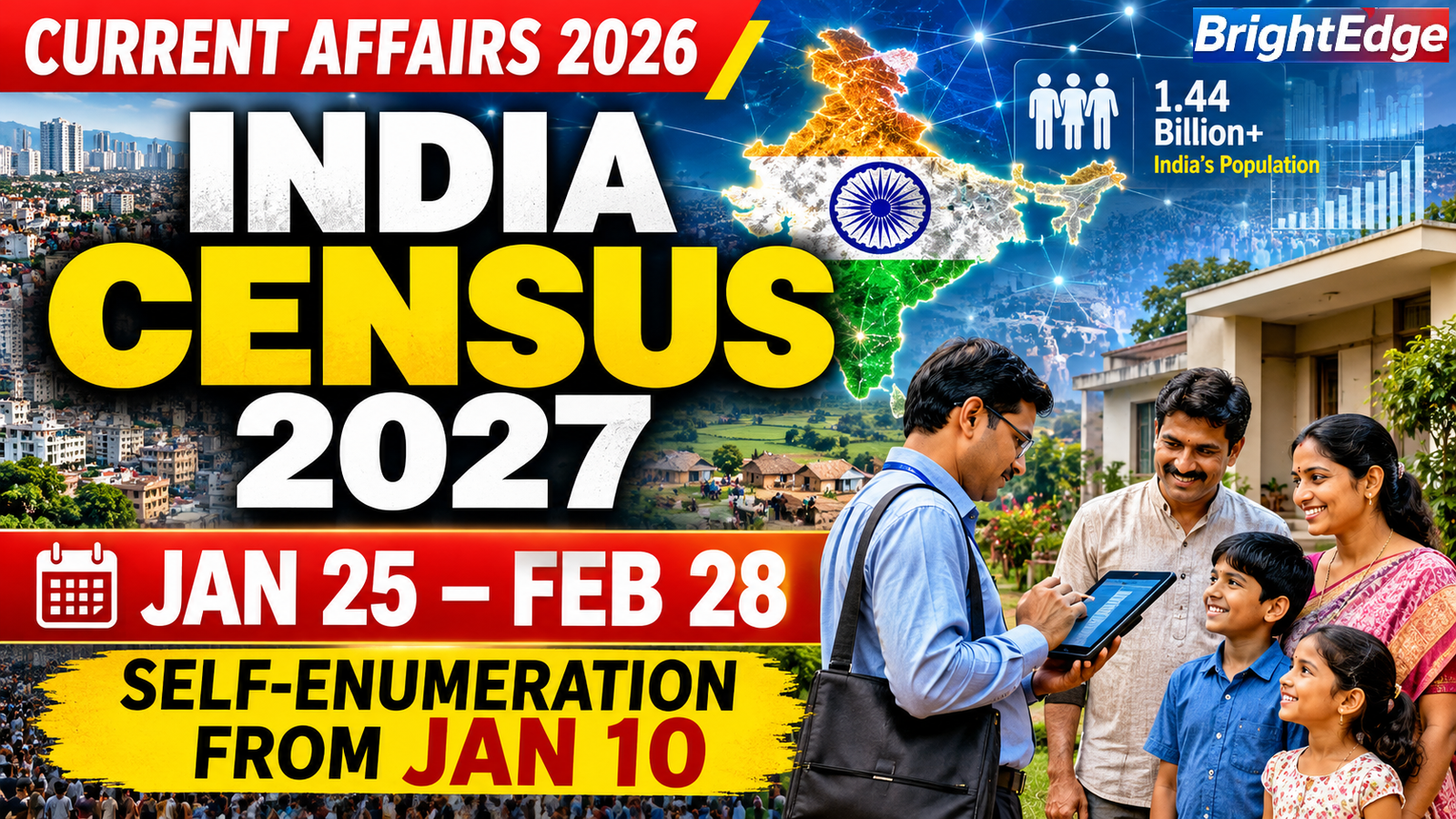
India will conduct its next population census, “CENSUS 2027” from January 25 to February 28, 2027, according to a notification issued by the Ministry of Home Affairs on October 30, 2026. The announcement establishes the schedule for the second phase of Census of India 2027, known as Population Enumeration.
The government has also introduced an optional self-enumeration facility from January 10 to January 24, 2027, before the commencement of the house-to-house population counting exercise.
The reference date for the census will be midnight (00:00 hours) on March 1, 2027, for the states and Union Territories covered under the announced schedule.
Key Highlights of Census of India 2027
- Census: Census of India 2027
- Population Enumeration: January 25 – February 28, 2027
- Self-Enumeration Period: January 10 – January 24, 2027
- Revisional Round: March 1 – March 5, 2027
- Reference Date: March 1, 2027
- Nodal Ministry: Ministry of Home Affairs
- Implementing Authority: Office of the Registrar General and Census Commissioner, India
- Legal Framework: Census Act, 1948 and Census Rules, 1990
- Registrar General and Census Commissioner: Mritunjay Kumar Narayan
1. When Will India’s Census 2027 Be Conducted?
- According to the notification issued on October 30, 2026, the population enumeration exercise will take place between January 25 and February 28, 2027.
- The exercise will be followed by a revisional round from March 1 to March 5, 2027, to address any remaining enumeration requirements.
- The announcement provides a clear timeline for the second phase of the nationwide census exercise.
2. Self-Enumeration Facility from January 10, 2027
- For the first time in India’s census exercise, citizens will have an option to participate through a self-enumeration facility.
- The self-enumeration window will remain open from January 10 to January 24, 2027.
- This facility will allow eligible households to submit their information digitally before the commencement of house-to-house population enumeration.
- The initiative aims to improve convenience, efficiency and the accuracy of census data collection.
3. Census 2027: Important Dates
| Event | Important Dates |
|---|---|
| Self-Enumeration | January 10–24, 2027 |
| Population Enumeration Begins | January 25, 2027 |
| Population Enumeration Ends | February 28, 2027 |
| Revisional Round | March 1–5, 2027 |
| Census Reference Date | March 1, 2027 |
4. Which States and Union Territories Are Excluded from the Announced Schedule?
The January 25–February 28, 2027 schedule will not apply to certain states and regions.
These include:
- Manipur, until further declaration.
- Goa.
- Uttar Pradesh.
- Punjab.
- Uttarakhand.
- Union Territory of Ladakh.
- Snow-bound non-synchronous areas of Himachal Pradesh.
- Snow-bound non-synchronous areas of Jammu and Kashmir.
These exclusions are linked to separate scheduling requirements, including election-related considerations and geographical conditions.
The alternative schedule for the excluded regions will be notified separately.
5. Two Phases of Census of India 2027
The Census of India 2027 is being conducted in two major phases.
Phase 1: Houselisting and Housing Census
The first phase is scheduled between April and September 2026.
It focuses on collecting information regarding:
- Housing conditions.
- Type and condition of houses.
- Availability of drinking water.
- Electricity facilities.
- Sanitation and toilet facilities.
- Household amenities.
- Assets possessed by households.
Phase 2: Population Enumeration
The second phase focuses on collecting individual-level demographic, socio-economic and other population-related information.
It covers:
- Population size.
- Age and sex composition.
- Educational qualifications.
- Occupation and economic activities.
- Migration characteristics.
- Fertility-related information.
- Social and cultural characteristics.
- Caste-related information.
Caste enumeration is also included in Census 2027.
6. Technology to Be Used in Census 2027
The government is incorporating digital technology to improve the efficiency and accuracy of the census process.
Important technological initiatives include:
- Mobile applications for digital data collection.
- Centralised portals for monitoring census operations.
- Digital self-enumeration facilities.
- Improved data processing and dissemination mechanisms.
These measures are expected to make the census exercise more efficient and improve accessibility to census information.
7. Why Is Census 2027 Important for India?
The population census is one of India’s largest administrative and statistical exercises.
The information collected will play an important role in:
- Government policy formulation.
- Planning public healthcare infrastructure.
- Education and employment planning.
- Allocation of development resources.
- Urban and rural development.
- Welfare scheme implementation.
- Infrastructure development.
- Understanding migration and demographic changes.
The census will provide updated population data after the 2011 Census, which was India’s last completed nationwide population census.
8. Historical Background of the Indian Census
The history of India’s census dates back to the nineteenth century.
- 1872: First attempt at conducting a census across India during British rule.
- 1881: First synchronous and regular census conducted throughout British India.
- 2011: Last completed nationwide population census.
- 2021: The scheduled census was postponed.
- 2027: Next nationwide census exercise.
The 2027 Census is particularly significant because it will provide updated demographic information after a gap of more than 15 years.
Note: Ministry responsible for the Census: Ministry of Home Affairs
Who conducts the census: Office of the Registrar General and Census Commissioner, India
Who is the Registrar General and Census Commissioner: Mritunjay Kumar Narayan
Click here to read: Sardar Vallabhbhai Patel: The Iron Man Who United India
Click here to read: ISRO Launches NVS-03 Satellite