

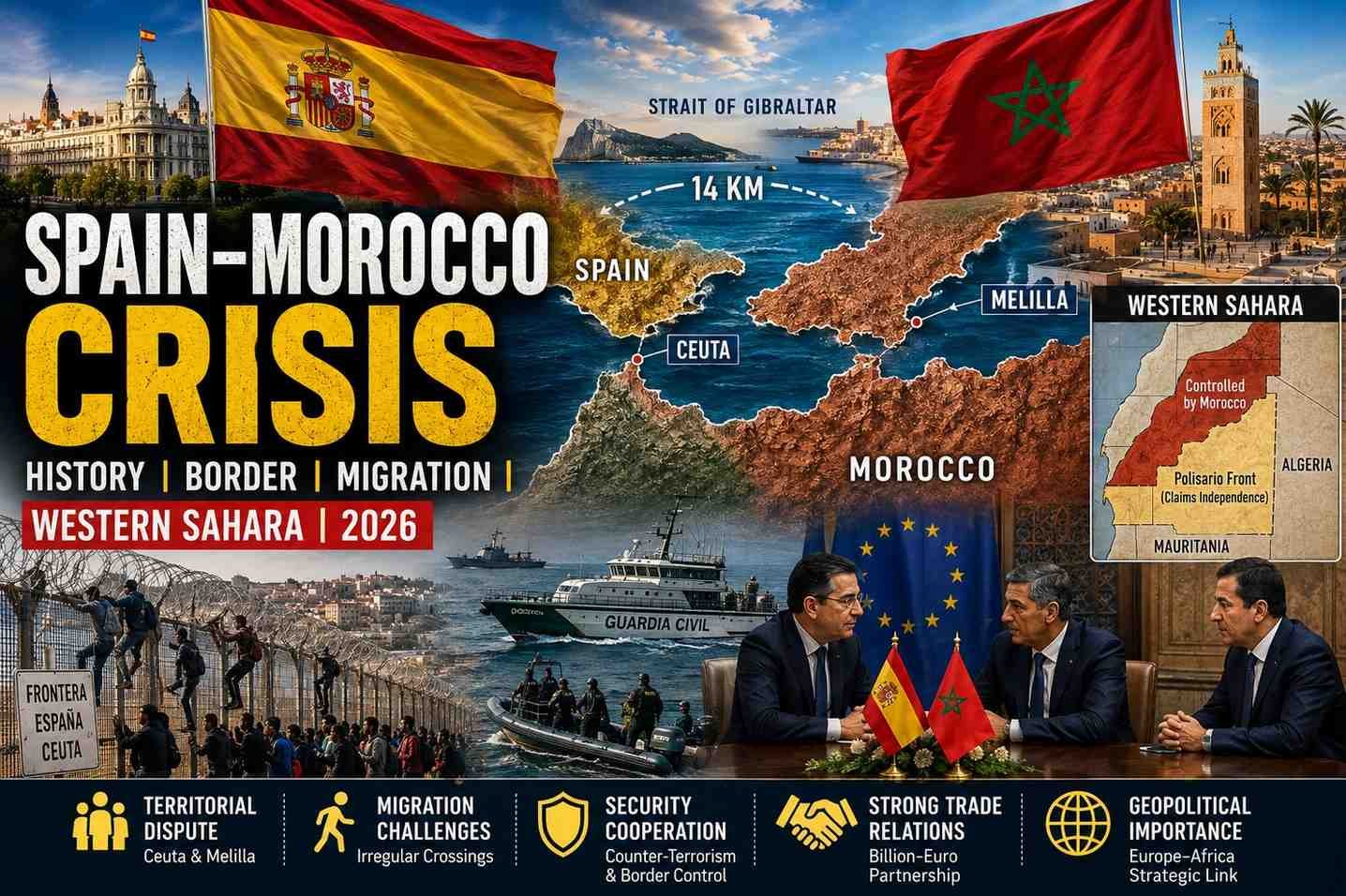
The Spain–Morocco crisis is one of Europe’s longest-running geopolitical disputes. Although the two countries maintain strong economic and security ties, disagreements over Ceuta, Melilla, migration, maritime boundaries, and Western Sahara continue to create diplomatic tensions.
Separated by just 14 kilometres across the Strait of Gibraltar, Spain and Morocco share one of the world’s busiest maritime routes and one of the European Union’s most strategically important borders.
As migration, regional security, and North African geopolitics evolve, understanding the roots of the Spain–Morocco relationship has become more important than ever.
Where Are Spain and Morocco?
Spain lies in southwestern Europe, while Morocco is located in North Africa.
The two countries are separated by the Strait of Gibraltar, the narrow waterway connecting the Atlantic Ocean with the Mediterranean Sea.
Despite the short distance, this maritime corridor has immense strategic, economic, and military significance.
A Brief History of the Spain–Morocco Dispute
15th–17th Century
Spain established control over several North African coastal territories during the age of exploration.
- Melilla came under Spanish rule in 1497.
- Ceuta, originally controlled by Portugal, became part of Spain in 1668.
Morocco has never formally accepted Spain’s sovereignty over these territories.
Morocco’s Independence
Morocco gained independence from France and Spain in 1956.
However:
- Ceuta remained Spanish.
- Melilla remained Spanish.
- Several smaller islands also stayed under Spanish administration.
Since then, Morocco has consistently maintained its claim over Ceuta and Melilla.
The Ceuta and Melilla Issue
Ceuta and Melilla are autonomous Spanish cities located on the northern coast of Africa.
They are:
- Part of Spain
- Part of the European Union
- Outside NATO’s explicitly defined treaty area, though Spain considers their defense a national priority
- Major gateways between Europe and Africa
Spain views them as integral parts of the country.
Morocco regards them as territories that should eventually return to Moroccan sovereignty.
The Western Sahara Factor
Western Sahara remains another major source of diplomatic sensitivity.
After Spain withdrew from the territory in 1975, Morocco took control of most of it.
The Polisario Front seeks independence for Western Sahara and is backed by Algeria.
Spain has shifted its diplomatic approach over time and now supports Morocco’s autonomy proposal as a basis for negotiations while continuing to support a UN-led political process.
The 2021 Migration Crisis
Relations reached one of their lowest points in May 2021.
Thousands of migrants crossed into Ceuta after Morocco relaxed border controls during a diplomatic dispute over Spain’s decision to allow Polisario leader Brahim Ghali to receive medical treatment.
Spain responded by deploying security forces.
The incident highlighted how migration can quickly become a source of diplomatic tension.
Demographics
| Spain | Morocco | |
|---|---|---|
| Population | ~49 million | ~38 million |
| Capital | Madrid | Rabat |
| Monarch | Felipe VI | King Mohammed VI |
| Currency | Euro | Moroccan Dirham |
| Prime Minister | Pedro Sánchez |
Aziz Akhannouch |
Economic Relationship
Despite political disagreements, Spain and Morocco enjoy close economic ties.
Key sectors include:
- Automobile manufacturing
- Renewable energy
- Agriculture
- Fisheries
- Tourism
- Logistics
- Infrastructure
- Textile exports
Spain is one of Morocco’s largest trading partners.
Migration and Border Security
Migration remains one of the most sensitive aspects of bilateral relations.
Routes include:
- Ceuta
- Melilla
- Strait of Gibraltar
- Western Mediterranean
The two countries cooperate on:
- Border surveillance
- Human trafficking prevention
- Counter-terrorism
- Coast Guard operations
- Maritime rescue
Why the Crisis Matters Globally
The Spain–Morocco relationship affects:
- European Union border security
- NATO’s southern neighborhood
- Mediterranean maritime trade
- Migration policy
- North African stability
- Energy cooperation
- Counter-terrorism efforts
Current Situation (2026)
Relations between Spain and Morocco are generally more stable than during the 2021 migration crisis.
Current priorities include:
- Expanding trade and investment
- Managing migration through bilateral cooperation
- Enhancing security coordination
- Supporting tourism recovery
- Continuing dialogue on Western Sahara
However, the status of Ceuta, Melilla, and Western Sahara remains unresolved and continues to shape bilateral relations.
Frequently Asked Questions
Why are Spain and Morocco in conflict?
The main areas of disagreement are Ceuta, Melilla, Western Sahara, and migration management.
Does Morocco claim Ceuta and Melilla?
Yes. Morocco considers both cities part of its historical territory, while Spain regards them as integral parts of the Spanish state.
Is Spain and Morocco at war?
No. The two countries maintain diplomatic relations and cooperate extensively on trade, migration, and security despite ongoing disputes.
Why is the Strait of Gibraltar important?
It is one of the world’s busiest maritime chokepoints, linking the Atlantic Ocean with the Mediterranean Sea and serving as a key route for global trade and energy shipments.
Conclusion
The Spain–Morocco crisis is rooted in centuries of history, competing territorial claims, migration challenges, and regional geopolitics. While cooperation has improved in recent years through stronger economic and security ties, unresolved issues surrounding Ceuta, Melilla, and Western Sahara continue to influence one of the Mediterranean’s most strategically significant bilateral relationships.