

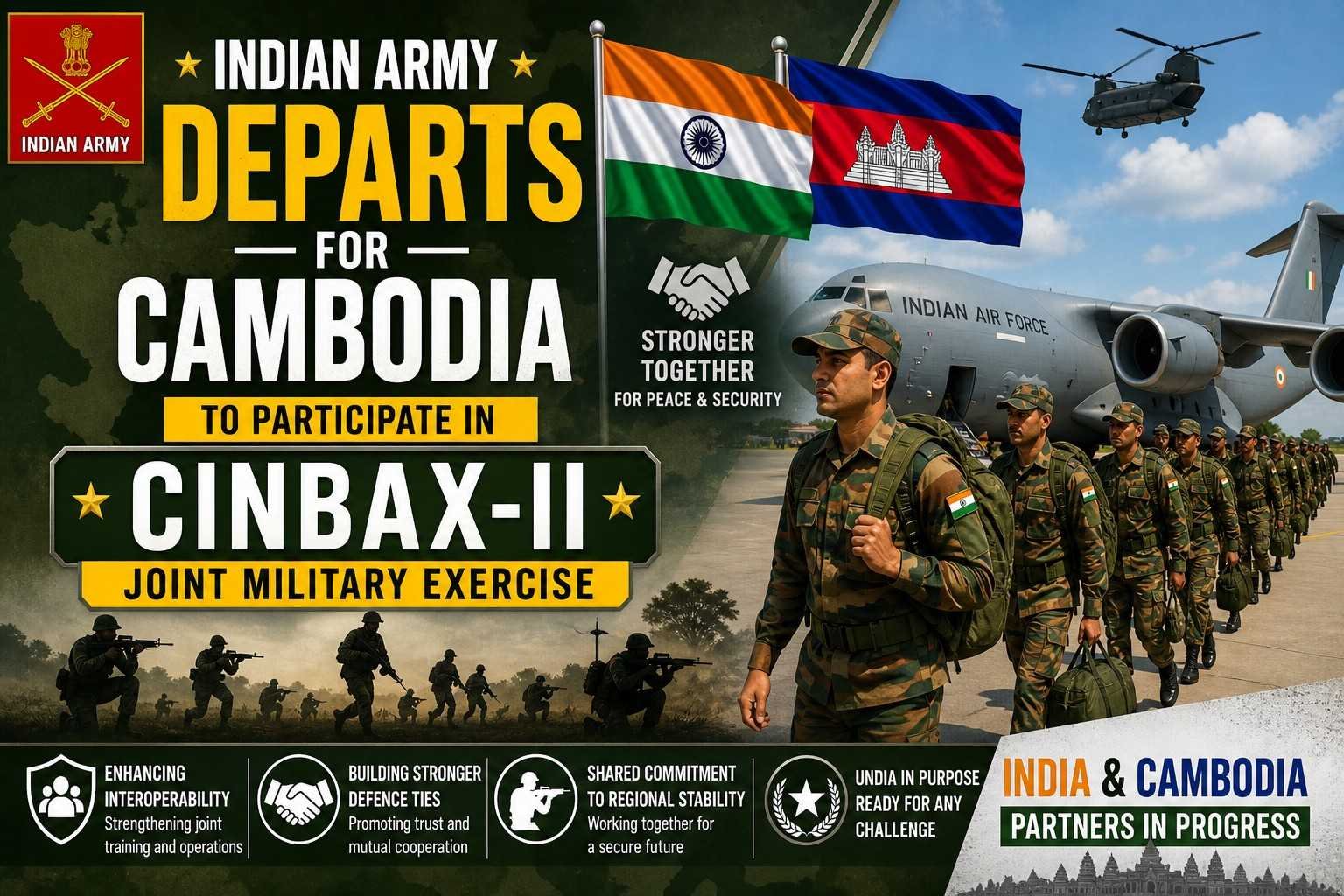
The Indian Army has dispatched its contingent to Cambodia for the second edition of the bilateral military exercise CINBAX-II, marking another step forward in strengthening defence cooperation between India and Cambodia.
The exercise will be conducted from May 4 to May 17, 2026, at the Techo Sen Phnom Thom Mreas Prov Royal Cambodian Air Force Training Centre (Camp Basil) in Cambodia.
Focus on Joint Operations & Counter-Terrorism
CINBAX-II is designed as a company-level joint training exercise, focusing on operations in a sub-conventional environment, which typically involves counter-insurgency and counter-terrorism scenarios.
The key objectives of the exercise include:
- Enhancing interoperability between the two armies
- Improving coordination and tactical synergy
- Sharing best practices and operational experiences
- Strengthening preparedness for UN peacekeeping missions
The training will be aligned with real-world challenges faced by forces deployed in United Nations peacekeeping operations, particularly in handling complex counter-terrorism situations.
- Indian contingent: 120 personnel
- Cambodian contingent: 160 personnel
Both sides will engage in intensive training drills, including:
- Tactical manoeuvres in semi-urban environments
- Counter-terrorism simulations
- Joint planning and execution exercises
Strengthening Bilateral Defence Ties
CINBAX-II reflects the growing defence partnership between India and Cambodia. Such exercises:
- Build mutual trust and understanding
- Promote regional security cooperation
- Enhance joint operational capabilities
They also underline India’s commitment to maintaining peace and stability in the Indo-Pacific region.
About Cambodia
- Cambodia is a Southeast Asian country known for its rich history, ancient temples, and vibrant culture.
- Capital: Phnom Penh
- Currency:Cambodian Riel
- Official Language: Khmer
- Famous site: Angkor Wat
- River: Mekong
- Lake: Tonle Sap
Conclusion
The second edition of CINBAX marks an important milestone in India–Cambodia defence relations. By focusing on modern warfare challenges and UN peacekeeping scenarios, the exercise will not only improve operational readiness but also contribute to global peacekeeping efforts.