

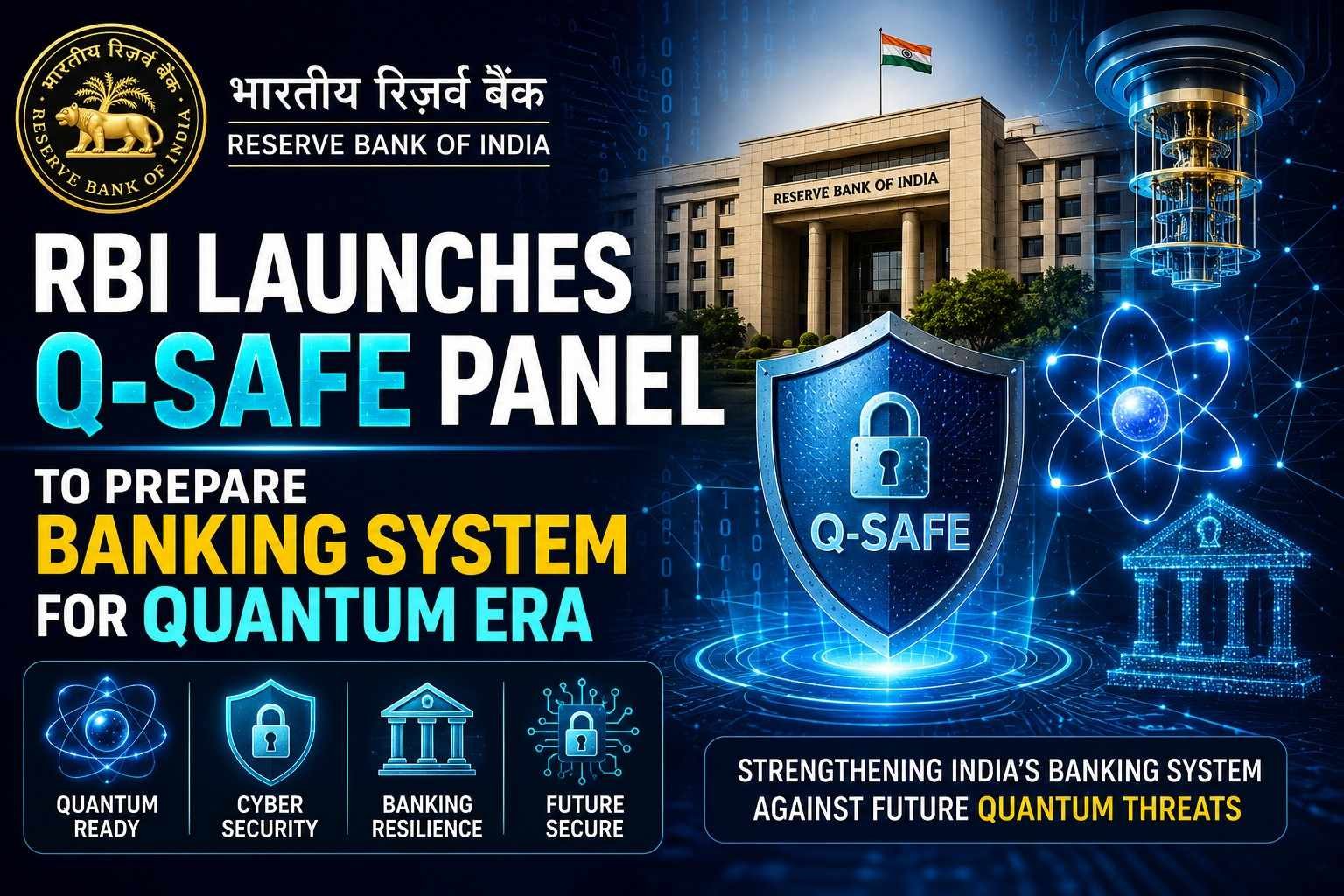
- The Reserve Bank of India has announced the formation of an expert committee named Q-SAFE (Quantum Secure and Adaptive Financial Ecosystem).
- The initiative aims to study the opportunities and risks associated with quantum technology in banking and financial services.
Why Quantum Technology Matters
Quantum technology is considered the next big leap in computing. Unlike traditional computers that process information in binary bits (0s and 1s), quantum computers use principles such as superposition and entanglement to solve highly complex problems at much faster speeds.
For the financial sector, quantum computing can offer significant benefits in areas such as:
- Portfolio optimisation
- Fraud detection
- Risk assessment
- Macroeconomic modelling
- High-speed data processing
However, alongside these advantages comes a major concern — quantum computers could potentially break existing encryption systems that currently protect banking transactions, customer data, and digital payment networks.
Objective of the Q-SAFE Committee
The newly formed Q-SAFE committee will evaluate how prepared India’s banking and financial ecosystem is for the quantum era. The panel has been tasked with examining vulnerabilities in current cryptographic systems and suggesting a roadmap for adopting quantum-safe security frameworks.
The committee will specifically:
- Assess critical financial infrastructure exposed to quantum threats
- Evaluate existing cryptographic standards used in banking
- Study “crypto agility” and the readiness of institutions to shift to quantum-safe systems
- Examine vendor tools and industry preparedness
- Recommend a long-term strategy to secure India’s financial sector against future cyber risks
The panel will also prepare a Cryptography Bill of Materials (CBOM) to identify systems and processes that could become vulnerable once quantum computing becomes commercially viable.
IIT Madras Professor to Lead Panel
The RBI has appointed Anil Prabhakar, Professor in the Department of Electrical Engineering at Indian Institute of Technology Madras, as the convener of the committee.
Other key members include:
- Dilip Asbe, Managing Director & CEO of National Payments Corporation of India
- Sunil Kumar
- Vinayak Godse
- Satish Rao Nagesh
- L Venkata Subramaniam
The committee will submit its report within six months from its first meeting.
Importance for India’s Financial Sector
- The launch of Q-SAFE reflects the RBI’s proactive approach towards emerging technological risks. As India rapidly expands its digital payment ecosystem through platforms like UPI and real-time banking systems, ensuring cybersecurity resilience has become increasingly important.
- Experts believe that preparing early for quantum threats can help India avoid future disruptions in banking operations, digital transactions, and financial data security.
- The initiative also aligns with India’s broader push towards advanced technologies and secure digital infrastructure, ensuring that the country’s banking system remains future-ready in the evolving global financial landscape.