

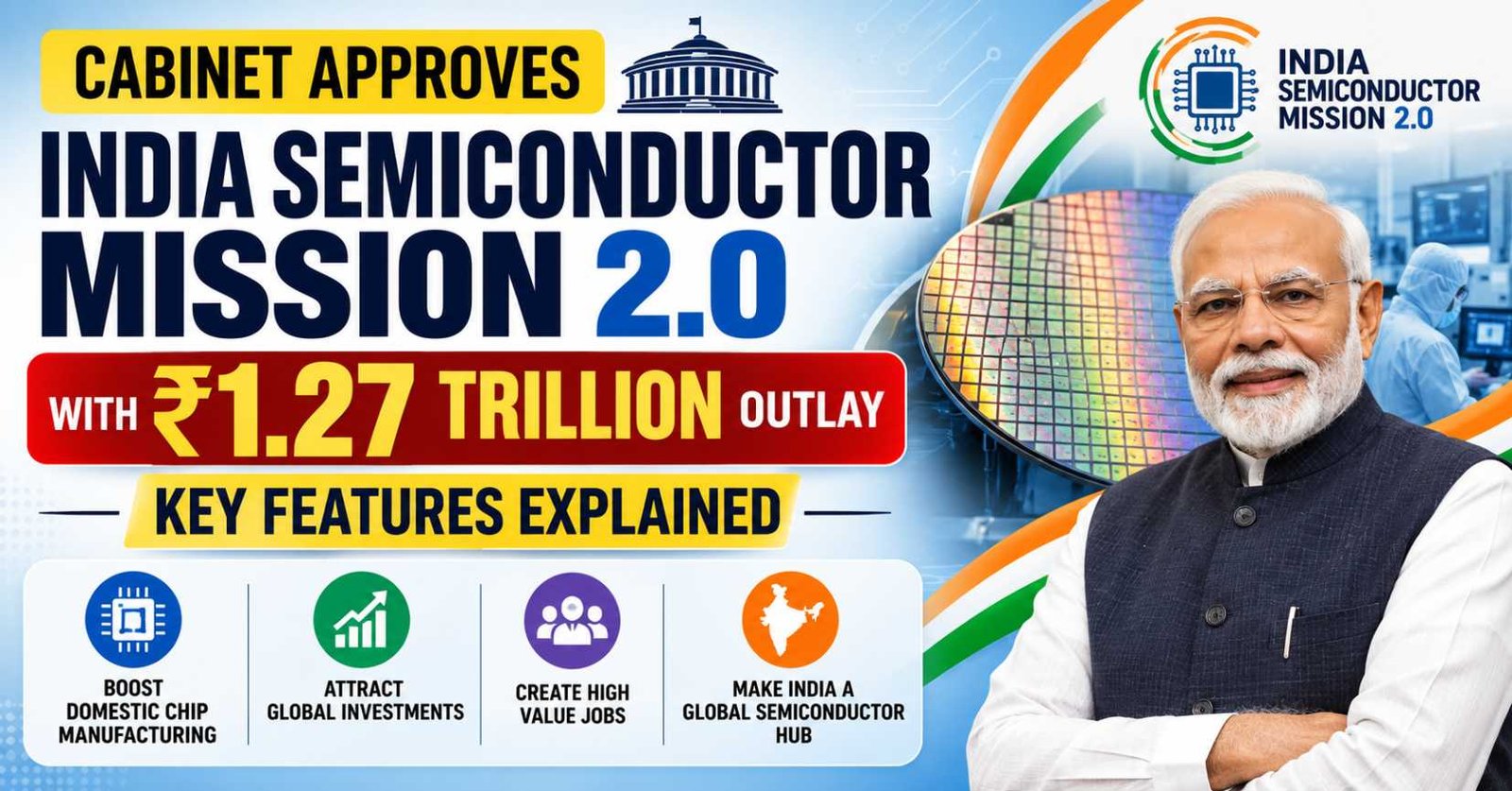
- In a landmark decision aimed at making India a global semiconductor powerhouse, the Union Cabinet has approved the India Semiconductor Mission (ISM) 2.0 with a massive ₹1.27 trillion (₹1.27 lakh crore) outlay.
- The second phase of the mission seeks to accelerate domestic chip design, semiconductor manufacturing, and the production of critical components such as semiconductor equipment, specialty chemicals, industrial gases, and advanced materials.
- The Cabinet also approved the second phase of the Mobile Phone Manufacturing Scheme with an additional ₹62,500 crore, reinforcing India’s ambition to become a global electronics manufacturing hub.
What is India Semiconductor Mission 2.0?
India Semiconductor Mission (ISM) 2.0 is the next phase of the Government of India’s flagship initiative to build a complete semiconductor ecosystem within the country.
While the first phase focused mainly on attracting fabrication and packaging facilities, the second phase expands support across the entire semiconductor value chain, including:
- Chip design
- Semiconductor fabrication
- Chip packaging
- Semiconductor equipment
- Specialty chemicals
- Industrial gases
- Advanced materials
The objective is to reduce India’s dependence on imported semiconductors and establish the country as a trusted global manufacturing destination.
Major Features of ISM 2.0
1. Support for Chip Design
Recognising that innovation begins with design, the government will support Indian semiconductor companies through:
- Direct grants.
- Equity investments.
- Assistance for strategic chip development.
- Support for commercial semiconductor products.
This is expected to encourage Indian startups and design firms to develop indigenous semiconductor technologies.
2. 30% Incentive for Semiconductor Supply Chain
A major highlight of ISM 2.0 is a flat 30% incentive for companies manufacturing:
- Semiconductor fabrication equipment.
- Specialty chemicals.
- Industrial gases.
- Semiconductor materials.
- Other critical inputs required for chip manufacturing.
This aims to create a robust domestic supply chain rather than relying heavily on imports.
Investment and Economic Impact
- According to Union Electronics and IT Minister Ashwini Vaishnaw, the programme is expected to generate:
- Total Investment: ₹4 trillion
- Manufacturing Output: ₹2 trillion
- Exports: ₹1 trillion
- These projections underline the government’s long-term vision of positioning India among the world’s leading semiconductor manufacturing nations.
Progress Under the First India Semiconductor Mission
The original ₹76,000 crore India Semiconductor Mission, approved in December 2021, has already achieved significant milestones.
Approved Projects
- 12 semiconductor projects approved.
- Cumulative investment exceeding ₹1.60 trillion.
- Three projects have entered commercial production.
This demonstrates that India’s semiconductor ecosystem is gradually transitioning from planning to actual manufacturing.
Major Semiconductor Projects Approved So Far
Micron Technology ATMP Facility
In June 2023, the government approved Micron Technology’s proposal to establish an:
- Assembly
- Testing
- Marking
- Packaging (ATMP)
facility at Sanand, Gujarat.
The project involves an investment of approximately $2.75 billion.
Tata Electronics–PSMC Fabrication Plant
India’s first semiconductor fabrication facility was approved later in 2023.
The project is a joint venture between:
- Tata Electronics
- Taiwan’s Powerchip Semiconductor Manufacturing Corporation (PSMC)
Investment
Approximately ₹91,000 crore (around $11 billion).
The facility marks a historic step towards establishing India’s domestic chip fabrication capability.
Mobile Phone Manufacturing Scheme Gets ₹62,500 Crore Boost
Alongside ISM 2.0, the Cabinet also approved the second phase of the Mobile Phone Manufacturing Scheme with an allocation of ₹62,500 crore.
The initiative is expected to:
- Strengthen electronics manufacturing.
- Expand smartphone exports.
- Attract additional global investments.
- Support employment generation.
- Deepen domestic value addition.
Together with ISM 2.0, the scheme reinforces India’s strategy to become a global electronics production hub.
Why Semiconductor Manufacturing Matters
Semiconductors are the foundation of modern technology.
They power:
- Smartphones
- Computers
- Electric vehicles
- Medical devices
- Defence systems
- Artificial Intelligence
- Data centres
- Telecommunications
- Consumer electronics
Building domestic semiconductor capabilities reduces import dependence, improves supply chain resilience, and strengthens national technological security.
Benefits of ISM 2.0
The second phase is expected to:
- Promote indigenous semiconductor design.
- Attract global chip manufacturers.
- Build a complete semiconductor supply chain.
- Generate high-skilled employment.
- Increase exports.
- Strengthen India’s strategic manufacturing capabilities.
- Support the “Make in India” initiative.
- Improve resilience against global chip shortages.
Future Outlook
With global demand for semiconductors rising rapidly due to artificial intelligence, electric vehicles, 5G, and advanced computing, India is positioning itself as a major player in the global semiconductor industry.
ISM 2.0 is expected to accelerate investments, encourage innovation, and establish India as an alternative semiconductor manufacturing destination alongside established global hubs.
Key Highlights
- Cabinet approves India Semiconductor Mission 2.0.
- Total government outlay: ₹1.27 trillion (₹1.27 lakh crore).
- 30% incentive for semiconductor equipment, chemicals, gases, and materials.
- Chip design companies to receive grants and equity support.
- Expected total investment: ₹4 trillion.
- Projected production: ₹2 trillion.
- Expected exports: ₹1 trillion.
- Three semiconductor plants have already begun commercial production.
Conclusion
The Cabinet’s approval of the ₹1.27 trillion India Semiconductor Mission 2.0 marks one of the most significant industrial policy decisions in recent years.
By supporting chip design, fabrication, equipment manufacturing, and the broader semiconductor ecosystem, the government aims to build a globally competitive semiconductor industry capable of driving economic growth, technological innovation, and export expansion.
Combined with the expanded Mobile Phone Manufacturing Scheme, the initiative is expected to play a pivotal role in transforming India into a global electronics and semiconductor powerhouse.