

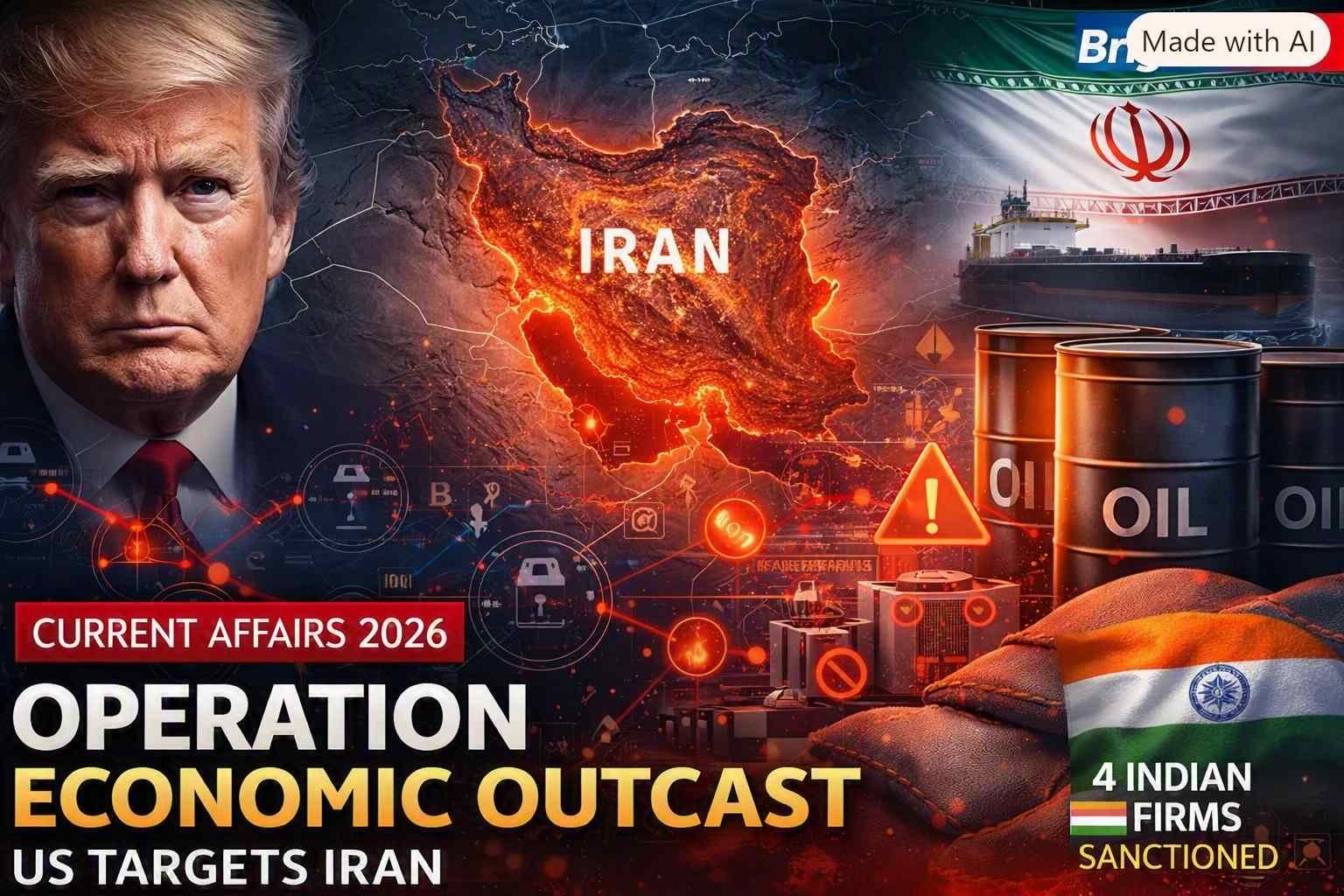
The United States has launched a major new economic campaign against Iran called Operation Economic Outcast, intensifying Washington’s efforts to restrict Tehran’s access to international finance, oil revenues and global trade networks.
The U.S. Department of the Treasury announced the operation on August 24, 2026, describing it as a sustained campaign against Iran and entities accused of supporting or enabling the Iranian regime.
The development became particularly significant for India after the United States sanctioned four India-based companies and three Indian nationals over alleged involvement in the import of Iranian petroleum and petrochemical products.
What Is Operation Economic Outcast?
- Operation Economic Outcast is the name given by the Trump administration to its intensified economic and financial pressure campaign against Iran.
- According to the U.S. Treasury, the objective is to disrupt the economic networks that generate revenue for the Iranian regime and the Islamic Revolutionary Guard Corps (IRGC).
- Treasury Secretary Scott Bessent said the operation would target the financial connections and networks used by Iran to generate revenue and evade sanctions.
- The campaign is therefore broader than a conventional sanctions announcement. Washington is seeking to identify and disrupt companies, financial channels, vessels, intermediaries and other networks connected with Iran’s revenue-generating activities.
Why Has the US Launched Operation Economic Outcast?
The United States says Iran continues to use international networks to generate revenue, evade sanctions and support military and other activities.
The Treasury announcement specifically highlighted Iranian networks involved in:
- Oil smuggling and revenue generation
- Sanctions evasion
- Nuclear and missile-related procurement
- Cyber operations
- Shipping
- Technology procurement
- Digital assets
- Gold transactions
- Aviation
The U.S. Treasury said it had sanctioned nearly 60 entities, individuals and vessels across multiple jurisdictions as part of the initial operation.
Four Indian Firms Face US Sanctions
One of the most important developments for India is Washington’s action against four India-based companies.
The companies identified in reporting on the U.S. action are:
- Portease Partners LLP
- Sadashiva Overseas Limited
- PP Softtech Private Limited
- Prakrutees Infra Impex Private Limited
The U.S. action also included Indian nationals associated with the companies. Washington alleged that the entities were involved in transactions involving Iranian petroleum or petrochemical products.
What Does the US Allege?
- According to the U.S. announcement cited by Hindustan Times, Portease Partners allegedly facilitated multiple shipments of Iranian petrochemical products to India.
- Sadashiva Overseas was reported to have imported approximately $69 million worth of Iranian-origin petroleum products between February 2024 and June 2025.
- PP Softtech was reported to have imported approximately $25 million worth of Iranian-origin petroleum products between January 2024 and June 2025.
- Prakrutees Infra Impex was reported to have imported approximately $25 million worth of Iranian-origin petroleum products between May 2023 and February 2026.
- These figures are allegations cited in the U.S. sanctions announcement and should not be interpreted as findings of criminal guilt.
Which Sectors Are Being Targeted?
Operation Economic Outcast significantly expands the sanctions risk surrounding several sectors of the Iranian economy.
The U.S. Treasury identified five important sectors:
1. Oil and Shipping
Iran’s petroleum trade is a major source of revenue. Washington is therefore targeting networks involved in transporting, selling and financially facilitating Iranian oil and petroleum products.
2. Digital Assets
The Treasury says Iran has increasingly used digital assets as part of efforts to circumvent sanctions and move funds.
3. Technology
The campaign also focuses on technology procurement that Washington says can contribute to Iran’s military and weapons programmes.
4. Gold
Gold is another area of concern because it can be used as an alternative store of value and financial mechanism when conventional banking channels are restricted.
5. Aviation
The United States has also expanded sanctions risks around Iranian aviation networks, alleging that some aviation channels can facilitate the movement of personnel, weapons, technology and financial assets.
What Are Secondary Sanctions?
- One of the most important concepts connected with Operation Economic Outcast is secondary sanctions.
- Secondary sanctions can affect entities outside the United States that conduct certain types of business with sanctioned countries or entities.
- This means the consequences of the U.S. campaign could extend beyond Iranian companies.
- Foreign businesses dealing with Iran may face increased compliance, banking and commercial risks if their activities fall within the scope of U.S. sanctions.
- The Treasury has specifically warned that entities facilitating money laundering or sanctions evasion for Iran could face restrictions involving the U.S. financial system.
Why Is This Important for India?
- India has historically maintained economic and strategic relations with Iran, including trade and connectivity interests.
- The sanctions against four India-based companies therefore make the latest U.S. campaign particularly relevant for Indian businesses involved in international petroleum, petrochemical, shipping and financial transactions.
- However, sanctions against specific companies should not automatically be interpreted as sanctions against India as a country.
- The action is directed at identified companies and individuals over alleged transactions involving Iranian petroleum and petrochemical products.
Possible Impact on India
The development could have several implications for Indian businesses.
Higher Compliance Risk
Indian companies involved in international trade with Iran may face greater scrutiny of their counterparties, shipping arrangements, payment mechanisms and supply chains.
Banking Challenges
Businesses dealing with sanctioned entities can face difficulties involving international banks and dollar-based transactions.
Energy Trade Concerns
Any major disruption to Iranian oil and petrochemical trade could influence global energy markets and the availability of alternative supplies.
India-US Relations
The sanctions could also create another area of sensitivity in India-U.S. economic relations, particularly if Washington continues expanding secondary-sanctions pressure.
Impact on Global Oil Markets
- Iran remains an important participant in global energy markets.
- Any significant reduction in Iranian oil exports could potentially tighten global supply and influence crude oil prices.
- At the same time, the actual impact will depend on enforcement, the response of major buyers and the ability of Iranian networks to reroute trade through alternative channels.
- China’s role will be particularly important because it remains a major buyer of Iranian oil and an important economic partner for Tehran.
Is Operation Economic Outcast the Same as a Military Operation?
No.
Despite its aggressive language, Operation Economic Outcast is primarily an economic and financial campaign.
Its principal tools are:
- Economic sanctions
- Financial restrictions
- Trade restrictions
- Secondary-sanctions exposure
- Entity designations
- Restrictions on financial networks
- Pressure on third-country businesses
The U.S. Treasury describes the campaign as an economic effort designed to isolate Iran and restrict its revenue sources.
Operation Economic Outcast vs Traditional Sanctions
| Feature | Traditional sanctions | Operation Economic Outcast |
|---|---|---|
| Main target | Specific entities/sectors | Wider Iranian economic networks |
| Financial pressure | Yes | Expanded |
| Oil networks | Frequently targeted | Major focus |
| Third-country businesses | Risk varies | Greater secondary-sanctions exposure |
| Shipping | Targeted | Major focus |
| Technology | Targeted | Expanded |
| Digital assets | Increasingly targeted | Specifically highlighted |
| Gold | Targeted in some cases | Specifically highlighted |
| Aviation | Targeted entities | Expanded sectoral risk |
What Happens Next?
- The effectiveness of Operation Economic Outcast will depend heavily on how aggressively the United States enforces the measures and whether other countries cooperate.
- The U.S. Treasury has indicated that the campaign is intended to be sustained rather than a one-time sanctions announcement.
- Washington has also signalled that entities continuing to facilitate Iran-related activities could face greater sanctions exposure.
- For India, companies involved in Iran-related trade are likely to pay particular attention to sanctions screening, banking relationships, shipping documentation and international compliance requirements.
Click Here to Read: The Makkah Joint Defence Agreement: “Attack on One Is an Attack on All”