

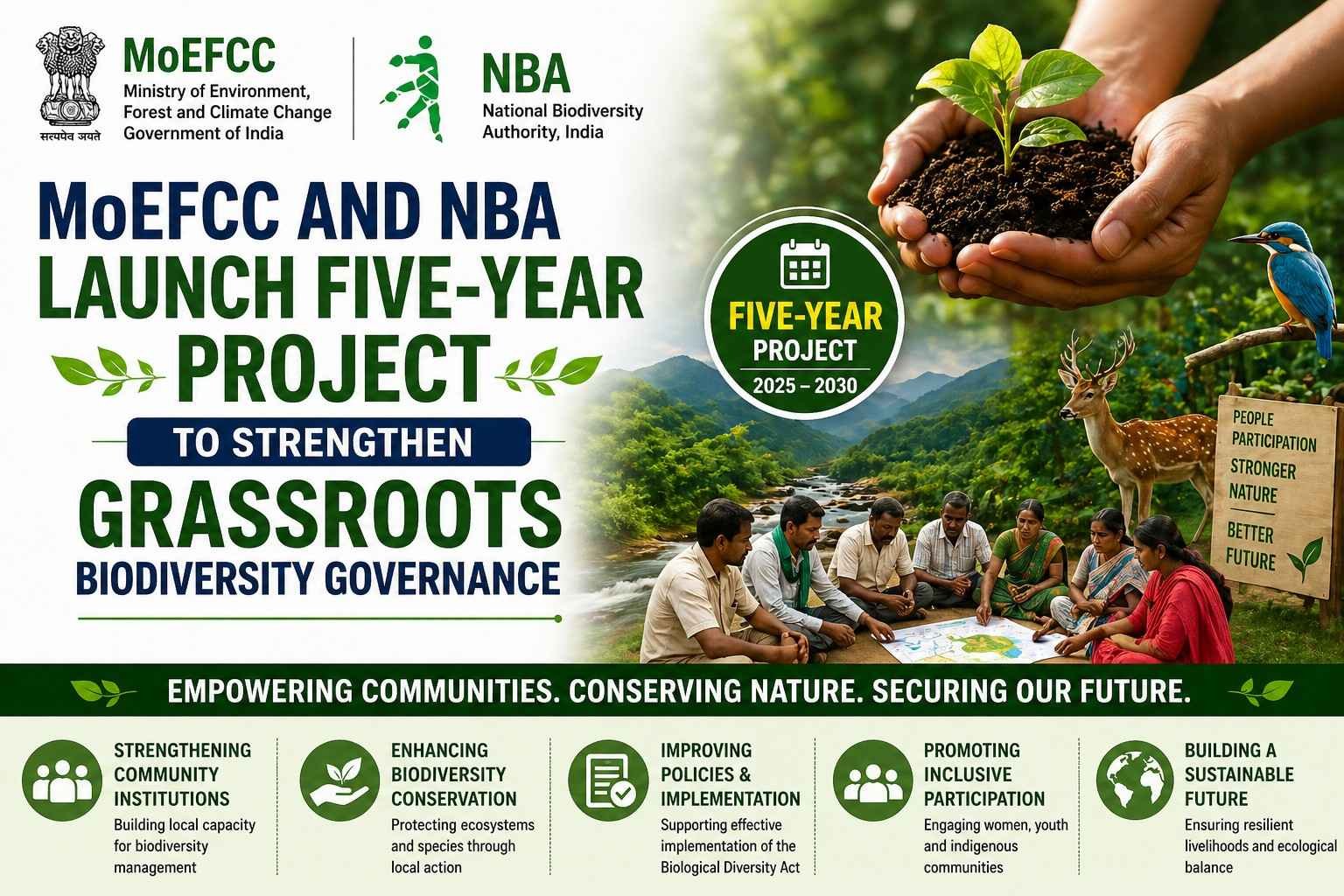
In a major push for biodiversity conservation and community-led environmental governance, the Ministry of Environment, Forest and Climate Change and the National Biodiversity Authority have launched a landmark five-year project titled “Strengthening Institutional Capacities for Securing Biodiversity Conservation Commitments.”
The initiative is a joint collaboration between the Government of India, the Global Environment Facility and the United Nations Development Programme, backed by a grant of USD 4.88 million (around ₹41 crore) for the period 2025–2030.
Key Objective of the Project
The project aims to strengthen grassroots biodiversity governance by empowering local communities and institutions through:
- Greening of Gram Panchayat Development Plans (GPDPs)
- Promoting innovative financing mechanisms
- Supporting biodiversity-linked livelihoods
- Building local institutional capacities
This will ensure biodiversity conservation becomes a part of local development planning.
Focus Areas: Tamil Nadu and Meghalaya
The project is rooted in two ecologically significant landscapes:
1. Sathyamangalam Landscape, Tamil Nadu
Located at the confluence of the Western Ghats and Eastern Ghats, this region includes:
- Mudumalai Tiger Reserve
- Sathyamangalam Tiger Reserve
The region is known for:
- Forest-fringe communities
- Wildlife corridors
- Rich biodiversity and indigenous ecological knowledge
Their local knowledge will be integrated into GPDPs.
2. Garo Hills, Meghalaya
This region includes:
- Nokrek Biosphere Reserve
- Balpakram National Park
- Siju Wildlife Sanctuary
Community-led conservation here will be integrated into Village Employment Councils (VECs).
Three Major Objectives
1. Mainstream Biodiversity in Development Plans
The project will strengthen:
- Panchayati Raj Institutions (PRIs)
- Biodiversity Management Committees (BMCs)
- Multi-stakeholder landscape platforms
These will help create community-owned biodiversity plans.
2. Promote Innovative Financing
The project will activate:
- Access and Benefit Sharing (ABS) arrangements
- CSR co-financing
- Green micro-enterprises
This will generate sustainable livelihoods linked directly to conservation.
3. Knowledge Management and Capacity Building
The initiative will document innovations for nationwide replication through NBA and MoEFCC platforms.
Special focus will be on empowering:
- Women
- Scheduled Castes
- Tribal communities
Why This Project Matters
The initiative supports implementation of:
- India’s Updated National Biodiversity Strategy and Action Plan (NBSAP) 2024–2030
- Kunming-Montreal Global Biodiversity Framework and its 30×30 target
- India’s Nationally Determined Contributions (NDCs) under the Paris Agreement
- Tamil Nadu Vision 2030
- Meghalaya Vision 2030
Governance Model
The project follows a bottom-up approach where local bodies play a central managerial role.
It adopts:
- Whole-of-Government approach
- Whole-of-Society approach
This ensures participation from:
- Forest departments
- Revenue authorities
- Elected representatives
- Civil society organizations
Conclusion
The launch of this five-year biodiversity governance initiative by the Ministry of Environment, Forest and Climate Change and the National Biodiversity Authority marks a transformative step toward community-led conservation in India. By combining governance reforms, innovative financing, and local participation, the project can become a model for sustainable development and biodiversity protection nationwide.