

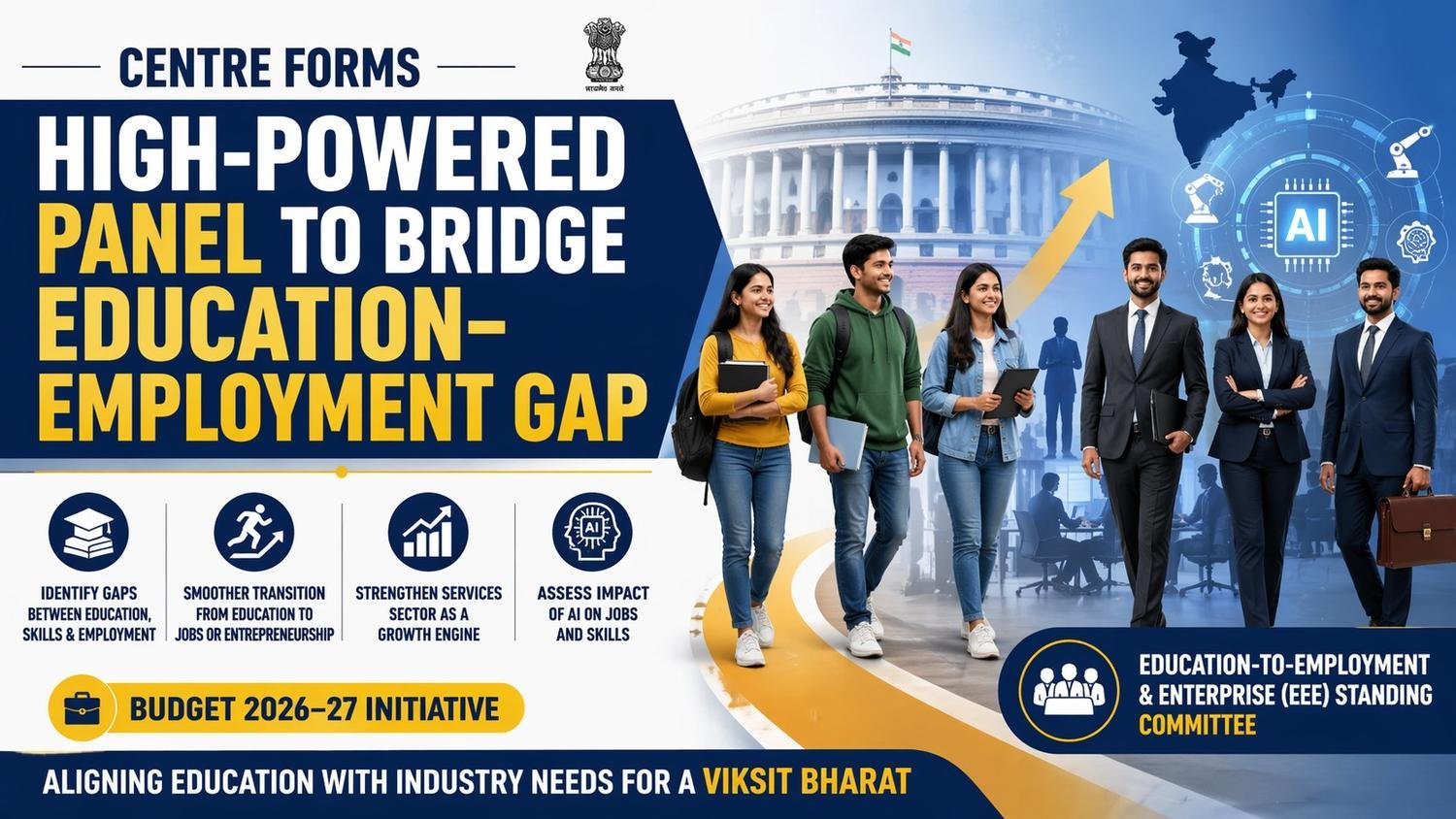
In a major move to address the growing mismatch between education and employment in India, the government has set up a high-powered Education-to-Employment and Enterprise (EEE) Standing Committee. The initiative was announced in the Union Budget 2026–27 and aims to improve job creation, strengthen the services sector, and assess the impact of emerging technologies like Artificial Intelligence (AI) on employment.
The committee has been constituted through an order issued by NITI Aayog on April 22, 2026.
Why Has This Committee Been Formed?
India is facing a serious challenge where many graduates are unable to find suitable jobs, while industries continue to report a shortage of skilled workers.
According to the State of Working India 2026 report by Azim Premji University:
- Over two-thirds of unemployed Indians aged 20–29 were graduates in 2023.
- The share of degree holders among the unemployed increased from 46% in 2017 to 67% in 2023.
This clearly shows a widening gap between the education system and market requirements.
Main Objective of the Committee
The committee will focus on:
- Identifying gaps between school education, higher education, skill development, and employment or entrepreneurship.
- Recommending policies to ease the transition from education to jobs.
- Positioning the services sector as a key driver of India’s Viksit Bharat vision.
- Helping India achieve a 10% share in global services by 2047.
- Studying the impact of AI and automation on jobs and future skill requirements.
Who Will Chair the Committee?
The committee will be chaired by the CEO of NITI Aayog.
The Services Division of NITI Aayog will act as its secretariat.
Members of the Committee
The committee includes senior officials and experts from different sectors:
Government Representatives
Secretaries from ministries such as:
- Labour and Employment
- Skill Development and Entrepreneurship
- Statistics and Programme Implementation
- Electronics and IT
- Commerce
- Economic Affairs
- Higher Education
- School Education and Literacy
It also includes Chief Secretaries from:
- Andhra Pradesh
- Bihar
- Maharashtra
- Uttar Pradesh
Industry Bodies Included
Representatives from major industry organisations such as:
- NASSCOM
- CII
- FICCI
- FISME
- SEPC
Education Sector Experts
Faculty members from:
- Indian School of Business
- Shiv Nadar University
Key Areas of Work
The committee will:
1. Map High-Potential Services Sectors
Identify services sub-sectors with high potential for:
- Growth
- Employment
- Exports
2. Recommend Policy and Regulatory Reforms
It will identify sector-specific challenges and suggest policy fixes.
3. Study AI’s Impact on Jobs
The committee will examine:
- How AI may replace some jobs
- New job opportunities created by AI
- New skills required in the future
It may recommend:
- Integration of AI in education
- Teacher training upgrades
- Large-scale upskilling and reskilling
4. Improve Services Exports
It will suggest ways to:
- Access global markets
- Improve workforce competitiveness
- Attract skilled Indian diaspora and foreign talent
5. Support Informal Workers
The panel will recommend measures to improve:
- Worker identification
- Registration systems
- Feedback mechanisms
- Mobility across sectors
Why This Move Is Important
India’s services sector is a major contributor to GDP and employment. However, automation and AI-led delivery models are changing the job landscape rapidly.
Several companies have announced layoffs in recent years, including:
- Tata Consultancy Services
- Amazon
- Microsoft
- Intel
For example, TCS reportedly reduced around 12,000 employees globally, while Amazon India cut 500–700 roles.
This committee could play a crucial role in ensuring India’s workforce remains future-ready in an AI-driven world.
Conclusion
The formation of the EEE Standing Committee is a significant step towards aligning India’s education system with evolving job market demands. By focusing on skills, technology, and industry needs, the government aims to create a workforce that is future-ready, employable, and globally competitive.