

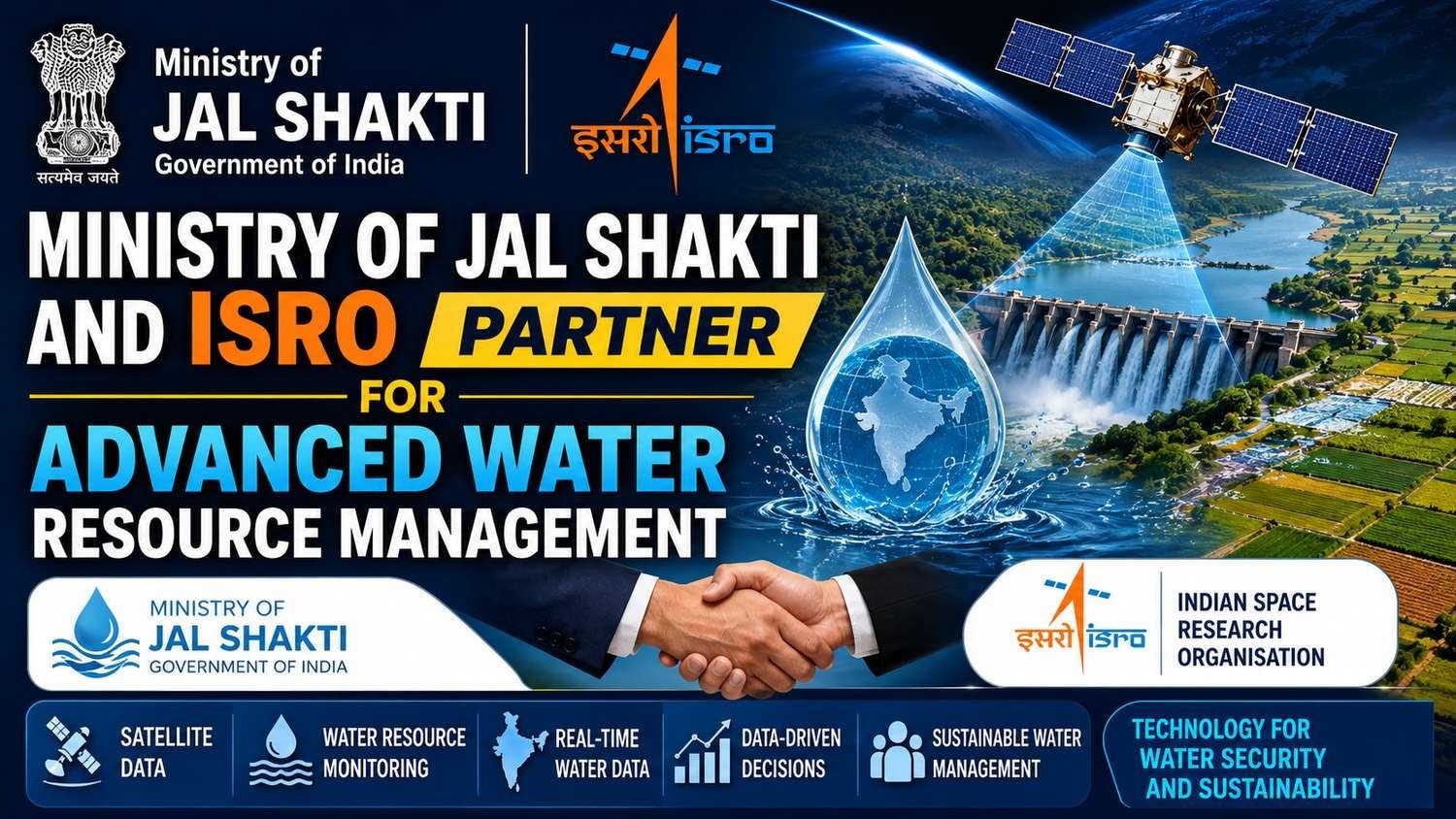
- The Ministry of Jal Shakti and the Indian Space Research Organisation (ISRO) signed a Memorandum of Understanding (MoU).
- The agreement aims to enhance the use of satellite technology and space-based applications for effective water resource management across the country.
- The MoU was signed during a National Research and Development (R&D) Workshop on the Water Sector organized by the Ministry of Jal Shakti at the Dr. Ambedkar International Centre.
- The partnership reflects the government’s growing emphasis on integrating science, innovation, and technology into water conservation and management efforts.
Key Areas of Collaboration
Under the agreement, the Department of Water Resources and ISRO will jointly undertake research in 24 priority areas related to water management. Some of the major focus areas include:
- Reservoir monitoring and assessment
- Water-spread mapping and analysis
- River-flow monitoring
- Satellite-based water quality assessment
- Groundwater evaluation
- Flood forecasting
- Monitoring macroplastic pollution in water bodies
The collaboration is expected to leverage ISRO’s advanced satellite capabilities to provide accurate and real-time information for better planning and management of water resources.
Water Security Essential for Viksit Bharat 2047
Addressing the workshop, Union Jal Shakti Minister C. R. Patil emphasized that water security is one of the most critical pillars for achieving the vision of Viksit Bharat 2047.
He stated that challenges related to water availability, conservation, and management must be tackled through a combination of:
- Modern technology
- Innovation
- Traditional knowledge systems
- Public participation
The minister highlighted that the Ministry of Jal Shakti has supported numerous research projects over the last decade, including 113 directly sponsored studies, which have contributed practical and scalable solutions in the water sector.
Launch of Jal Sanchay Jan Bhagidari Campaign Phase III
- During the event, Patil also launched the third phase of the Jal Sanchay Jan Bhagidari (JSJB) Campaign, a nationwide initiative focused on water conservation through community participation.
- The government has set an ambitious target of creating two crore water conservation structures between June 2026 and May 2027.
- According to the minister, the previous phase of the campaign successfully created more than 1.5 crore water conservation structures across the country.
MAHA-Water Programme Launched
Another major announcement at the workshop was the launch of the Mission for Advancement in High-Impact Areas (MAHA)-Water Programme. The initiative has been jointly launched by the Ministry of Jal Shakti and the Anusandhan National Research Foundation.
The programme aims to promote cutting-edge research and innovation in critical water-related sectors. It will support collaborative projects involving:
- Universities and academic institutions
- Research laboratories
- Startups
- Industry partners
ANRF CEO Shivkumar Kalyanaraman stated that the programme will encourage multi-institutional research efforts capable of delivering high-impact solutions to India’s water challenges.
Bharat WIN Platform for Startups and MSMEs
- The workshop also witnessed the launch of an open call under the Bharat Water Innovation Network (Bharat WIN) platform.
- The initiative is designed to encourage startups and MSMEs to develop innovative technologies and solutions for sustainable water management.
- The platform is expected to create opportunities for entrepreneurs and innovators working in areas such as water conservation, treatment technologies, monitoring systems, and resource optimization.
ISRO’s Growing Role in Water Management
ISRO Chairman and Secretary of the Department of Space, V. Narayanan, highlighted the transformative role of space technology in water resource management.
He noted that satellite technology today offers unprecedented capabilities for:
- Water resource observation
- Resource assessment
- Forecasting and planning
- Disaster management and flood prediction
Narayanan also pointed out that collaboration between ISRO and the water resources sector dates back to 1982, and the new agreement will further strengthen this long-standing partnership.
Conclusion
- The MoU between the Ministry of Jal Shakti and ISRO marks a major milestone in India’s efforts to use advanced space technology for sustainable water management.
- Along with the launch of the MAHA-Water Programme, Bharat WIN platform, and the third phase of the Jal Sanchay Jan Bhagidari campaign, the initiative demonstrates the government’s commitment to achieving water security and supporting the vision of a developed India by 2047.