

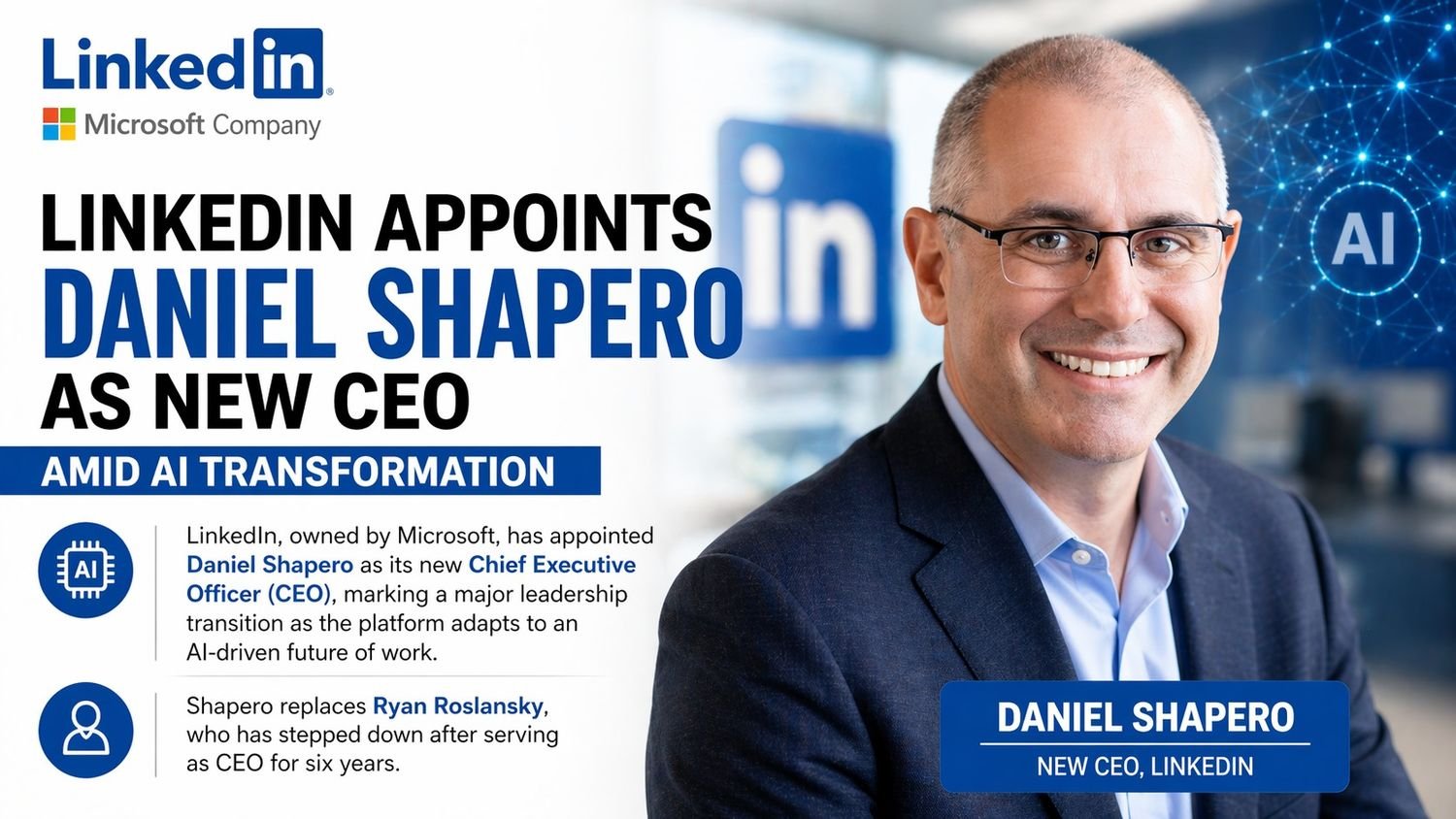
LinkedIn, owned by Microsoft, has appointed Daniel Shapero as its new Chief Executive Officer (CEO), marking a major leadership transition as the platform adapts to an AI-driven future of work.
Shapero replaces Ryan Roslansky, who has stepped down after serving as CEO for six years.
Leadership Changes at LinkedIn
- Daniel Shapero (former COO) becomes CEO
- Ryan Roslansky moves to a senior role at Microsoft as Executive Vice President
- Mohak Shroff appointed as President of Platforms & Digital Work
This transition comes at a time when LinkedIn is positioning itself at the center of AI-led workforce transformation.
About Daniel Shapero
- Joined LinkedIn in 2008
- Previously served as Chief Operating Officer (COO)
- Led key functions including:
- Product
- Sales
- Marketing
- Operations
He holds degrees from Johns Hopkins University and Harvard Business School, and has prior experience at Bain & Company.
LinkedIn’s Growth Under Previous Leadership
During Ryan Roslansky’s tenure:
- Membership grew from 700 million to 1.3 billion users
- Annual revenue increased from ~$8 billion to over $17 billion
- LinkedIn contributed 6.3% of Microsoft’s total revenue (2025)
Focus on AI and Future of Work
Daniel Shapero has emphasized that:
- AI will transform nearly every job role
- Professionals must adapt and learn AI tools
- Demand will grow for both:
- Technical skills
- Human skills (creativity, communication)
LinkedIn is increasingly integrating AI into:
- Hiring processes
- Candidate matching systems
- Workplace productivity tools
Strategic Importance for Microsoft
Since its acquisition by Microsoft in 2016 for $27 billion, LinkedIn has become a key part of Microsoft’s ecosystem.
- Integration with Office 365 and AI tools (like Copilot)
- Plays a role in enterprise solutions and workforce analytics
Conclusion
The appointment of Daniel Shapero as CEO signals LinkedIn’s strong push towards an AI-powered future. As the job market evolves rapidly, LinkedIn aims to remain a central platform for professional growth, hiring, and digital networking, while aligning closely with Microsoft’s broader AI strategy.