

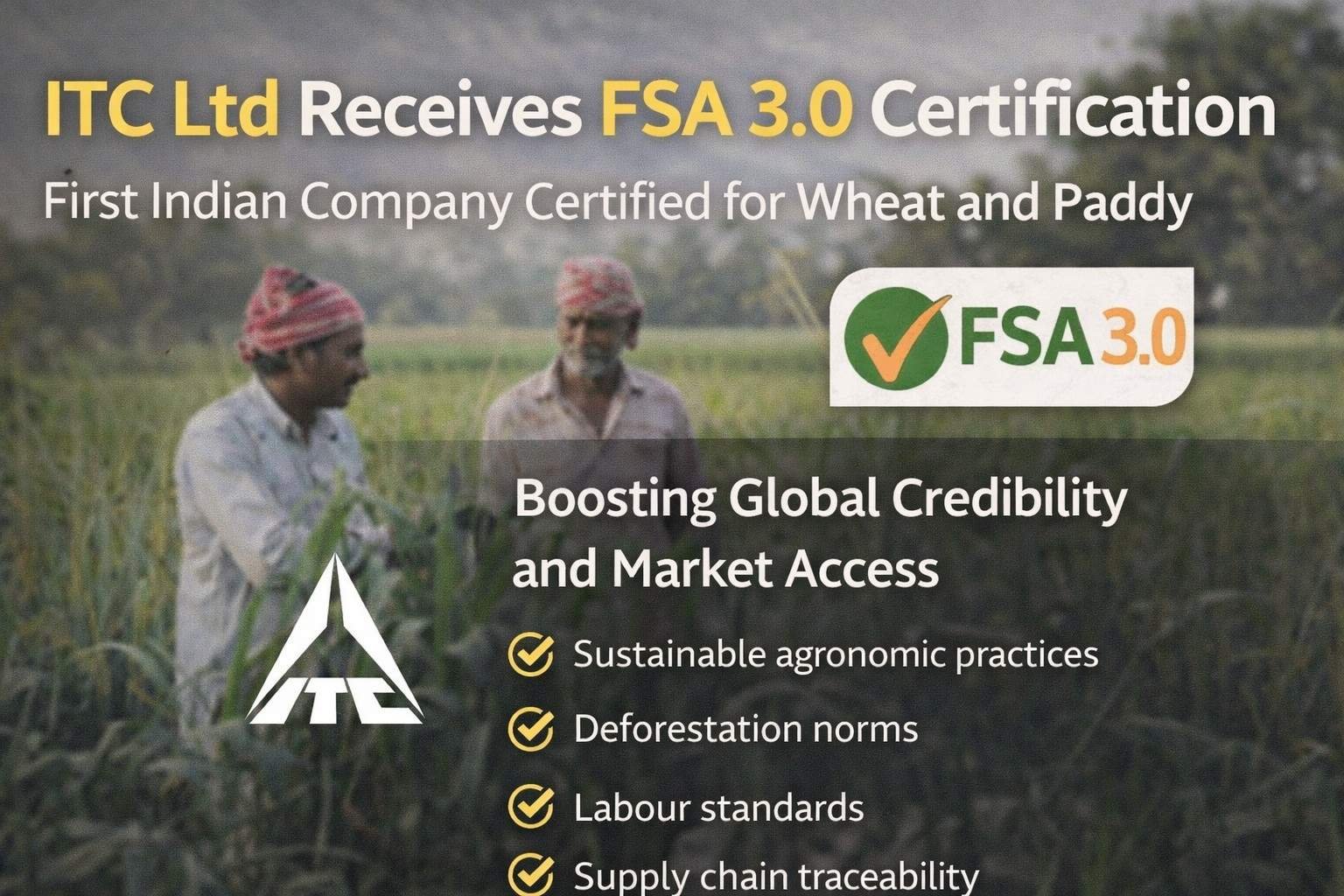
In a major milestone for India’s agri-sector, ITC Ltd has become the first company in the country to receive the globally recognised Farm Sustainability Assessment (FSA 3.0) certification for wheat and paddy.
This certification highlights ITC’s commitment to sustainable, traceable sourcing and its efforts to connect Indian farmers with global markets.
Boosting Global Credibility and Market Access
The FSA 3.0 certification strengthens ITC’s credibility among international buyers, particularly in regions like the European Union (EU), where sustainability and traceability standards are increasingly important.
The certification ensures compliance with global expectations related to:
- Sustainable agronomic practices
- Deforestation norms
- Labour standards
- Supply chain traceability
Benefits for Farmers and Environment
The adoption of FSA standards brings significant advantages:
For Farmers:
- Improved crop yields
- Better price realisation
- Stronger market linkages
For Environment:
- Enhanced soil health
- Reduced carbon emissions
- Efficient use of water, fuel, and fertilisers
Large-Scale Implementation in India
ITC has implemented FSA 3.0 standards across:
- 22,000+ acres
- States: Uttar Pradesh and Bihar
- Farmers covered: 3,500+
- FPOs involved: 70+
This initiative is part of ITC’s Crop Development Programme, which focuses on sustainability, traceability, and inclusivity.
About FSA 3.0 Standards
The Farm Sustainability Assessment (FSA) framework is developed by the Sustainable Agriculture Initiative (SAI) platform, which includes over 190 global organisations.
- Latest version: FSA 3.0 (launched April 2021)
- Purpose: Assess sustainability across agricultural value chains
- Widely used by global food and agri companies
Technology-Driven Farming: ITCMAARS Platform
ITC leveraged its digital ecosystem, ITCMAARS (Metamarket for Advanced Agriculture and Rural Services), to implement and monitor sustainable practices.
Key features:
- AI-based crop advisory
- Geo-fencing of farms
- End-to-end traceability
- Digital + physical (“phygital”) support system
The platform has benefited:
- 2.2 million+ farmers
- 2100+ FPOs across 11 states
Sustainable Practices Promoted
Farmers were trained in advanced and eco-friendly techniques, including:
- Direct-seeded rice
- Zero tillage
- Drone spraying
- Micro-irrigation
- Soil-test-based nutrient management
- Climate-resilient crop varieties
- Use of nanofertilisers
Structured Implementation and Compliance
To achieve FSA 3.0 certification, ITC adopted:
- Comprehensive training and advisory programmes
- Monitoring and evaluation systems
- Three-tier external audit mechanism
- 30+ formal policies on:
- Soil health
- Water use
- Biodiversity
- Waste management
- Air quality and emissions
Conclusion
ITC’s achievement marks a significant step in aligning Indian agriculture with global sustainability standards. It not only enhances India’s agri-export competitiveness but also ensures long-term benefits for farmers, the environment, and the overall agricultural ecosystem.