

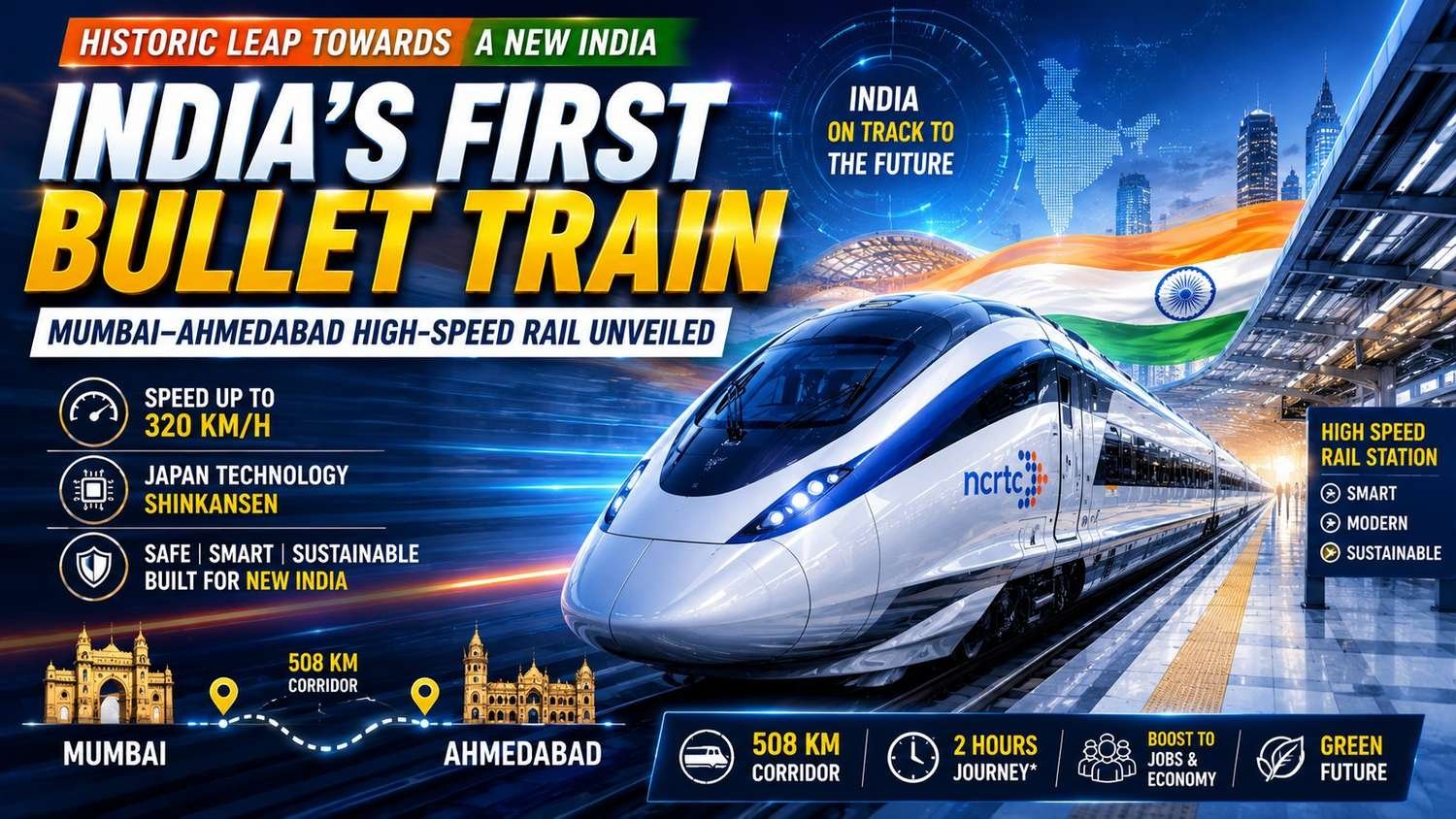
- India has officially unveiled the first look of its much-awaited bullet train project connecting Mumbai and Ahmedabad, marking a historic step in the country’s high-speed rail journey.
- The Mumbai-Ahmedabad High-Speed Rail (MAHSR) corridor is set to become India’s first bullet train route and is expected to revolutionize transportation, connectivity, and economic growth.
- The newly revealed design showcases a sleek, modern, and aerodynamic train inspired by Japan’s famous Shinkansen technology.
- The bullet train is being developed with advanced safety systems, world-class passenger comfort, and ultra-fast travel capabilities.
Key Highlights of the Mumbai-Ahmedabad Bullet Train Project
- India’s first high-speed rail corridor
- Route Length: Around 508 km
- Connecting major cities including Mumbai, Surat, Vadodara, and Ahmedabad
- Maximum speed expected up to 320 km/h
- Travel time likely to reduce from 7 hours to nearly 2 hours
- Developed with technical support from Japan
The project is being executed by the National High-Speed Rail Corporation Limited (NHSRCL) with significant financial and technological assistance from Japan.
Modern Features of the Bullet Train
The unveiled train design highlights futuristic interiors and cutting-edge technology. Some expected features include:
- Spacious seating and premium cabins
- Advanced passenger safety systems
- Noise reduction technology
- Earthquake-resistant infrastructure
- High punctuality and energy efficiency
- Smart stations with modern facilities
Phased Operations
The bullet train will be inaugurated in phases:
1. Surat to Vapi – 100 km stretch, first operational section in 2027.
2. Vapi to Ahmedabad – Extending services to major Gujarat cities.
3. Thane to Ahmedabad – Connecting Maharashtra to Gujarat.
4. Full corridor (Mumbai to Ahmedabad) – Targeted for 2029.
Trains will initially run every 30 minutes, eventually increasing to every 10 minutes once the operational framework is established.
Technology and Infrastructure:
- The project uses Japanese Shinkansen technology, including the J-Slab ballastless track system, advanced signalling, and rolling stock (E10 Series Shinkansen trains) capable of 350 km/h.
- About 90% of the alignment is elevated, with viaducts, bridges, and tunnels, including a 7 km undersea tunnel beneath Thane Creek.
- Safety features include Earthquake Early Warning Systems, wind and rainfall monitoring, and automatic train control
Economic and Infrastructure Impact
Experts believe the bullet train project will boost infrastructure development, tourism, employment, and regional economic growth. The corridor is expected to generate thousands of jobs during construction and operation phases.
The project also symbolizes India’s push towards modern transportation and next-generation infrastructure under rapid urban development initiatives.
Future Prospects
- The Mumbai–Ahmedabad corridor is the first of several planned high-speed rail lines in India, including Delhi–Varanasi, Delhi–Ahmedabad, Chennai–Bengaluru–Mysuru, and Mumbai–Nagpur,
- Its aim to modernize India’s rail infrastructure and reduce travel times across major corridors.
Conclusion:
The first look of India’s debut bullet train has generated massive excitement across the country. Once operational, the Mumbai-Ahmedabad Bullet Train will not only redefine rail travel in India but also place the nation among the global leaders in high-speed rail technology.