

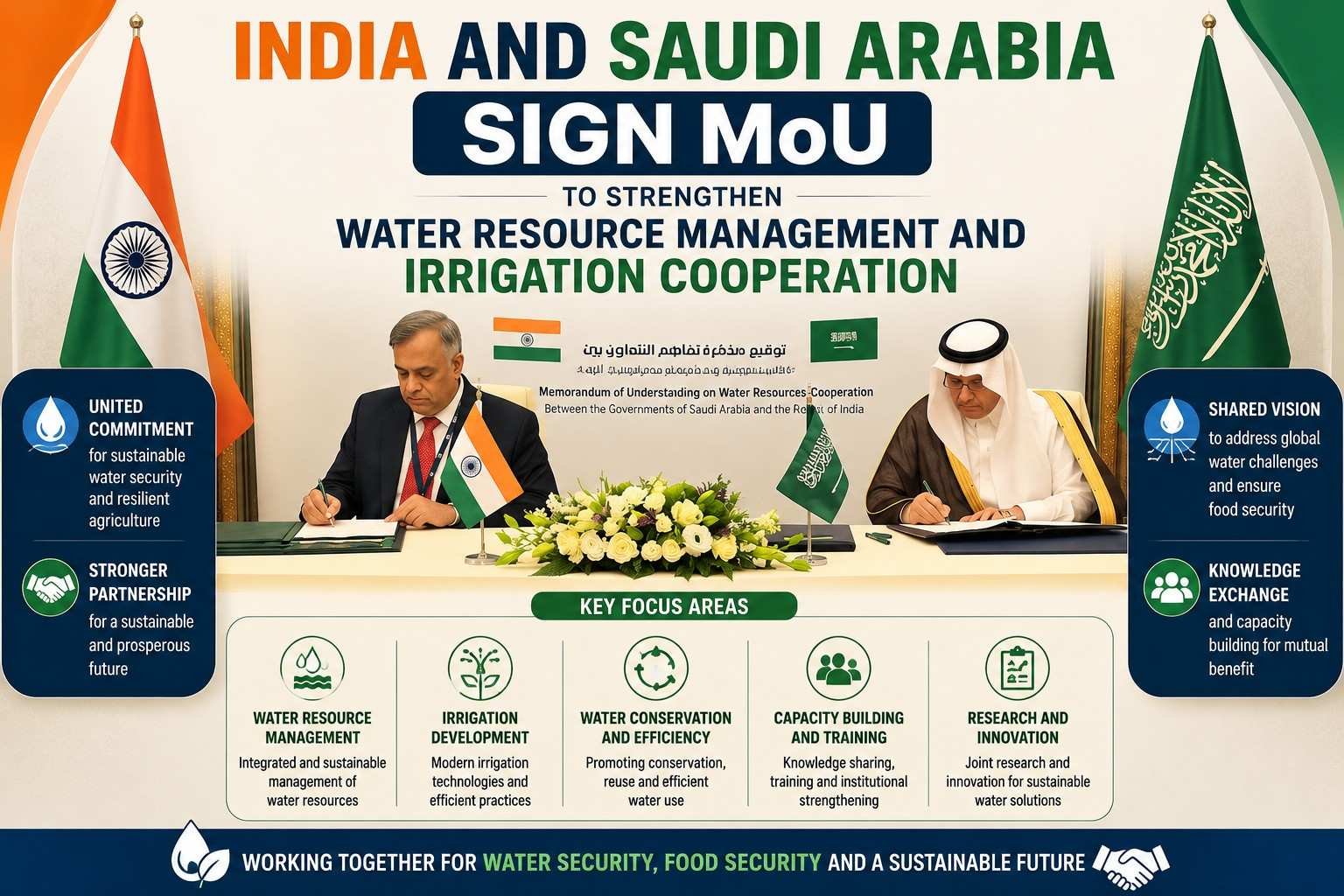
- India and Saudi Arabia have taken another important step towards strengthening their strategic partnership by signing a Memorandum of Understanding (MoU) on water resource management.
- The agreement aims to promote collaboration in sustainable water management, irrigation systems, capacity building and the exchange of technical expertise between the two countries.
- The MoU was signed during the inaugural Saudi Water Week held in Jeddah, reflecting the growing importance of water security and sustainable resource management in bilateral cooperation.
A New Chapter in India–Saudi Relations
- The agreement was signed by India’s Ambassador to Saudi Arabia, Suhel Khan, and Abdulrahman Abdulmohsen AlFadley, Saudi Arabia’s Minister of Environment, Water and Agriculture. The signing ceremony was also attended by Consul General of India Fahad Suri.
- Describing the development as a major milestone, the Indian Embassy in Riyadh stated that the agreement represents “a significant step in advancing the India–Saudi Arabia strategic partnership.”
- The MoU further strengthens cooperation between the two countries beyond traditional sectors such as energy, trade and investment.
Key Objectives of the MoU
The newly signed agreement focuses on enhancing cooperation in several critical areas of water management.
Major areas of collaboration include:
- Sustainable water resource management.
- Water resources planning and conservation.
- Efficient irrigation systems.
- Capacity building and skill development.
- Exchange of technical knowledge and best practices.
- Cooperation on emerging water management technologies.
The agreement aims to support long-term water security while promoting efficient and sustainable use of water resources.
Why the Agreement Matters
- Water scarcity has emerged as one of the most significant global challenges due to rapid urbanisation, climate change, population growth and increasing demand for freshwater resources.
- Both India and Saudi Arabia face distinct water management challenges.
- India is working to improve irrigation efficiency, groundwater conservation and river basin management to support agriculture and growing urban centres.
- Saudi Arabia, one of the world’s most water-scarce countries, has invested heavily in desalination, water recycling and advanced irrigation technologies to ensure long-term water sustainability.
- By combining their expertise and experiences, the two countries can jointly develop innovative solutions to improve water conservation and management.
Saudi Water Week: A Global Platform
- The agreement was signed during the inaugural edition of Saudi Water Week, a national conference organised in Jeddah to promote innovation, sustainable water policies and international cooperation in the water sector.
- The event brought together policymakers, government officials, experts and industry leaders from around the world to discuss solutions for future water security.
- India’s participation highlights the expanding scope of bilateral engagement between the two nations.
Strengthening the Strategic Partnership
The India–Saudi Arabia relationship has expanded significantly over the past decade across multiple sectors, including:
- Energy and petroleum cooperation.
- Trade and investment.
- Infrastructure development.
- Renewable energy.
- Technology and innovation.
- Food security.
- Water resource management.
The new MoU demonstrates the commitment of both countries to deepen collaboration in areas that contribute to sustainable development and climate resilience.
Conclusion
The signing of the India–Saudi Arabia Water Cooperation MoU marks another milestone in the growing strategic partnership between the two nations. By focusing on sustainable water management, irrigation systems, knowledge exchange and capacity building, the agreement is expected to promote innovative solutions for water conservation while strengthening bilateral ties.
As climate change and water scarcity continue to pose global challenges, partnerships such as this will play an increasingly important role in ensuring long-term water security and sustainable development.