

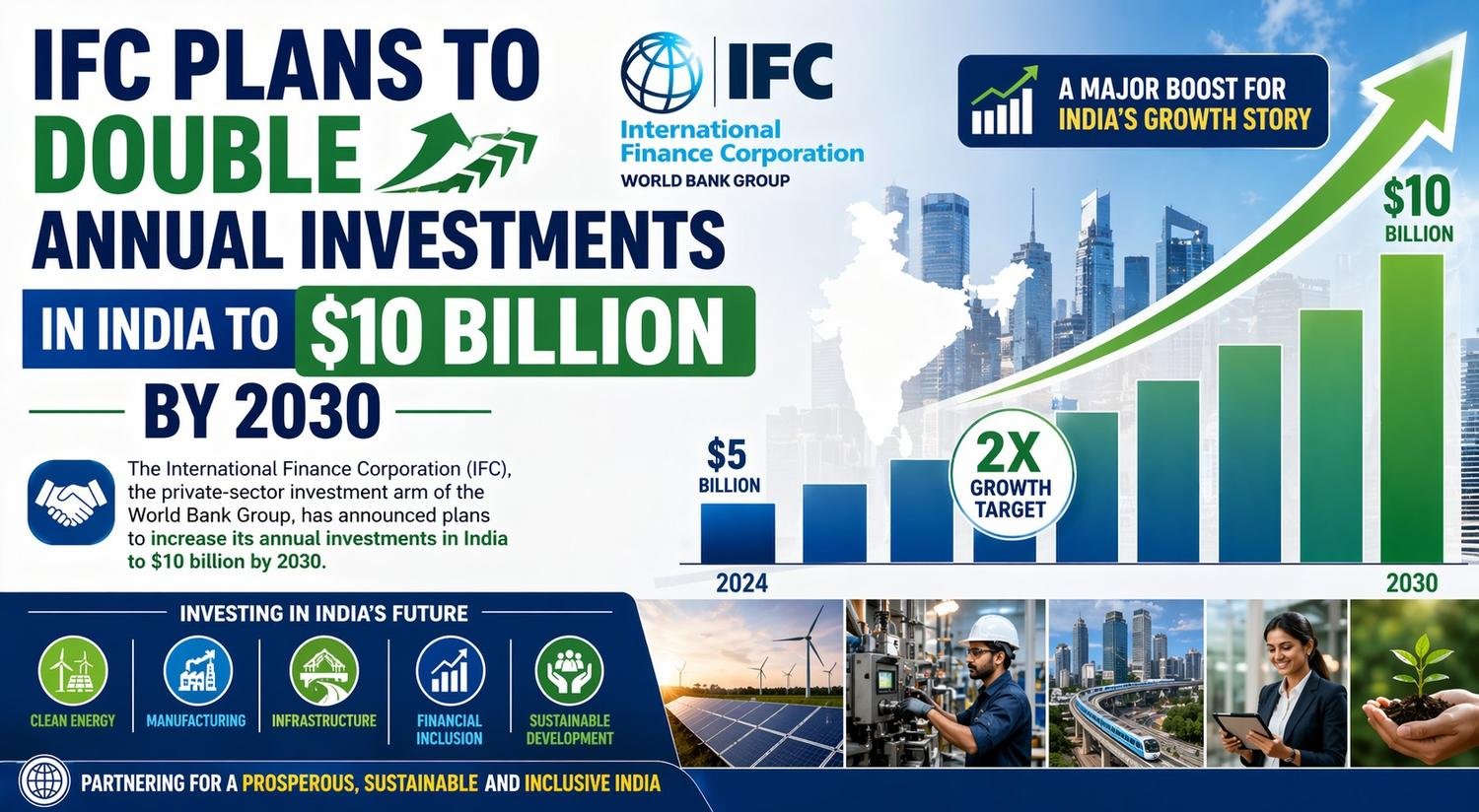
The International Finance Corporation (IFC), the private-sector investment arm of the World Bank Group, has announced plans to scale up its annual investments in India to $10 billion by 2030.
This move highlights India’s growing importance as a global investment destination, especially in sectors critical for long-term economic growth.
Rising Investment Momentum
IFC’s investments in India have seen a sharp increase in recent years:
- $1.3 billion in FY 2021–22
- $5.4 billion in FY 2024–25
India is now IFC’s largest global investment destination, with a total portfolio of around $10.3 billion (as of June 2025), spanning both equity and debt investments.
Key Sectors of Focus
IFC plans to expand investments in high-growth and priority sectors:
1. Renewable Energy
- Solar and wind energy projects
- Support for India’s clean energy transition
2. Urban Infrastructure
- Roads, water supply, and city development
- Financing smart and sustainable urban projects
3. Financial Services
- Banking and housing finance
- Expanding credit access and financial inclusion
Strong Presence Across Industries
IFC has already invested in several Indian companies across sectors:
- Financial institutions like Federal Bank and PNB Housing Finance
- NBFCs such as Manappuram Finance
- Real estate ventures like TVS Emerald
- Agribusiness platforms such as Leap Agri Silos
Notably, equity investments account for more than one-third of IFC’s India portfolio.
Focus on Municipal Financing
A key new area of focus is municipal bonds, which are used by cities to fund infrastructure projects.
- IFC is in discussions with states and urban local bodies
- Plans to act as an anchor investor to attract private capital
- Exploring pooled bond structures to help smaller cities raise funds
Example Initiative
- IFC committed $60 million financing for water and wastewater projects in Visakhapatnam
- This marked its first direct lending to an Indian city
Why This Matters
- Strengthens India’s position as a global investment hub
- Supports infrastructure development and urbanisation
- Boosts clean energy transition
- Encourages private sector participation in development
Municipal bonds, in particular, could transform how Indian cities raise funds, as this market is still underdeveloped.
Conclusion
The IFC’s plan to double its investments to $10 billion annually by 2030 reflects strong confidence in India’s economic trajectory. By focusing on infrastructure, finance, and sustainability, IFC is set to play a key role in supporting India’s long-term growth and development goals.